Search
Search Results
-
Effects of cultivation practices and hybrid selection on endofusariosis and mycotoxin contamination in maize
69-78Views:548The aim of this study was to determine the levels of deoxynivalenol (DON) and fumonisin mycotoxins in tillage and no-till systems in 2020 and 2021. Additionally, we sought to establish the levels of internal Fusarium infection in different tillage systems. We examined four tillage systems for two years (conventional tillage (plowing), conservation tillage, reduced tillage, and strip-till). The results indicate that toxin levels varied between the two years, with fumonisin production dominant in 2021, while DON toxin production was dominant in 2020. Regarding internal Fusarium infection, the lowest levels were observed in the plowing system in 2020, whereas in 2021, the lowest levels were measured in the reduced tillage system. Like the low DON levels in 2020, the plowing-based tillage system resulted in the lowest fumonisin levels in 2021. Throughout our experiment, the toxin levels were below the permissible limits for unprocessed corn, with DON levels under 1750 μg kg-1 and combined fumonisin B1 and B2 levels under 4000 μg kg-1. However, in areas where toxin contamination is typically problematic, considering the beneficial impact of plowing on reducing toxin contamination might be advisable when planning tillage.
-
Investigation of the Effect of P-Supply on Maize (Zea mays L.) Development
171-173Views:745Quantification of plant development is important in areas where the actual dates of certain phonological stages should be identified. The influences of different ecological factors are put into algorithms by crop modellers. In this process the effect of plant nutrients are not yet well quantified. This paper gives data on the effect of phosphorus on maize development prior to flowering stage. The main conclusions are as follows: 1. In lack of phosphorus more degree days are needed for flowering then in case of well P-supply. 2. The effect of P is seen not on leaf initialisation (i.e. final eaf number is the same) but rather on the phyllochron interval. 3. P effect on phyllochron interval can be observed at the younger stage (prior to leaf number 10) but not later.
-
Investigation of directions of crossing in maize (Zea mays L.)
43-48Views:349In Hungary, we examined eight features of twelve direct cross hybrids over a period of three years. The twelve hybrids were derived from direct and reciprocal crosses of four parental lines. We did not find significant differences in the cases of stalk diameter and leaf number in the average of 3 years in any of the hybrids. Statistically explainable differences in primary branches were observed in hybrids UDH5 and UDH8 and also in UDH6 and UDH11. It was evident in both instances that degrees of heterosis in reciprocal crosses far exceeded those of direct ones. High tassel branch number was dominant over the low one; consequently, parents with higher tassel numbers enforced their effects during the formation of this trait in hybrids. We experienced positive correlation (r=0.67**) between plant height and main ear height. A positive correlation (r=0.89**) was also found between the tassel length of the main axis above the lowest and the upper side branch. We observed a medium correlation (r=-0.42**) between the number of primary lateral branches and plant height. The number of primary lateral branches showed the highest heterosis. These results can be utilized in practical selection and seed production.
-
Effect of molybdenum treatment on uptake of plant and soil molybdenum content in a field experiment
117-122Views:714Molybdenum is not a well-known microelement, but being a constituent of several important cellular enzymes it is an essential microelement. Molybdenum occurs in all foods, but at very low levels. There does not appear to be any particular foods or types of foods, which in the absence of extrinsic factors, naturally have high levels of molybdenum. However, environmental pollution, from natural or anthropogenic sources, can lead to high level of the metal in plants.
Our study is based on the long-term field experiments of Nagyhörcsök, where different levels of soil contamination conditions are simulated. Soil and plant samples were collected from the experiment station to study the behaviour of molybdenum: total concentration, available concentration, leaching, transformation, uptake by and transport within the plants, accumulation in different organs, phytotoxicity and effects on the quantity and quality of the crop. In this work we present the results of maize and peas and the soil samples related to them.
According to our data molybdenum is leaching from the topsoil at a medium rate and it appears in the deeper layers. In the case of plant samples we found that molybdenum level in the straw is many times higher than that is in the grain, so molybdenum accumulates in the vegetative organs of the plant. The data also show differences in the molybdenum-uptake of cereals and Fabaceae (or Leguminosae). -
The relationship between the nutrient supply and the yield of maize hybrids with different genetic traits on chernozem soil in variant years
27-31Views:487The experiments were set on lime-coated chernozem soil in 2013 and in 2014, in our study four hybrids were included with different FAO number. We studied the effect of NPK fertilization and row spacing on the yield. The fertilizer doses were based on a 25-year longterm experiment. Compared to control, the N40 +PK treatment has also achieved a significant yield increase, although some hybrids responsed with yield loss to the increasing fertilizer doses; this effect was observed especially in 2014. The majority of hybrids reached higher yields in both years using the 50 cm row spacing. The water release of hybrids was measured weekly during the maturation, at the same time points. The rainy September slowed ripening and the water release of the hybrids in 2013, so the grain wet content at harvest showed higher values. The moisture contents were increased for some hybrids, in spite of the positive and favorable dynamic of water loss.
-
Study of plant production modells with different intensity in winter wheat production
51-60Views:525The effects of crop rotation, nutrient supply and plant protection technologies were examined on the yield of Mv PÁLMA winter wheat variety and on the most important diseases of ear and leaf. Our experiments were carried out on chernozem soil in the Hajdúság in 2006 and 2007, and three plant protection technologies (extensive, average, intensive) and three irrigation variations (without irrigation, irrigated with 50 mm, irrigated with
100 mm) were applied in different crop rotation systems.
In the triculture crop rotation a higher rate of infection was observed than in the biculture crop rotation, because the vegetative growth was more expressed after pea and these microclimatic factors were favourable for the development of pathogens.
In the triculture crop rotation (pea – wheat – maize) the powdery mildew, DTR and leaf rust of wheat were present in both examined years (powdery mildew 5-15%, DTR 14-42%, leaf rust 8-37% in cropyear 2005/2006, powdery mildew 12-32%, DTR 9-29%, leaf rust 8-26% in cropyear 2006/2007). Fusaria could be observed in 2006 (depending on the plant protection technologies and nutrient supply in the biculture 7-27% and in the
triculture 5-19%). With higher amounts of fertilizers the rate of infection increased and reached its maximum at the highest dose of nutrient supply (N200 +PK).
We observed the highest rate of infection by ear and leaf diseases in the case of the extensive technology, while this rate could be considerably reduced by the application of the intensive technology.
Both in 2006 and 2007, yields were the highest at the N100-200+PK levels in the triculture after pea (6028-7939 kg ha-1 in cropyear 2006, 6578-8690 kg ha-1 in cropyear 2007 depending on plant protection technologies), and at the N150-200+PK levels in the biculture after maize (6096-7653 kg ha-1 in cropyear 2006, 4974-8123 kg ha-1 in cropyear 2007 depending on the plant protection technologies). The highest yield maximums were
reached when pea was the forecrop. The yields on the experimental plots of the intensive plant protection technology was 224-2198 kg ha-1 higher (depending on the forecrop) compared to the plots where the extensive technology was used.
The highest yield without irrigation was at the N150+PK both in biculture and triculture crop rotation. Among the irrigated variations Ö2 and Ö3 at N200+PK fertilisation resulted in the highest yield in the biculture crop rotation, while the N100+PK level in triculture system. In the biculture crop rotation the extra yield was 14-51% higher (575-1225 kg ha-1 depending on plant protection technology) when 50 mm water was irrigated, and
15-54% higher (778-2480 kg ha-1) if 100 mm irrigation was applied comparing to the non-irrigated versions. The yield was 7-17% higher (560-1086 kg ha-1) in the Ö2 irrigation variation, and 8-23% (691-1446 kg ha-1) higher in the Ö3 irrigation variation compared to Ö1 irrigation variation (non-irrigated).
A correlation analysis was made to reveal the connection between the yield, the amount of fertilizers, the rate of infection, the plant protection technologies and the forecrops. Strong positive correlation (0.846) was found between year and fusaria infection. Strong positive correlation was observed between fertilization and powdery mildew infection (0.525), fertilization and DTR (0.528), fertilization and yield quantity (0.683). Lower
correlation was found between fertilization and leaf rust infection (0.409), and forecrop and yield (0.472), recpectively. Negative correlation was calcutated between plant protection technologies and DTR (-0.611), and plant protection technologies and leaf rust (-0.649). -
Examination of Hybrid-specific nutrient supply at corn on chernozem soli
91-95Views:614The effect of increasing fertilizer dosages on the yield of eight different maize hybrids (SY Ondina, NK Kansas, NK Lucius, NK Octet, NK Thermo, SY Flovita, SY Brillio, NX 47279) has been investigated in the crop-year of 2011. According to our results it can be stated that contrarily to the control treatment the application of different nutrient-levels has resulted a significant yield increment (2 000–5 800 kg ha-1).
Based upon the results of this experiment we have drawn the conclusion that the nutrient level of 120 kg N+PK was the optimal for the investigated hybrids. The highest yield (14 475 kg ha-1–15 963 kg ha-1) of the hybrids with different genotypes has been produced in case of this fertilizer treatment. With the comparison of the control and the optimum-fertilizer treatments the yield-increasing effect of mineral fertilization and the different reaction of hybrids towards increasing fertilizer dosages have been proven. In case of the control treatments the best-yielding hybrids were NK Thermo (11 917 kg ha-1) and NX 47279 (11 617 kg ha-1). Contrarily on the optimal nutrient supply level the hybrids SY Brillio (15 876 kg ha-1) and NX 47279 (15 963 kg ha-1) have produced the highest yields. Summarizing, we can state that the hybrid NX 47279 has resulted stable and high yields in the fertilized treatments. Analysing the yield-increasing effect of 1 kg fertilizer active substance it was proven, that the hybrids SY Flovita (45.43 kg ha-1), SY Brillio (44.47 kg ha-1) and NX 47279 (42.33 kg ha-1) had a good reaction towards even lower nutrient supply levels as well. In case of the control treatment the average water utilization coefficient of the hybrids was significantly lower (35.2 kg mm-1), than in case of the optimal nutrient supply level (N120+PK) treatments (48.9 kg mm-1).
Therefore the hybrid specific difference between the water utilization of genotypes could be revealed. -
Changes in the Macro-, Mezo-, and Microelement Contents of Maize Hybrids in Relation to the Level of Nutrient Supply
126-130Views:234n my research, I measured the effect of NPK fertilisation on the macro- meso- and microelements content of maize hybrids in 2001. The experiment was set in the demonstration garden of the Department of Crop Production and Applied Ecology in the Agricultural Centre, at the University in Debrecen. The soil of the experiment is calcerous chernozem soil. Five fertilisation steps were applied. Besides the control the smallest rate was 40 kg N; 25 kg P2O5; 30 kg K2O of active ingredients. The largest rate was five times more than the smallest one: 200 kg N; 125 kg P2O5; 150 kg K2O, which is equal to 475 kg mixed active ingredients. The NPK treatment significantly influenced the macrolement content in several cases. The N content was the lowest in the control treatment. Compared to this the fertiliser treatments significantly increased the N content of hybrids. However the highest amounts of potassium and phosphorus could be measured in the control and the lowest amounts could be measured at the N 200+PK kg/ha treatment.
The Ca content of hybrids was the highest in the N 120+PK kg/ha treatment, while their Mg and Zn content was the highest in the control treatment. The lowest amounts were weighed in the N 200+PK kg/ha treatments, that in several cases resulted in statistically proved decreasement compared to the control or the lower fertilizer doses. Considering the two mesoelements and Zn the most favourable results were obtained in the case of the Norma SC and DK 366 SC hybrids.
Summing up what has been said moderate amounts of fertiliser doses (N 40-120+PK kg/ha) had a favourable influence on the micro- and macroelement content of hybrids. -
Phosphorus (from Different Phosphorus Sources) Utilisation in Piglets, and the Effect of the Addition of Phytase into the Feedstuff
30-36Views:248The experiments were carried out in a 2x2 factorial treatments with three replicates, and were completed with 32P phosphorus metabolism measurement. Hungarian Large White x Dutch Landrace growing pigs with 15–18 kg starting live weight were involved in the experiment.
The experimental scheme was the following:
Diet consisted of maize and extracted soybean meal. Both components have high phytase content and low phytase activity. 1/a animals received their P-supply according to their needs and 1/b animals got 10% less than their actual P-need in the first part of the experiment.
In the second part of the experiment both groups (2/a, 2/b) received identical P-supply and 500FTU/kg P supplementation. Apart from P- and phytase-supplementation, the piglets’ diet was identical.
Total P digestibility was 52% without phytase supplementation, which increases by 4% when P was added according to need and by 12% increase of decreased P-supply. Digestibility of nutrients somewhat increased as effect of phytase supplementation. According to the results of 32P experiments, inorganic P digestibility of MCP was 82–90.8%, which decreases to 73.4–87.2% in case of phytase supplementation.
Parallel with tendency, native P digestibility of the diet was 31.5–32.2%, which increased to 42.5–54.5% in the case of phytase supplementation.
Results support the that inorganic P input can be decreased by phytase supplementation and as a consequence P output, the concept and environmental pollution can at the some time be decreased. -
Risk effects of the spread route of mycotoxins
90-95Views:635In Hungary the mycotoxin is a great problem, because there are many natural toxins in wheat and maize. These cereals can be found on
considerable proportion of the country’s sowing area, and they are deterministic food for the population. The direct human and animal
utilization of the contaminated cereals mean a serious risk in the food chain. In Hungary’s climate the soil is contaminated with pathogen
moulds, particularly Fusarium species, which increase by respective temperature and moisture content in cereals. The Fusarium can
decrease the quality of the wheat in different ways: decrease the germination capability and cause visible discoloration and appearance of
mould, reduces the dry material and nutrient content of the grain. From the toxins produced by the Fusarium genus, the trichotecene (T-2,
HT-2, deoxinivalenol, nivalenol, diacetoxyscxirpenol, Fusarenon-X) and the estrogenic zearalenon (F-2) are the most common in Hungary.
The fumonisins (FB1, FB2, FB3) first identified in 1988, relatively newly discovered, are also important. Major proportion of mycotoxins in a
healthy organization is metabolized by the enzyme system of liver and intestinal bacteria. The toxicity is reduced or even leaves off.
However, more toxic and biologically active compounds can be formed. For the reduction of mycotoxin-contamination several possibilities
are available in the case of storage, processing and feeding. -
Evaluation of long term experiments from a new aspect
55-60Views:480During our work, we developed a new, simple method to show the effects of fertilization on yield, which can both be applied over the long term as well as in series of independent experiments.
During the testing of this method, at the experimental farm of the Debrecen University Center for Agricultural Sciences at Látókép on a chernozem soil with lime deposits, we examined the fertilizer reaction of maize hybrids between 1989 and 1994. The treatments were: winter tillage, plant density of 70-80 thousand, unfertilized, N 120, N 240 kg/ha fertilized treatments, long term experiments using Dekalb 524 and Volga SC hybrids in long term experiments.
Four parameters are shown in the model. In the examined period TRmax represents the greatest yield in the fertilized treatments, NT the yield in unfertilized treatment, k the „efficiency of fertilizer” to NT and b the depression-coefficient, where the expected value is zero. The expected grain yield of the fertilized treatments (Y), in the function of the unfertilized grain yield (x) is the following: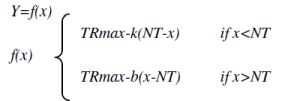
The parameters were determined using the Monte Carlo method, in the optimizing process the sum of deviation square was minimized. The correct conformation of the functions was determined by the greatness of the R-value and the standard error. We found that during six years of testing, the tendency of fertilization efficiency was similar in the case of both hybrids. There was an unfavorable weather interval and, in these years, the yields were low, fertilization did not have an effect and moreover, in extremely bad conditions resulted in an obvious yield decrease. With the improvement of conditions, which in the case of our country means an increase in precipitation, the efficiency of fertilization increases and reaches its peak at 13-14 t/ha. At this point, the yield increasing effect of fertilization is 4-4,5 t/ha. If the yield of the unfertilized treatments increases from 8-9 t/ha, then the efficiency of the applied fertilizer decreases.
Most likely, the k and b parameters depend on the soil of the experimental location (nutrient and water management) and on the amount of pplied fertilizer and the characteristics of the hybrid. With the increase of fertilizer dosage the k-parameter also increases. The greater value though does not obviously mean a more favorable situation. It is true that in medium and good years this means great fertilizer efficiency, but in low or extreme precipitation conditions it also means greater risk. With the increase of the k-parameter, the yield deviation also increases which, from a cultivation point of view, is quite unfavorable. If the value of the b-parameter is other than, zero then the effect is clearly unfavorable, because with the increase of this value, the yield decrease is also greater. The fertilizer reaction of the two examined hybrids can be well characterized by these two hybrids.
Examining the six years, our created model estimated the effect of fertilization on the yield accurately and with a high degree of safety. Both in highly unfavorable and extremely good years, it gave an exact estimate. In our opinion, it can be used well to evaluate the effects of fertilization on yield in the future. -
Allelopathic Effect of Italian Cocklebur on Sugar Beet
74-77Views:514Cockleburs are noxious weeds in Hungary, where they are widespread in row crops, especially in maize, sunflower and sugarbeet. A low density population of these weeds may be harmful because of their large competitive ability, fast growth in early phenological stages, allelopathy, and persistant sprouting.
Allelopathy of Xanthium italicum Mor. was examined during the growing season in 2004. Root and shoot samples were collected at 4 or 5 leaves stage (in the end of May and in the beginning of June) and before flowering (in the beginning of July) before and after rain. Extracts were made in tap water. The test plant was Beta vulgaris L.; its germination, root and shoot growth were evaluated at the 6th and 10th days after treatment.
Most of extracts inhibited the germination of sugar beet. In these experiments the phenological stage of the donor plant determined slightly the effectiveness of the extracts on sugar beet. Generally, significant differences existed between treatments only in cases of concentrated extracts.
Rainfall can modify the inhibitory effect of extracts (especially shoot extracts). Shoot extracts of young plants inhibited stronger germination and growth after rain than before rain. Density of cockleburs influenced the effect of extracts, as well. Generally, differences between the efficacy of extracts was larger after rain.
The results supported the hypothesis that the phenological stage and some environmental factors can modify allelopathy of cockleburs. -
The role of agriculture in regional development
25-30Views:885Agriculture is the leading national economic sector of Hajdú-Bihar county. The proportion of employees in this sector and the share of pro ducts produced in this region is above the country average. The contribution of agriculture to the GDP is 6.3%, as opposed to the average value of the country (3.3%). Based on their primary activity, 8% of the enterprises in the county are classified as agricultural and forestry companies, while this proportion is only 5.3% in the whole country.
Nearly three quarters (71.1%) of the sowing area is occupied by maize and other cereals, mainly wheat. This proportion is slightly more than the country average (69.2%). The proportional area of oil crops - including sunflower – and roughage is nearly the same as the country average. However, there is a significant difference in vegetable production. Due to the higher intensity of vegetable production, the area occupied by vegetables is three times the country average. 19.4% of the crop products, 23.5% of animal products and living animals, 25.8% of the income generated by production factors and 29.8% of net enterprise income of Hungary originates from the North Great Plain region.
The facilitation of creating local markets, e.g. local public food supply, satisfying the needs of food trade with local goods, the necessary awareness raising actions, secondary and higher education of experts, as well as the more specific and targeted utilisation of development resources are agricultural development tasks.
-
Comparative analysis of certain soil microbiological characteristics of the carbon cycle
137-141Views:396In our researches, we examine the soil microbial parameters related to the carbon cycle. In this study, we compare the changes of microbial biomass carbon (MBC) and the soil CO2 production in soil samples which were taken in spring and autumn. The 30 years old long-term experiment of Debrecen-Látókép is continued in our experiments. The long-term fertilization experiment was set in 1983, and our sample was taken in spring 2014. The examinations of soil respiration processes and factors that influence soil respiration are required in optimal management. In our study, we interested to know how the growing levels of fertilization influence the soil respiration and microbial biomass carbon under non-irrigated and irrigated conditions in maize mono, bi, and triculture.
-
Qualitative detection of genetically modified organisms in plant samples
309-313Views:741We analysed the GMO content of corn samples by polymerase chain reaction following the appropriate optimization of the reaction. The analysis included two main steps: extraction of DNA from the sample, and detection of the GMO content by polymerase chain reaction. The polymerase chain reaction is an in vitro method to multiply chromosomatic or cloned DNA (cDNA) sequences through the enzymatic pathway. The reaction is sensitive enough to produce DNA in sufficient amount for the analysis from a single DNA. We identified the PCR products by agarose gel electrophoresis. When optimizing the reaction, the MgCl2 concentration, reaction time and temperature have to be taken into consideration. The temperature of the anellation has to be increased until the highest specificity and yield is reached. If the temperature of the anellation is too high, the primer is linked to non-specific sites as well; in the gel visualization, more lines can be seen at one sample. If the temperature of the anellation is too high, the primer is insufficiently linked or is not linked at all (too few lines in the gel visualization). After optimization, the GMO content in the unknown sample can be determined along with the appropriate positive and negative controls.
-
Challenges and agroecological approaches in crop production
75-89Views:347Never has the need been greater for an ecosystem approach to agriculture. As our global population exceeds 9 billion in the next 30 years, with a concomitant demand for agricultural products, ever more pressure will be placed on our agricultural systems. Meanwhile, climate change is altering the ecological settings in which agriculture is practiced, demanding adaptation. Knowledge generated by long-term research will help to address one of the grand challenges of our time: how to meet sustainably the growing world demand for agricultural products – in a way that minimizes environmental harm and enhances the delivery of a diverse array of ecosystem services.
-
The Examination of the Year Effect Based on Cumulative Temperature and Rainfall Curve
70-77Views:216In order to get to know the numerical differencies of favourable and unfavourable weather conditions, our research lean to 29-years-data (1961-1989) of maize yield of productive area of Hajdúság from which we chose two low (1964, 1976) and two high (1969, 1975) yield yerars. Choosing the years we fitted a linear trend to the time series and the valued data was divided by the realised crop. From the cumlative temperature- and rainfall data calculatd curve concern the period between 01. April and 01. September. The basis was the cumulative value of many years daily average value. The temperature- and rainfall curve of favourable and unfavourable yield with the many years average data was represented on the same scale. In order to numericate the differencies we count the differencies monthly frequency. Based on it became sunder the feature of years. The method used by us ensure possibility to separate the temporal types. It was found that informing the yield the rainfall has main role in this productive area and the temperature has only second role.
-
Evaluation of the microbial soil quality indicators in agricultural soils from Crisurilor Plain
79-80Views:266The researches were carried out in 2010 and 2011 on the haplic luvisol cultivated in three variant such as: pasture, cropland, and orchards. Based on the total number of microorganisms monitored in the haplic luvisol (aerobic mesophilic heterotrophs, yeast and mould, Actinomycetes, nitrogen fixing bacteria and nitrifying bacteria) was calculated the bacterial indicators of soil quality (BISQ) and was appreciate the bacterial potential of the haplic luvisol. Seasonal analyses were carried out, and annual BISQs have been calculated too. The values of the bacterial indicators of the haplic luvisol in different cultivation conditions (pasture, cropland and orchards) indicate a high density of the bacterial groups in 2010 and 2011. In 2010 the values of the BISQs are included between 3.617 (minimum in autumn, in pasture) and 5.458 (maximum, in spring, in pasture). In 2011, the minimum value (3.622) was registered in pasture, in autumn, and the maximum value (4.851) in the haplic luvisol cultivated with maize, in spring. In 2010 and 2011, based on the bacterial indicators of the soil quality values, on the first position is the cropland (4.750, 4.721) followed by orchards (4.615, 3.985) and pasture (4.537, 3.758).
-
A dual infection of two microscopic fungi on common milkweed (Asclepias syriaca) in Hajdúság region (East-Hungary)
189-195Views:391Common milkweed (Asclepias syriaca L.) is one of the most noxious and invasive weed species in Hungary. A. syriaca invades arable lands, horticultural and forestry plantations, natural and semi-natural habitats too. In cases of field crops it can cause considerable yield losses mostly in maize (2–10%), soybean (12–32%) and sorghum (4–29%), but only with high rate of coverage. It can also increase these problems that the common milkweed can be serve as reservoir and host for viruses, other pathogens and pests.
Because of the importance of common milkweed and in spite of demand to develop effective biological control, until now has not been developed a proper control program against A. syriaca. The aim of our research was to identify the necrotrophic fungal pathogens, which were involved in notable disease occurrence on this weed in different parts of Hajdúság region of Eastern-Hungary in 2016.
To the isolation of fungi from leaves and their identification were based on morphological colony characters on potato dextrose agar (PDA) and Sabouraud dextrose agar (SDA). To the description of conidia features were used PDA for Alternaria and synthetic low-nutrient agar (SNA) for Fusarium species, respectively. The examination of axenic cultures revealed that the fungi isolated from the leaves of common milkweed were Fusarium sporotrichioides and Alternaria alternata. -
Virtual Appliances for geospatial data management and processing in the Integrated Land Management System (ILMS)
59-62Views:234Virtualization is increasingly taking on a key role in various system architectures which follow new platform concepts like Software as a Service (SaaS). This trend addresses more instant and short-term environments and comes with new methods and strategies for the distribution of mainly complex application stacks not only in large IT infrastructures. The paper presents how a so called Virtual Appliance can be set up in order to operate in virtual server environments using hypervisor software like Oracle Virtual-Box. Using the example of two server-side components within the Integrated Land Management System (ILMS), it will be shown that the use of state-of-the-art methods, standardized tools and interfaces on servers enables different aspects of environmental system management, analysis and planning.
-
Agronomical and economic evaluation of various cultivation systems on meadow soil
103-106Views:266The requirements and objectives of cultivation are in constant change. There are different cultivation aims if the objective is soil protection, the prevention of its moisture content or on areas with different precipitation supply or production site endowments. Based on the experimental database of the Institute for Land Utilisation, Regional Development and Technology of the University of Debrecen, Centre for Agricultural and Applied Economic Sciences and the KITE Plc., the various cultivation systems in Hajdú-Bihar country were examined with maize as indicator plant. The sample area can be found in the outskirts of Biharnagybajom on meadow soil. On the examined plot, spring strip basic cultivation, loosening and autumn ploughing were applied on 15-15-15 ha, respectively. At the time of taking undisturbed soil samples, soil conductivity measurements were also performed with a Penetronik penetrometer. Undisturbed soil samples were taken from each treatment before sowing (on 5th April 2012). The yield obtained in the strip cultivation treatment increased that of the ploughing and the loosening technology. The economic indexes are the most favourable in the strip cultivation.
-
Impact assesment of soil conditioners on a high clay content soil
137-141Views:383Our measurements were done in a soil conditioner experiment started in 2014 which was set in conventional tillage system at the Karcag Research Institute where a soil conditioner was used from 2010. Effect of two different soil conditioners on compaction, moisture content of the soil and on CO2-emission was studied. Measurements were done after sowing of maize and millet, and on stubble after harvesting. It can be established that less degree of compaction was characteristic to the soil of the plots treated for several years with the soil conditioner during the vegetation period than in case of untreated plots. Higher CO2-emission values were observed on the plots treated for several years than on the control plots. This effect can’t be established in case of soil conditioners used for first time in this year.
-
Soil Biological Activity within Integrated and Ecological Management of Soil
47-52Views:233The effects of the integrated (IS) and ecological (ES) management of soil on chosen parameters of soil biological activity were investigated in the period 1999-2000. The following characteristics were determined: biomass of microorganisms (Cmic), dehydrogenase activity (DHA), an amount of potentially mineralizable nitrogen (Nbiol), and nitrification intensity. Soil samples were collected from a stationary field experiment established in 1990 on gley brown soil at the Experimental Station of Slovak Agricultural University, Nitra. For each field with a different crop rotations two fertilization treatments were selected: (a) no fertilization and (b) use of manure for silage maize and, within IS, also mineral fertilizers. There was a statistically significant difference at α = 0.05 in the amount of biologically released nitrogen (Nbiol) between both systems and in the nitrification intensity in favour of ES. A higher amount of microbial biomass (Cmic) was noted for ES but without statistical significance. Cultivated crops and the timing of soil sampling were found to have the greatest effect on all the parameters observed in individual experimental years and within the two systems of soil management.
-
Grain Moisture of Maize Hybrids in Different Maturity Groups at Various Harvesting Dates
24-25Views:274The experiments were designed to determine the extent to which late harvesting helped to achieve low grain moisture content. The grain moisture contents of 24 hybrids from each of four different maturity groups were recorded during the last decade of September and the first decade of November over a period of three years (1999-2001).
The data indicated that late harvesting led to a substantially smaller difference between the hybrids. While in late September the difference between the grain moisture content of the earliest (FAO 200) and latest (FAO 500) hybrids was 8.9%, this value dropped to 1.5% over the average of three years when measurements were made in early November. With the exception of the earliest group, the grain moisture content in all the maturity groups declined during October. The later the hybrid, the greater the decline.
This change in the grain moisture content during October exhibited a considerable year effect. When the weather in October was warm, with little rain, the decrease was greater, while in cool, wet years the grain moisture content declined to a lesser extent, or in some cases even increased. -
On-line and off-line solutions in the precision weed control
249-252Views:243There are two directions of the development of the methods in precision weed controll. One is the on-line, either is the off-line solutions. The advantige off the on-line method is that it covers all the territory of the field, therefore there are no problems in sampilng methodology. At the same time picture processing is slow and the performance of the machines is low. We have choosen the off-line precision weed controll in Hungary to start with and we have solved the precision wedd controll of wheat, maize and sunflower successfully. We have also conducted on-line developments with the application of Weed Seeker sensor.