Search
Search Results
-
Impact of tillage systems on maize emergence
129-136Views:432In Europe, there has been a significant change in the way tillage is approached in recent years. This change is due to a growing awareness among farmers, politicians and society as a whole that soil is not a renewable resource in itself. From an agricultural point of view, the greatest impact on soil condition can be achieved through the use of the applied tillage systems. My research takes this approach as a basis when examining the different tillage systems and their impact on the environment. In this context, conventional and a variety of no-tillage systems are examined in this paper. As a next step, it is examined how the environmental conditions created by the different tillage systems influence the emergence of maize hybrids. The analyses are carried out in a multi-factorial, long-term tillage field experiment. The same batch of the same hybrid seed was sown in several crop years, and the effects of environmental conditions on the emergence process were examined. Environmental effects and emergence-related uptake were measured in the examined plots. Measurements of environmental effects included air temperature, precipitation, soil temperature measured at seeding depth, as well as % cover of stem residue on the surface in the treated plots. The first emergence time measurements of the sown crop in the plots of each treatment were compared and relationships between these factors were investigated.
-
Genetic diversity study of Hungarian honey bee (Apis mellifera L.) colonies – Previous announcement
61-64Views:624In Hungary, the Apismelliferacarnica is the native breed which is the only recognised and breedable honey bee in the country. It is assumed that there are a number of non-native and hybrid honey bee breeds in Hungary. The microsatellite and mitochondrial DNA surveys applied here will be utilised to easily and accurately identify the various sprads, and open up new ways in the research of honey bees. The isolation of the genomial DNS from 5 to 7 day old larvae samples was successfully carried out. In the future the plan is to carry out the measure with microsatellite markers. As an initial step the optimal annealing temperature was identified. In the mitochondrial DNA survey the COI-COII mytochonrial regional primer due to its low anneling temperature cannot be used with any normal sequencing methods. By using these method the aim of this research is the measurement of genetic variance.
-
Study of plant physiological parameters in winter oilseed rape (Brassica napus var. napus f. biennis L.) production on chernozem soil
111-115Views:573We made plant physiology examinations in Arkaso winter oilseed rape hybrid substance: relative chlorophyll content (SPAD) and leaf area index (LAI) measurements. The experiment was set in University of Debrecen Agricultural Sciences Center at Látóképi Experimental Station in four replications, in two different sowing times (I. sowing date on 08/22/2014 and II. sowing date on 09/09/2014 sowing againhappened because of the incomplete germination in the second subtance 01/10/2014) Three different plant density 200, 350 and 500 thousand ha-1, under the same nutrient supply, 45 cm row spacing. The experiment was green crop of winter wheat. The relative chlorophyll content (SPAD) and leaf area index (LAI) measurements were made in seven different times. We measured the maximum value of chlorophyll content in the first sowing time at 500, and the second sowing time at 350 thousand ha-1 plant density. The measurement results proved that there was a linear relationship between the number of plants and the LAI. The maximum leaf area index values we measured in both the sowing time at 500 thousand ha-1 reached.
-
Investigation of combining ability and superiority percentages for yield and some related traits in yellow maize using line × tester analysis
5-14Views:407Combining ability estimation is an important genetic attribute for maize breeders in anticipating improvement in productivity via hybridization and selection. This research was carried out to investigate the genetic structure of the 27 F1 maize hybrids established from nine lines derived from Maize Research Department and three testers, to determine general combining ability (GCA), determine crosses showing specific combining ability (SCA) and superiority percentages for crosses. Nine lines, three testers, 27 F1 hybrids and two check commercial hybrids (SC162 and SC168) were studied in randomized complete block Design (RCBD) with three replications during 2016. The results of mean squares showed that significant and highly significant for most studied traits (days to 50% tasseling, days to 50% silking, plant and ear height, ear position, ear length, no. of kernels per row, 100-kernel weight and Grain yield). Estimates of variance due to GCA and SCA and their ratio revealed predominantly non-additive gene effects for all studied traits. Lines with the best GCA effects were: P2 (line 11) and P6 (line 21) for grain yield, for testers Gm174 and Gm1021 had significant GCA effects for grain yield. The hybrids P5×Gm1021, P6×Gm1021, P7×Gm1021, P8×Gm1002, P9×Gm1002 had significant and negative SCA effects for grain yield. Crosses P1×Gm174, P2×Gm1002, P5×Gm1021, P6×Gm174, P6×Gm1021, P7×Gm1021, P8×Gm1002, P9×Gm1021 were the best combinations manifested and significant superiority percentages over than check varieties (SC162 and SC168) for most studied traits. Therefore, these hybrids may be preferred for hybrid crop development.
Abbreviations: GCA general combining ability; SCA specific combining ability
-
Evalution of energy for bioethanol production
77-80Views:377The objective of this study was the ethanol which classified as agro fuels. The aim of our research was the calculation of efficiency of bioethanol production, and evaluates the yield of maize hybrids grown for this purpose. We examined the energy demand of corn production per hectare in two vintages of 2009 and 2010. The focus of the experiment was placed in three different doze of fertilizer. Results show that the control corn plot used the least amount of non-renewable energy. Improving starch yield by adding fertilizer required additional nonrenewable energy inputs. So then the invested energy has a great impact on the efficiency.
-
Andrological examination of Hungarian Large White and Landrace boars
5-10Views:380The Hungarian Large White and Hungarian Landrace pig breeds have outstanding lifetime performance, production parameters and crossbreeding ability. Nevertheless, during the recent decades, these breeds could not compete with the West European hybrid pigs concerning on production results. In this study, we made a complex andrological evaluation of boars in different Hungarian nucleus breeding stocks. After taking blood and semen samples, performing gonadotropin-releasing hormone (GnRH) challenge, ultrasonic and thermographic examinations were done. Laboratory tests were accomplished in reproduction labs of NARIC ABNMS. Our goal was to determine the reproductive performances of boars and collect samples for future genetic examinations, respectively.
-
Effect of Planting Time of Maize on Factors Influencing Yields in 2001-2002
112-116Views:180In this paper we analysed the results of maize planting time experiments by the Department of Crop Sciences and Applied Ecology of the University of Debrecen, Centre of Agricultural Sciences in 2001. We made the experiments at the experimental garden of DE ATC in Hajdúböszörmény.
We examined in 2001, 2002 ten hybrids with three planting times. The results were analysed by analysis of variance with two factors. In 2001 the yields were high, between 7.2-11.6 t/ha. The seed moisture contant of hybrids was 6-8% less after early planting than after late planting. The vegetation period of the hybrids became longer after early planting, which helped the drying-down of the hybrid and determined the seed moisture content at harvest to a great extent.
In 2002 the yields were high, between 4.02-10.47 t/ha. The seed moisture contant of hybrids was 5-14% less after early planting than after late planting.
On the basis of the above, variety specific technologies should be applied where the planting time is adapted to the hybrids. In accordance with the other cultivation factors. -
The effect of agrotechnological factors and the cropping season on sweetcorn (Zea Mays L. convar. saccharata Koern.) production in a humid year
146-151Views:202We have examined the effect of three agrotechnological factors (sowing time, fertilization, crop density) and four genotypes on the yield
of sweetcorn on chernozem soil in the Hajdúság region in 2009. The experiment was set up at the Látókép Research Site of the University of
Debrecen. We have included two sowing times (27 April, 26 May), six nutrition levels (control, N30+PK, N60+PK, N90+PK, N120+PK,
N150+PK) and four genotypes (Jumbo, Enterprise, Prelude, Box-R) at two crop density levels (45 thousand ha-1).
In the humid cropyear of 2010 the amount of precipitation exceeded the 30-year average by 184 mm in the cropping season; the average
temperature exceeded the same by 0.8 C on the average of the examined months. The circumstances were most favourable for sweetcorn
production with the first sowing time, thus, this was when the yield of all hybrids was the highest.
With early sowing time, the highest yield (23437 kg ha-1 yield) was obtained with Enterprise at 45 thousand ha-1 crop density level at
N150 + PK nutrition level. The highest yield of the other three hybrids was 22253 kg ha-1 (Jumbo) 22286 kg ha-1 (Box-R) and 1873 kg ha-1
(Prelude). With the second sowing time, the highest yield was obtained with Enterprise again (22237 kg ha-1) at 65 thousand ha-1 crop
density level. With this sowing time the yield of Jumbo, Box-R and Prelude was 20888 kg ha-1, 17796 kg ha-1 and 17401 kg ha-1, respectively.
We found that the highest yield was obtained at the highest nutrition levels (N120 + PK, N150 +PK) with the first sowing time, while the same
was obtained at lower nutrition levels (N90 + PK, N120 + PK) with the second sowing time. -
The hydric stress influence on quantityand quality of the maize yield in the Crisurilor Plainconditions
21-27Views:268The paper is based on the researches carried out in an experiment placed on the preluvosoil from Agricultural Research and Development Station Oradea, Crisurilor Plain during 2008–2011in the following variants: V1=Irrigated, without irrigation suspending; V2=Irrigated, irrigation suspending in May; V3=Irrigated, irrigation suspending in June; V4=Irrigated, irrigation suspending in July; V5=Irrigated, irrigation suspending in August; V6=Unirrigated. The hybrid used: Fundulea 376. In the variant with optimum irrigation, water reserve on 0–75 cm depth was maintained between easily available water content and field capacity. Pedological drought was determined every year and the irrigation was also needed. The irrigation determined the increase of the total water consumption and yield gain in comparison with unirrigated variant. Irrigation suspending in different months determined the yield losses very significant statistically. The biggest protein content was registered in the variant without irrigation suspending; the values registered in the variants with irrigation suspending in May, June, July and August and in the unirrigated variant are smaller, with differences statistically assured. There was a direct link between de Martonne aridity index values and water consumption, yield and protein content and an inverse link between pedological drought and yield quantity and protein content. These are the arguments for irrigation opportunity in maize from Criurilor Plain.
-
Evaluation of long term experiments from a new aspect
55-60Views:410During our work, we developed a new, simple method to show the effects of fertilization on yield, which can both be applied over the long term as well as in series of independent experiments.
During the testing of this method, at the experimental farm of the Debrecen University Center for Agricultural Sciences at Látókép on a chernozem soil with lime deposits, we examined the fertilizer reaction of maize hybrids between 1989 and 1994. The treatments were: winter tillage, plant density of 70-80 thousand, unfertilized, N 120, N 240 kg/ha fertilized treatments, long term experiments using Dekalb 524 and Volga SC hybrids in long term experiments.
Four parameters are shown in the model. In the examined period TRmax represents the greatest yield in the fertilized treatments, NT the yield in unfertilized treatment, k the „efficiency of fertilizer” to NT and b the depression-coefficient, where the expected value is zero. The expected grain yield of the fertilized treatments (Y), in the function of the unfertilized grain yield (x) is the following: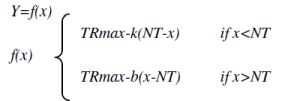
The parameters were determined using the Monte Carlo method, in the optimizing process the sum of deviation square was minimized. The correct conformation of the functions was determined by the greatness of the R-value and the standard error. We found that during six years of testing, the tendency of fertilization efficiency was similar in the case of both hybrids. There was an unfavorable weather interval and, in these years, the yields were low, fertilization did not have an effect and moreover, in extremely bad conditions resulted in an obvious yield decrease. With the improvement of conditions, which in the case of our country means an increase in precipitation, the efficiency of fertilization increases and reaches its peak at 13-14 t/ha. At this point, the yield increasing effect of fertilization is 4-4,5 t/ha. If the yield of the unfertilized treatments increases from 8-9 t/ha, then the efficiency of the applied fertilizer decreases.
Most likely, the k and b parameters depend on the soil of the experimental location (nutrient and water management) and on the amount of pplied fertilizer and the characteristics of the hybrid. With the increase of fertilizer dosage the k-parameter also increases. The greater value though does not obviously mean a more favorable situation. It is true that in medium and good years this means great fertilizer efficiency, but in low or extreme precipitation conditions it also means greater risk. With the increase of the k-parameter, the yield deviation also increases which, from a cultivation point of view, is quite unfavorable. If the value of the b-parameter is other than, zero then the effect is clearly unfavorable, because with the increase of this value, the yield decrease is also greater. The fertilizer reaction of the two examined hybrids can be well characterized by these two hybrids.
Examining the six years, our created model estimated the effect of fertilization on the yield accurately and with a high degree of safety. Both in highly unfavorable and extremely good years, it gave an exact estimate. In our opinion, it can be used well to evaluate the effects of fertilization on yield in the future. -
The main influencing factors effecting the yield of maize
137-141Views:331Maize is one of Hungary’s major cereals. In the 1970s and 1980s, we were in the frontline regarding yields and genetic advancement. However, yield fluctuation in maize has increased to 50-60% from 10-20% since the 1980s, which was partly caused by the increase in weather extremes due to climate change and by agrotechnical shortcomings.
The experiments were carried out on typical meadow soil in four repetitions in the period of 2007-2008. In the sowing time experiment, sowing was performed on 10 April, 25 April, 15 May under a uniform fertilization of N120, P2O580 K2O 110 kg/ha. In the fertilization experiment, the yielding capacity of 10 hybrids with different genetic characteristics was studied in a control (non-fertilized) treatment and basic treatment of N40 P2O5 25, K2O 30 kg ha-1 active ingredient and a treatment with fivefold dosages of the basic treatment. In the plant density experiment, the relationship between plant density and yield was analysed at plant densities of 45, 60 and 75 thousand plants per ha. We found a tight correlation between sowing time and yield and grain moisture content at harvest. We found that grain moisture can be reduced by 5-10% by applying an earlier sowing time.
The agroecological optimum fertilizer dosage was N 40-120, P2O5 25-75, K2O 30-90 kg ha-1 active ingredient at a plant density of 60-90 thousand plants ha-1 depending on the hybrid and the year. -
Study of drought stress correlation on yield and yield components of maize cultivars (Zea mays L.)
67-73Views:671This article was investigated to study the correlation and analysis of drought stress regression on maize cultivars' yield and components. The variance analysis results showed a significant difference between drought stress levels in terms of plant height, total dry weight and number of seeds per row, the total weight of cob, grain yield, harvest index, stem diameter, and cob weight with protective leave. Also, there was a significant difference in ear weight without protective leaves, ear diameter, ear length, plant weight, 100-seed weight, and seed per ear on hybrid treatments. There were statistically significant differences between cultivars in plant height, leaf area, ear diameter, ear length, number of seeds per row, number of seeds per ear, the total weight of cob wood, 100-seed weight, harvest index, plant dry weight. The results of the correlation of traits for the mean levels of drought stress showed a positive and significant correlation between plant yield and plant height, seed per row, ear length and weight of 5 pieces of wood and also with a total weight of cob wood, ear weight with bark showed the highest correlation. There is a significant correlation between leaf area and stem diameter, plant weight, total dry weight at the probability level of 0.05. Correlation coefficients between traits in non-stress conditions showed a positive and significant correlation between grain yield and height, ear length and grain in the row, which was a significant increase compared to stress conditions. The correlation of traits under full stress conditions also showed that the correlation coefficient between cob length trait and positive height was positive and significant. From the study of correlation coefficients between maize traits in non-stress conditions, it can be concluded that the most important components of grain yield are cob length and grain per row. While the correlation coefficients under moisture stress conditions show that the grain trait in the row has a positive and significant correlation with yield, under stress conditions in the cob stage did not show any traits with correlation yield.
-
Phenometric studies on stalk juice and sugar contents of silo sorghum types
41-49Views:265Bioenergies (among them e.g. bioalcohol) can be solutions for the replacement of fossil fuels. For its production, plants with high sugar or starch content can be used. Juice pressed from the stalk of sugar sorghum has high sugar content (14-17%) that makes it suitable for bioethanol production. During our experiment, we examined 53 restorer male lines; among them 22 were silo type sugar sorghum. We studied the following traits: plant height, breeding time, level of foliation, stalk diameter, characteristics of stalk medulla, juice content of stalk, sugar content of stalk juice. According to examined characteristics, we selected six restorer male lines for studies in the forthcoming years: RL 1, RL 2, RL 3, RL 4, RL 5, RL 9, RL 12, RL 15, RL 18. Their stalk medullas were wet, stalk diameters were medium-thick, sugar contents of juices varied between 17 and 24% at the end of milk mature. Harvest was made in September, they can be classified into early maturation group. Male sterile female lines were the following: SL 1, SL 2, SL 3, SL 4, SL 5. The maintainer male lines were: CL 1, CL 2, CL 3, CL 4, CL 5. In Hungary, there are only a few male sterile female
lines, so we will use these lines for hybrid production during the next years. -
Associations analysis of production traits with leptin gene T3469C polymorphisms in pig
39-43Views:537The aim of this study was to define the connection between the leptin (LEP) gene T3469C polymorphism and its potential association with production traits in improved hybrid pigs. The study included data from 397 gilts and barrows from 2 different sample. The polymorphism was identified by using the polymerase chain reaction-restriction fragment-length polymorphism (PCR–RFLP) method with HinfI restriction enzyme. Two alleles of LEP gene were identified: T (0.93) an C (0.07). The analysis of values of production traits, depending on LEP genotype did not reveal significant (P≤0.05) differences. In the examination the loin diameter (between the 2nd and 3rd ribs), the live weight at slaughter and the averege daily gain during fattening were higher at pigs with C allele than pigs with TT genotipe. Accordingt to our data the effect of C allele was favourable in this population, because these animals had bigger bodyweight without valuable change of lean meat percent.
-
Impact of chronic heat stress on digestibility of nutrients and performance of meat type ducks
51-55Views:372The aim of the study is to determine the effect of vitamin and mineral supplement under permanently high environmental temperature (30±1 °C) on the digestibility of nutrients, performance and furthermore the composition of duck meat in the growing period. A total of four hundred mixed sex 14 days old Cherry Valley type hybrid ducks were used for the study. Two experimental diets were formulated in the study (control and vitamin E, C and zinc supplemented diet). Based on the results the following conclusions were drown: the antioxidant defence system plays an important role in the reduction of heat stress generated lipid peroxidation process. Feed additives which have direct or indirect antioxidant effects can reduce the negative effects of heat stress on the ducks performance and meat composition. Digestibility of nutrients (Dry Matter, Crude Protein, Crude Fat) was not affected by antioxidant supplementation under chronic heat stress (30±1 °C). The performance was affected significantly by Vitamin C and E and zinc supplementation under heat stress (P<0.05). In the treated group the daily weight gain (dWG) increased and the feed conversion ratio (FCR) was improved significantly (P<0.05). The energy and protein conversion was decreased also significantly (P<0.05).
-
Role of Sowing Time in Maize Production (Review)
36-39Views:210Many authors, both in Hungary and abroad, have reported on experiments carried out to determine the role of sowing time in maize, but the results are often contradictory. This is hardly surprising, since the maize plant exhibits enormous genetic variability and the hybrids created through selection and inbreeding may have very specific requirements as to sowing date. The year effect, too, often complicates the efforts of scientists to provide clear guidance to farmers on the optimal sowing date for each hybrid.
-
Effect of cultivation factors on the yield and yield security of maize
263-265Views:385Cultivation factors have a significant effect on the yield and yield security of maize. Ensuring a suitable green crop is important. Tricultural crop rotation (pea–wheat–maize) in the average of 25 years provided a 2 t ha-1 higher yield compared to monocultural cultivation. A harmonious NPK nutriment supply determines yield and yield security, which can be especially realized by means of the application of precision cultivation technologies. Under average circumstances N 80 kg ha-1, P2O5 50 kg ha-1, K20 60 kg ha-1 active ingredient is the agro-ecological dosage of artificial fertilizer.
Plant density is a factor that determines yield. Optimal plant density – beside the genetic characteristics of the hybrid – is mostly influenced by the level of water and nutriment supply. -
The effect of the sowing time on the yield and oil content of sunflower (Helianthus annus L.) in different crop protection models
57-61Views:296The field research was carried out at the experimental farm of the University of Debrecen at Látókép on calcareous chernozem soil in Hungary. We examined the effects of the sowing time and the fungicide treatment on the yield, oil yield and oil content of two different genotypes of sunflower hybrids (NK Ferti, PR64H42) in 2012 and 2013. We applied three different sowing times (early, average, late) and two different treatment levels of fungicides (control =no fungicides applied, double fungicide protection).
During our research, we received better results in 2013 than in 2012. The application of different planting times affected the yield and oil yield production and the oil content as well. The optimal circumstances for yield and oil yield production were provided by late planting in 2012, while by average planting time in 2013. The highest oil yield results were reached by late plating in both years (except for hybrid PR64H42 in the double treated parcels where average plating time turned out to be more effective). The correlation between the plating time, the yield and oil yield production and the oil content was strong in 2012 (r=0.600**, r=0.639**, r=0.590**). On the other side, in 2013, the correlation was medium between the planting time, the yield production and the oil content.
We applied Pearson’s correlation to analyze the effect of the double fungicide treatment on the yield and oil yield production (2012: r=0.498**, r=0.407**). These results were better in 2013 (r=0.603**, r=0.623**), besides, the double fungicide treatment also increased the oil content (r=0.315**).
-
Grain yield and quality of maize hybrids in different FAO maturity groups
126-131Views:216An improvement in the quality of maize grain by increasing the level of components responsible for its biological value is possible
by using genetic means. However, a change in the genotype, together with improving the nutrient properties of the grain, also has some
adverse consequences connected with a fall in yield and in resistance to diseases.
Field experiments were conducted during three years (2003, 2004and 2005) to evaluate environmental effects on grain yield and
quality responses of maize hybrids. Twenty one hybrids of various maturity groups (FAO 150-400) were planted to achieve an optimum
(60-70 000 plants per hectare) plant populations and grown under the medium-N (80 kg N ha-1) fertilization. Environmental conditions
significantly affected maize hybrid responses for grain yield, starch, oil and protein contents, and consequently, starch, oil and protein
yields per hectare. Hybrids of flint type, which have a short vegetation period, had high protein and oil content but the yield averages
were low due to the slower rate of starch incorporation. Hybrids of the dent type have a longer growing season and more intense
carbohydrate accumulation, but low protein and oil contents. In wet years there was a higher rate of starch accumulation, while dry
years are favorable for protein and oil accumulation. Positive correlation existed between starch content and grain yield and 1000-
weight as well as between oil content and volumetric weight among tested hybrids. Negatively correlation existed between grain oil and
starch content as well as between oil content and grain yield and 1000-weight. Thus, end-users that require high quality maize may need
to provide incentives to growers to off set the negative correlation of grain yield with oil and protein content. -
Comparative analysis of soil analysing datas on different sempling-plots
85-90Views:255Hibrid maize is cultivated on larger plots, therefore the sown areas of hibrid maize are heterogeneous from a pedology aspect. Heterogenity causes problems during tasseling, chemical plant protection and harvest. The heterogenity of sown areas can be compensated by fertilization which is based on soil analysis. We carried out research into change of the soil on four soil types from 1987 to 2005.
There were no significant changes in pH, hydroiodic acidity, CaCO3-content, humus-content on meadow chernozem soil. We detected equalization of salin content in the examined soil layers. There were no significant changes in the measured values on chernozem meadow soil and solonetz meadow soil in 2005. We discoverd equalization of saline content on chernozem meadow soil, but the changes were not as obvious as the changes on meadow chernozem soil. We found salinization in the 30-60 cm soil layer on type meadow soil that may be due to water movement. -
Impact of fertilization on production capacity and reaction to fertilization in maize hybrids
42-46Views:158New varieties and fertilization have significantly increased yields of maize in recent decades. It has to be taken into account however that the interactions and the balanced combination of cropping factors (ecological, biological and agrotechnical) are the main factors which determine yields. Weather conditions were rather unfavourable during the last decade. Extreme weather conditions occurred due to global warming; 6 of 10 years were plagued by drought. Consequently yields increased from 10-20% to 30-50%. In view of varieties the situation is advantageous, maybe the supply of hybrids is too high, nevertheless those hybrids need to be selected which are particularly well adjusted to the ecological conditions. Many technologies can be applied which vary according to intensity, but the balanced combination of cropping factors should be secured on the basis of the hybrid’s intensity. Among agrotechnical factors the compensation of nutrients and technological conditions were inadequate. These days farmers only use nitrogenous fertilizers consequently they significantly decrease the easily available P and K content of the soil which in long term leads to the deterioration of the soil’s productivity. The technological background is therefore important, because sufficient yields can only be expected if agrotechnical operations are carried out in the right time and quality.
-
The effect of NPK fertilization and the plant density on maize yield and bioethanol production
13-18Views:400For industrial (bioethanol) production of maize, a new production technology is needed. I tested and selected hybrids appropriate for this purpose and set up fertilization and plant density experiments. The experiment were set up on chernozem soil in 2008.
In bioethanol production, the selection of a high-yielding hybrid with high starch content, a slight reduction of N, increase of potassium, the application of the highest plant densities of the optimum interval, harvest at full maturity (when starch content is the highest compared to protein content) are of great importance. -
Examination of plant number and sowing date in different crop years
79-82Views:213We examinated three agrotechnical factors in 2011, 2012 and 2013 (sowing time, nutrient factor and plant density), as well as five different effects of genotypes on the crop of corn, on brown soil in the Hajdúság. The experiment was set next to the 47 main road in Debrecen, at the 6th kilometre stone.
In the present processing I would like to touch on the effects of sowing time and plant density, as I do not have the chance to present the whole experiment results here. It is true for all three years that the humidity factors differ from the long years’ average, so the genotypes had different reactions on it. According to our results we found out that the late sowing time’s result had the most successful crop yield result with 9975 kg ha-1, while examining the plant density the result of the highest plant density proved to be the best with 9967 kg ha-1.
We take the critical season in corns’ life cycle process into consideration when examining the results: June, July and August months’ humidity and temperature markers. According to the results in the tested 3 months we had 227 mm humidity with 10 days, when the average temperature was over 25 °C. The same factors in 2012 were 135.5 mm humidity with 37 days of average temperatures of 25 °C and in 2013 we recorded 102.5 mm humidity with 24 of these days.
Our goal is to help the farmers in the Hajdúság with the results of our sowing times, hybrid choice and plant density results.
-
Volume of Paulownia Shan Tong (Paulownia fortunei × Paulownia tomentosa) plantation in Eastern Hungary: a case study
43-46Views:679Volume tables for tree plantations are not unknown in international practice. In many places, this is due to the uniqueness of the species or variety composition of the plantations and the cultivation technology used. In most cases, this is also justified by specific soil (ecological) conditions. In Hungary, publications on Paulownia have not yet included a volume table. This is the first one we are publishing, thus it can be considered as a gap-filler. The research was conducted in Monostorpályi, a 1.8 hectare, 8-year-old municipal plantation. 8 trees were selected randomly and their parameters were studied.
-
Comparative analysis of maize hybrides grown for bioethanol production purposes
11-14Views:203The objective of this study was to evaluate the effects of crop year on the main components of maize grown for bio-ethanol production yield, starch content and starch yield per hectare of maize hybrids were investigated in a droughty (2007) and in a favourable years with optimal weather conditions (2008, 2009). We measured very low starch yield (1.5 t ha-1) in the year with unfavourable precipitation supply (2007) together with higher starch content (73%). In the case of good precipitation supply we measured a much higher starch yield per hectare (7.7 t ha-1) with lower content (72.4%). In 2009 the starch content (74.5%) exceed the results of the two previous years, but on the other hand the average of starch yield was (4.9 t ha-1) which falls between the other two years values.