Search
Search Results
-
The role of the hybrid-specific technological recommendations of maize in precision crop production procedures
297-302Views:257The necessity of application of hybrid specific crop production technology has been confirmed not only by trial results but also by the experiences gained from the agricultural practice. For this reason it is essential to test and collect data in field trials about the specific agronomic traits of the corn hybrids belonging to different maturity groups and genotypes. Corn hybrids are tested for their responses to sowing time, plant density and fertilizer supply; sensitivity to herbicides; and lately, the resistance to the damages caused by the larvae of corn root worm. Last but not least, mention should be made of the differences in the responses of the corn hybrids to the damages caused by drought stress. Based on the trial results, suggestions for the hybrid specific corn production are compiled and made public for the experts and farmers engaged in corn growing. Corn hybrids may deliver maximum yields on the impact of specific crop production technology only in case if it relies on carefully done general production technology including soil cultivation, seed bed preparation and weed control. Similarly, precision crop production technology may advance the yield increase in economic way if it is constantly drawing on the source of research results.
-
Estimation of Inheritabilities from Holstein-Friesian Test Day Data in Hungary
23-25Views:653Recently, test day models (TDM) began to be increasingly used for the genetic evaluation of dairy cattle. The main advantage of the TDM compared with the 305 days lactation yield models is that more effects can be used in the evaluation. Therefore, the TDM is more accurate than the lactation models. The main disadvantage is the increased computational requirement, but this can be offset by improvements in computer capabilities.
The topic of this paper is the use of a fix regression test day model to estimate the inheritabilities of test day data from Hungarian Holstein-Friesian dairy cattle. The inheritability was 0.26 for milk production, 0.2 for fat production, 0.24 for protein production and 0.06 for the somatic cell count. -
Experience at Russian State Agrarian University – Moscow Timiryazev Agricultural Academy on introduction and integration of precision agriculture technology
73-76Views:199Traditional and precision agriculture technologies are compared on the basis of the field experiment. Problems of soil and crop survey and mapping are discussed.
-
Examination of the vegetative and generative accomplishment of new apple varieties
29-34Views:247Our research focuses on apple varieties, what are planted expansively in the development apple orchards of Western-Europe, but about the production characteristics of these varieties we don't have or just few practical experiences in Hungary. These varieties can be described with regular and high yields, aesthetic and alluring appearance in their origin places, what ensure profitable producing for the growers. In our climate what tends to be often extreme (hard cold winters, late spring frosts, summer drought, heat stress) these varieties may behave differently, so before the substantial planting it is expedient to carry out variety evaluations to avoid the later failures. The place of our experimental is located in the Nyírség, what presents adequately the ecological conditions of the surrounding areas, so the gained results can be easily adapted in the biggest apple production site of Hungary. Regarding the vegetative and the generative parameters of the 14 examined varieties ('Schniga', 'Jugala', 'Fendeca', 'Galaval', 'Fengal', 'Red Cap', 'Early Red One', 'Jeromine', 'Crimson Crisp', 'Red Topaz', 'Red Jonaprince', 'Red Idared', 'Fuji SW', club variety) we found significant differences, which is the result of the genetically coded characteristics of the varieties, the effects of the vintage, the different training methods and the correlations of these factors.
-
Livestock production development in AP Vojvodina
501-513Views:194The aim of this paper is to present the effects of breeding program implementation on the development of animal breeding in Vojvodina since 2010. Data from the Main breeding organization (controlled population) and data from the Statistical Office of the Republic of Serbia (total population) were used as a basis for this research. The main breeding organization is the Departmant of
Animal Science, Faculty of Agriculture, University of Novi Sad that implemented the main breeding programs in cattle, pig, sheep, goat, horse and poultry production. The milk yield in a recorded population of Holstein Friesian and Simmental cows shows evident phenotypic increasing trend as opposed to a population that is not controlled. The results of the selection measures in Vojvodina show that pig breeding has an upward trend and that we have an increasing number of small and medium (family) farms. Interest in sheep and goat production is increasing primarily because of the high demand for products made from sheep meat and goat milk and meat. In the recent decades, Vojvodina has been faced with a decrease in the number of horses. At the same time, there is an increasing interest in sports horses and recreation. According to poultry production results of parental flocks, an increasing tendency was observed in the production of controlled flocks recently, while the number of breeding stock breeders was reduced. -
Preliminary Critical P-limit Values of 0.01 M CaCl2 Soil Test Procedure
18-21Views:266In the last decade, the 0.01 M CaCl2 extraction procedure was tested as a multi-nutrient extractant. In 1995-97, international joint research activities were carried out within the COPERNICUS project. Detailed calibration of conventional and the 0.01 M CaCl2 extraction procedures for pH, Mg and K were published.
The amount of phosphorus extracted using a 0.01 M CaCl2 solution is very low and reflects the intensity parameter of phosphorus bio-availability. As a readily desorbed P fraction of soils can reflect the soil P-supply and the CaCl2-P values are in close correlation with P-fertiliser rates and P balance. However, the effects of various soil characteristics on CaCl2-P values are different and their interpretation is difficult.
Relatively poor correlations were found between amounts of P extracted by conventional and CaCl2 soil test methods and, therefore, P limit values could not be calculated directly. To characterise the soil P supply at different sites, the CaCl2 desorbed P and the adsorbed P in a modified Baker Soil Test were also applied.
Soil test results of Hungarian long-term fertiliser experiments and recommended CaCl2-P limit values, calculated on yield effects and soil characteristics, are discussed. -
Presentation of sales price reserves for live lamb
37-45Views:203Although sheep breeding in Hungary is grounded in strong traditions, its activities only comprise 1% of the total production value generated from agriculture, and 2% of that for animal-based products. The most significant portion of incomes earned in the Hungarian sheep sector has, for years now, stemmed from the sale of live animals. The sector is decidedly export-oriented, as the domestic demand for its main product, i.e. lamb meat, and is minimal, equaling some 20-30dkg per person per year. Part of the sold animals is sold to market as dairy sheep, while the greater
part is sold in the category of lamb carcasses. For this reason, the average weight of slaughter sheep has lied between 19-22 kg for years now. The target markets for live lamb sales are predominately Italy and Greece. In Greece, movement on this market has shown an upward tendency in recent years; noteworthy are also sales to Austria, Holland, Bosnia-Herzegovina and Poland. In 2003, we exported sheep meat in the form of carcasses to Italy, as well as to Germany, and of these exports, 94% went to Italy, while the remaining 6% went to Germany.
Among sheep products, only the trade balance for live animal sales is positive. But even for such producers, only those who are specialized in intensive breeding and those sheep farms “targeting” meat production can obtain earnings. Specialized literature on the sector argues that the quality of Hungarian lamb has diminished dramatically and is beginning to lose its market position. If Hungarian lamb does not meet market expectations, then it will only be bought from producers at lower prices.
My research focuses on those factors which influence price. I separately discuss the question of quality, as one of the most important decisive factors on price. Within this discussion, I describe the market expectations which actually have an effect on the acceptance of live animals for sale on commission. In practice, after the problems of quality, the next most important question is that of when sale is made. In the course of my research, I studied the development of averages for sales on commission of live lambs using statistical methods. The most important problem of this sector is the hierarchical system used in sales: this is the topic hich neither the producer, nor the buyer, wish to discuss, not even with each other. On the basis of the information at my disposal, I outlined the levels of traders and individual levels used to arrive at commission prices. Finally, I examined the components of the production value of live lamb sales. The results I obtained quantified the key role of the prices and the yield, as well as the factors influencing income. -
Changes in weed flora of basket willow (Salix viminalis L.) under different soil nutrient supply
116-120Views:256The world is in a continuous progress, as a result of which energy consumption and with this the release of gases with adverse impact show rapid increase. As a result of the survey conducted by the International Energy Agency, if the major economic powers do not initiate a change in their energy policy, the increase of energy consumption may as well reach 40 % by 2030. This increased energy demand is getting more and more difficult to fulfill with the fossil energy resources, which is to lead to an increasing significance of renewable energy resources. In Hungary, these energy resources are the best to provide with biomass growth. Biomass growth for energetic purpose can mostly be provided by energy plants, out of which “energy willow” (Salix viminalis L.) is outstanding with its high yield and with its excellent burning technology characteristics of its timber. The willow’s cropping technology is being established in our country. One of our tasks is to work out an adequate weed control plan. The professional and safe use of herbicides can increase the success of production. In our paper, we discuss the weed flora data collected on treatments applied in the different fertilizer and compost. We started our survey in 2010. We examined twelve different fertilizer and compost treated areas. The dominant weeds were: Amaranthus retroflexus, Chenopodium album, Echinochloa crus-galli among annuals; Cirsium arvense and Agropyron repens among the perennials.
-
Economics of hail protection net installation in super intensive apple orchards
27-35Views:230The main objective of this study was to determine and organize beneficial and detrimental effects of hail protection nets, and as far as possible to quantify their economic impact. The main factors were determined, through which hail protection nets can affect the costs and incomes of the production, and as their sum the economic result. Considering these factors together with the investment cost and the annual maintenance costs allows the economic evaluation of purchasing of hail protection nets. The analysis was carried out using a deterministic simulation model based on primary data collection from apple producing businesses. Installing hail protection nets as additional technological elements of intensive apple orchards can be concluded by all means as an economic investment – trough their protective effect. However, to achieve really favourable economic indicators, definitely bigger tree height is needed making possible the realisation of around 8.0 t ha-1 extra yield. The main root of this phenomena are obviously the extremely high investment costs of hail protection nets, which result in a large mass of fixed costs during the production period. Therefore the basic economic interest is reaching higher yields and thereby higher profits per unit area.
-
Complex problem analysis of the Hungarian milk product chain
43-47Views:235Hungarian dairy sector went through significant changes in past two decades. The most significant changes were caused by our accession to the European Union. In Hungary milk production remarkably declined after EU accession. The size of our dairy herd has been practically reducing since the political transformation, but increasing yields per cow could compensate it in some way and for some time. However, in recent years, increasing yield per cow came to a stop and in parallel, the number of cows declined further and faster. Low prices, high production costs and tightening quality requirements ousted several producers from the market in past years. Feeding cost represents the highest rate in cost structure of production, but animal health expenditures and various losses are also significant. There are undeniably competitive disadvantages in the level of organisation and labour productivity; however competitiveness already depends on cost effectiveness in the medium run. In Hungary concentration of the dairies is relatively strong in spite of the relative high number of corporations. The dairies compete with each other and with the export market for the raw material and the better exploitation of their capacities. Applied technology of the Hungarian dairies lags behind the Western-European competitors’; in addition they have handicaps in efficiency and product innovation. Presence of chain of stores being dominant in sale of milk products does also not favour in all respects to the position of the dairies. The aforementioned retail chains are namely consumer-centric, engage in price follower conduct and weaken the position of the dairies with their private label products. As a result of increasing import of milk and milk products Hungary became a net importer in recent years. Today, disposable income still essentially determines the consumption habits of price-sensitive consumers. Loyalty for Hungarian products is not typical, consumers are open for import products being preferred by retail chains. In addition Hungarian milk and milk product consumption is about half of the Union average and it is far behind the level being necessary for healthy eating. In Hungary lack of competitiveness and vertical integration relationships and backwardness are revealing among the dairy farmers and the dairies, while chain of stores are in unprecedented “monopolistic situation”; the whole sector can be characterised by defencelessness.
-
The trend of cowmilk yield, its compostion and the body condition during the lactation
69-73Views:422The authors examined the data of 2767 trial milkings andthe months Body Condition Scores of 479 Holstein dairy cows. The condition loss was significant between the 30-60th days. The improvement of BCS begins only after the 120th day. The change in the milk protein and milk fat content were close after the condition changing. In each period of the lactation the closeness of the relationship among the condition, the milk quantity and the milk composition were different. In the aspect of the milk quantity the most significant difference was between the 2.5 and 4 BCS cows (6.68 kg) in the last period of the lactation.
-
Economic questions of precision maize production on chernozem soil
293-296Views:259It is one of the main topical objective to establish the conditions of sustainable farming. The sustainable development in crop production also calls for the harmony of satisfying human needs and providing the protection of environmental and natural resources; therefore, the maximum consideratio of production site endowments, the common implementation of production needs and environmental protection aims, the minimum load on the environment and economicalness. Precision farmin encompasses the farming method which is adjusted to the given production site, the changing technology in a given plot, the integrated crop protection, cutting edge technologies, remote sensing, GIS, geostatistics, the change
of the mechanisation of crop production, and the application of information technology novelties in crop production. Modern technology increases efficiency and reduces costs. The efficiency of crop production increases by reducing losses and the farmer has access to a better decision support information technology system. In addition, we consider it necessary to examine the two currently most important economic issues: “is it worth it?” and “how much does it cost?”. During the analysis of agricultural technologies, we used the precision crop production experiment database of KITE Zrt. and the Institute for Land Utilisation, Regional Development and Technology of the Centre for Agricultural and Applied Economic Sciences of the University of Debrecen.
During our analytical work, we examined three technological alternatives on two soil types (chernozem and meadow). The first technology is the currently used autumn ploughing cultivation. We extended our analyses to the economic evaluation of satellite navigationassisted ploughing and strip till systems which prefer moisture saving. On chernozem soil, of the satellite-based technological alternatives, the autumn ploughing cultivation provided higher income than strip till. In years with average precipitation supply, we recommend the precision autumn ploughing technological alternative on chernozem soils in the future. On meadow soil, the strip till cultivation technology has more favourable economical results than the autumn ploughing. On soils with high plasticity – considering the high time and energy demand of cultivation and the short amoung of time available for cultivation – we recommend to use strip till technologies. -
Investigation of the Quality of Winter Wheat in a Sulphur Fertilisation Experiment, 2001/2002
153-156Views:447We have started a small parcell and a factorial S fertilization experiment with winter wheat in the 2001/2002 cropping year to examine its effect on yield and quality. The scene of experiment was the Latokep Experimental Station of the DE ATC (calcareous chernozeem) in case of small parcell examination and the Agricultural Company of Felsőzsolca (brown forest soil) in case od factorial examination.
The protein and gluten content of the grain was investigated with PerCon Inframatic 9001 NIR Analyser, then we have measured these parameters with PerCon 8620 infra appliance. After the milling we measured the following parameters: glutenindex, farinographic parameters (farinographic index, water absorption capacity, dough development time, stability, softening, extension) and valorigraphic index.
Based on the results there’s no justified relation between the fertilization and the protein and gluten content. The valorigraphic index of the samples taken from Felsőzsolca factory characteristically increased as a result of the S-fertilization. In the small-parcell experiment the values of the water absorption capacity, the dough development time and the softening parameters from the valorigrphic parameters depended significantly from the mineral treatments. Signifikant quality improvement wasn’t experieced.
There was sampling in all of critical phenophase (…). The green plant samples were examined on element content with ICP-OES. These measurements are currently in progress. -
Possibilities of downsizing sweet cherry trees via growing techniques
71-74Views:300By applying smaller crown sizes and intensive growing techniques, many advantages can be identified compared to the extensive orchards. Also, nursing/pruning and harvest work can be performed more effectively. The outer and inner quality parameters of the fruit and the effectiveness of plant protection techniques are improved. The smaller crown size enables us to apply technologies for ensuring yield safety (e.g. hail, rain, bird nets), resulting in an increase in productivity. The introduction of smaller trees poses a great challenge to cherry production. Trials with dwarfing rootstocks have not yet been successful, therefore, we must use the cv. Mahaleb rootstock, which is excellently adapted to the Hungarian conditions, and also has a stronger growth. In addition, rootstocks with such strong growth are needed for the necessary regeneration of the productive parts of cherry cultivars, there is a need for. At the research garden of the University of Debrecen in Pallag, we planted 21 cherry cultivars on cv. Mahaleb (CT500) rootstock, in a 4 m x 1 m spacing pattern, in the spring of 2000. In our study, we demonstrated the possibilities of developing and maintaining the string super spindle through repeated summer pruning, in terms of growth, bud and fruit formation,. Based on these parameters, we determined which cultivars are the most suitable for intensive production.
-
The effect of NPK fertilization and the plant density on maize yield and bioethanol production
13-18Views:400For industrial (bioethanol) production of maize, a new production technology is needed. I tested and selected hybrids appropriate for this purpose and set up fertilization and plant density experiments. The experiment were set up on chernozem soil in 2008.
In bioethanol production, the selection of a high-yielding hybrid with high starch content, a slight reduction of N, increase of potassium, the application of the highest plant densities of the optimum interval, harvest at full maturity (when starch content is the highest compared to protein content) are of great importance. -
Upgrading breeding value estimation in beef cattle
451-458Views:372This paper gives a summary of the possibility for applying genomic information for breeding value estimation in beef cattle breeding. This process is called genomic prediction and is now widely used in dairy cattle globally as well as in some beef and sheep populations. The advantage of genomic prediction is a more accurate estimate of the genetic merit of an individual at a young age thereby facilitating greater annual genetic gain, predominantly through shorter generation intervals. Genomic predictions are more advantageous for sex-linked (e.g., milk yield), low heritability (e.g., fertility) and difficult-to-measure (e.g., feed intake) traits. The larger the reference population, on average, the more accurate the genomic predictions; additionally, the closer genetically the reference population is to the candidate population, the greater the accuracy of genomic predictions. Research is continuing on strategies to generate accurate genomic predictions using a reference population consisting of multiple breeds (and crossbred). Retrospective analysis of real-life data where genomic predictions have been operation for several years clearly shows a benefit of this technology.
-
The effect of different genotype cattle grazing on the nutrient content of saline grasslands vegetation
46-50Views:555Maintaining saline grasslands in good condition, preserving their yield and diversity is important not only for the purpose of nature conservation, but also for farming. Therefore, the primary purpose of our study is to analyse the effect of pasture use of the smaller weight extensive and the larger weight intensive beef cattle on the grassland vegetation and nutrient content. In this way, we can answer the question whether grazing for nature conservation can be achieved with more profitable, more economical and more intense varieties.
The tests were carried out in May 2016 and May 2017, in the Hortobágy National Park (Pap-ere and Zám puszta), where a total of 16 sample areas were analysed. These areas are grazed with extensive beef cattle (Hungarian grey) and mixed genotype of intensive cattle. The associations were selected along a moisture gradient, such as wet salt marsh (Bolboschoenetum maritimi) and drier saline meadow (Beckmannion eruciformis). All the vegetative material collected both years in May was analysed for the following parameters: dry matter, crude protein, crude fibre and life-sustaining net energy content. We compared the effects of medium grazing (0.46 livestock/ha) and abandonment on vegetation and nutrient content.
We examined the effect of (i) grazing, (ii) different grasslands (salt marsh, saline meadow) and (iii) grazing of different cattle breeds (Hungarian grey, intensive beef) on the nutrient content of the vegetation of grasslands Based on our results, it was found that grazing had an impact on crude protein and life-sustaining net energy content. The highest crude protein content (12.75 m/m%) was obtained in the year 2017 in the area where higher density had been grazed for two years. For the lifesustaining net energy, the highest value (5.05 MJ/kg d.m.) was also obtained in 2017 and the lowest in 2016. Furthermore, it was found that there was no significant difference between the effect of the two cattle breeds on the parameters examined. Significant effects were observed only in the case of life-sustaining net energy: in the area of intensive beef cattle we received a higher value (5.15 MJ/kg body weight) than in the area with extensive beef cattle (4.96 MJ/kg body weight).
Our results have also shown that cattle grazing is of the utmost importance for the maintenance of both wet and mesophilous habitats. Based on our three-year study, we can say that grazing by both extensive and intensive cattle breeds is suitable for the management of saline habitats.
-
The effect of hybrid, nutrient-supply and irrigation on the grain moisture content at harvest and the starch-content of maize (Zea mays L.)
89-95Views:230Maize is a worldwide dominant plant. According to nowadays plant production principles it is important to investigate and optimize the site-specific nutrient-supply and other production factors, such as hybrid and irrigation, in the case of this plant as well.
At the Research Institute of the University of Debrecen, Center of Agricultural Sciences and Engineering, at Látókép the effect of nutrient-supply and irrigation on the quantity and quality parameters of different hybrids were investigated in a small plot long-term field experiment. In this paper we introduce the results regarding the corn moisture-content and the starch content of the yield.
We have chosen three maize hybrids – that have been bread in Martonvásár – for our investigations. The effect of macronutrients is investigated in this experiment on five levels. The half of the experimental area can be irrigated during the vegetation period – whenever it is needed – by linear irrigation equipment, but on the other half only the water amount originating from the precipitation can be used by plants.
In the year 2008 the hybrid affected the grain moisture content at P=0.1% level, while nutrient-supply had an effect at P=10% significance level. We haven’t revealed either any effect of irrigation or of interrelationship between production factors. It can be stated that there are differences between the hybrids on each nutrient-supply and on both irrigation levels. The grain moisture content increased parallel to the longer vegetation
periods.
The starch content of maize is mostly affected by the hybrid,
so on P=0.1% significance level. Regarding our results, it can be
stated, that the starch content shows a decreasing tendency
parallel to the longer vegetation periods. -
Mitigation of environment impact of mycotoxins produced by Fusarium species
159-164Views:501The Fusarium fungi hazards the grain quality of cereals, therefore significantly affects their utilization as animal feed or consumable product. The Fusarium can decrease the quality of wheat in different ways: decreases the germination capability, causes visible discoloration, mould may appear, reduces the dry material and nutrient content of the grain, causes mycotoxin infection – as a result given by its by-product. Micotoxins produced by Fusarium genus, as the trichotecenes (T-2, HT-2, deoxynivalenol, nivalenol, diacetoxyscirpenol, Fusarenone-X) and the zearalenone (F-2) are the most common in Hungary. Occurrence of fumonisins first discovered in 1988 are must be identified carefully. About 20–30% of the overall worldwide production of cereals is infected with Fusarium and its toxins, which situation is similar in Hungary. This infection causes serious yield-losses in cereal production. In the case of cereal products, which non-utilizable as forage seems, an optimal solution is utilizing as biogas raw material, but it is also important to examine the effect of the infected cereal on the anaerobe digestion process.
-
Evaluation of automated anaerobic fermentation processes as in the case of mould infected maize
81-86Views:531In Hungary the renewable energy utilization is planned to achieve 13% by 2020. Biogas production is one of the fields with the largest energy potential. Achieving high efficiency during continuous production despite the mixed and variable composition of input materials is the most common problem which the newly built biogas plants using agricultural raw materials have to deal with. The first experimental reactors at the Department of Water and Environmental Management were built 12 years ago. Control and automation of the four separated bioreactors were executed with ADVANTECH GENIE 3.0 software which granted pre-programmed measurement and points of intervention for pH, temperature, CH4, CO2, H2S, and NH3. The system became out-of-data, therefore in 2010 it has been redesigned and tested. The system is controlled by Compair Proview SCADA (Supervisory Control and Data Acquisition) software running on Linux platforms. The Fusarium infection caused serious yield-losses in cereal production in 2010. In the case of cereal products, which non-utilizable as forage seems an optimal solution is utilizing as biogas raw material. The raw material was based on the Fusarium infected maize. In the recent publication infotechnological and technological experiences of the pilot test period are evaluated as well as direction of future development is defined.
-
Dimensionality Expressed by Caseendings and Spatial Prepositions
7-15Views:212The purpose of this essay is to investigate some of the uses of English prepositions and Hungarian case endings employed to express spatial relations. The observation of invariant mistakes Hungarian native speakers learning English make initiated the investigation. The questions raised are: (a) where do the two systems match and where do mismatches lie, (b) how do language users perceive the world, and (c) do speakers observe spatial relations as two-dimensional or three-dimensional cognitive models? Do different languages see the same thing as either three-dimensional, or two-dimensional?
Abondolo (1988) gives an adequate morphological analysis of ten Hungarian case-endings (inessive, illative, elative, superessive, delative, sublative adessive, ablative, allative and terminative) used in spatial reference, which give a closed set in references made to factors, such as (1) location which can be broken down as interior vs. exterior location with the latter being further analysable as superficial and proximal, and (2) orientation which can be analysed as zero orientation (position), source and goal. In addition to those in this list, two other case endings (genetive/dative and locative) are also used for expressing spatial relations but the last is only a variant of the inessive and superessive case-endings and is only used with place-names. The set is closed in the sense that the same item is meant to refer to the same sort of spatial relation in every case. Language textbooks, c.f. Benkő (1972) seem to suggest a neat match between the above Hungarian case endings and their English prepositional counterparts, e.g. London-ban (inessive) = in London.
The picture, however, is far from being so clear-cut. The data, which were taken from various dictionaries and textbooks, show that the choices of both the prepositions and the case endings listed above depend on how the speaker considers factors (1) and (2) and that proximity is very important. Instead of a one-to-one match between the prepositions and the case endings, we rather find that the above case endings will match a dual, and in some cases a tripartite system of prepositions with the correspondences found in the two languages, which yield the following chart: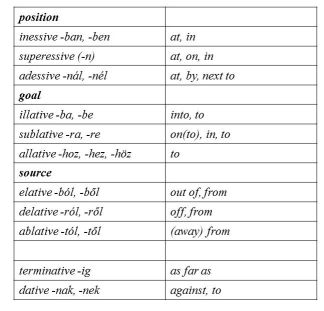
We suggest that languages may view or map the same physical entities in different ways, for example along surface vs. volume or goal vs. passage, etc.
Furthermore, we also find it possible that it is the language specific, inherent coding of the nominal phrase that decides – in many cases – upon the choice of prepositions and case endings. -
Comparative analysis of maize weed control system and the competitive effect of sorghum
97-104Views:330In our investigation we used different weed control technologies in the different phenology states of the maize. The experiment have been
carried out in Hódmezővásárhely, in the Experiment garden of the Pilot farm of University of Szeged Faculty of Agriculture, on meadow
chernozem soil, on 24 m2 plots, in 3 replications, randomized blotch design. The experiment can be regarded as 15 weed-control strategies
where, in addition to the untreated control, six chemicals or chemical-combinations are applied (Spectrum 720 EC, Motivell Turbo D,
Stellar + Dash HC, Clio + Akris SE + Dash HC, Clio + Dash HC) in five different times (pre, early post, post and two late post) and eight
mechanical weed-control technologies were used. Hoeing took place connected to the herbicide treatments in different times: until 2-3-leave
age weedless, in 3-4-leave age hoed once, from 3-4-leave age weedless, in 6-7-leave age hoed once, from 6-7-leave age weedless, in 8-leave
age hoed once, from 8-leave age weedless.
Our results were assessed by chemical efficiency examination, maize length measurement, corncob-length and fertility examination,
Sorghum plant-number determination and yield weighing carried out in four periods. The data were evaluated by a one-factor analysis of
variance and a two-factor linear regression analysis. -
Different soil fertility conditions depending on different land use methods
169-172Views:206In precision nutrient management the most important aspect is adaptation but we should consider the possibility of the long-term improvement of soil fertility within the less fertile landscape zones. This possibility can be evaluated principally by long-term field experiments, which are running on similar soil types. The results of these field experiments can indicate that which soil fertility status should be attained. Some more important soil fertility data, (such as pH, P-, K- and soil organic matter (SOM) content) of a long-term field experiment with increasing farmyard manure(FYM) doses or equivalent NPK fertilizers, set up on an Eutric cambisol, are presented. The yieldincreasing capacity of FYM doses was only 82%, as compared to the equivalent amount of mineral NPK, but long-term FYM treatments resulted in 10% higher SOM content than that of equivalent NPK
fertilizer doses. The studies indicate that SOM content is a function of local climate and clay content of the soil, and neither long-term high FYM doses can increase SOM content steadily above a supposed steady-state value. However we have to make efforts to keep the optimum level. The lowest soil reactions developed both with the highest NPK doses and without any fertilization. AL-P2O5 content of soil was increased more by mineral fertilization than by FYM treatments, but in case of AL-K2O content there was no difference between the fertilization variants. However the highest doses of both fertilization variants increased soil nutrient content to an excessive degree. Wecould get very valuable data from the unfertilized control plots as well, where long-term yield data suppose 48 kg ha-1 year-1 air-borne N-input. -
The impact of sowing date, production area and nutrient supply on the yield and quality parameters of millet
105-109Views:244The millet is a very special plant with good adaptation that gives the possibility for the late sowing and secondary production. However the effects of late sowing modifies to the efficiency of the agrotechnological elements. The examinations – focused on this aspect – was conducted in the DU CAS RINY in the small plots in four replications in 2013. The largest effect was recorded in the sowing time of the examined factors (sowing time, nutrient supply, growing area). The effectiveness of the agrotechnological elements decreases under unfavourable circumstances caused by the late sowing. The examined factors did not affect in the protein content and milling rate, except in the latest sowing time when protein content was significantly the highest.
-
Polymorphism of the bovine GH and LEP genes in a population of Slovak spotted bulls
19-23Views:285The aim of this study was the detection of polymorphism in the bovine growth hormone and leptin genes using the PCR-RFLP method. A
polymorphic site of the growth hormone gene (Alul loci) that results in amino acid change at position 127 of the protein chain (leucine, L to
valine, V) has been linked to differences in circulating metabolites, metabolic hormones and to milk yield. The polymorphism in bovine leptin
gene is situated in the intron between two exons, which results in an amino acid change at position 2059 of the protein chain (cytosine, C to
thymine, T). The polymorphisms were studied in a group of 58 bulls of the Slovak spotted breed. A strategy employing PCR was used to amplify 428 bp (GH gene) and 422 bp (LEP gene) products from blood samples. Digestion of PCR products with restriction enzymes AluI and Sau3AI revealed alleles: L and V; A and B for GH gene and LEP gene, respectively. The growth hormone gene is a candidate gene for body weight gain in cattle, since it plays a fundamental role in growth regulation. Leptin plays an important role in the regulation of feed intake, energy metabolism, growth and reproduction of cattle; therefore, animals with higher leptin gene expression will probably have lower daily weight gain than others with similar forage offer and nutritional condition and will also likely have longer calving intervals.