Search
Search Results
-
Effects of production factors on the yield and yield component of winter wheat
26-31Views:262The effect of major production factors (forecrop, fertilisation, irrigation, soil cultivation and soil preparation) on the yield components and yield of winter wheat were studied in a long-term experiment set up at the Látókép Experimental Nursery of the Agricultural Sciences Centre of the University of Debrecen. The results of regression analysis led to the following conclusions:
• In our experiments in 2000, after using maize as a forecrop –based on the results of analysis of regression – fertilisation determined the yield.
• After using pea as a forecrop, a N50 P35 K40 kg/ha fertiliser rate led to an economical increase in the yield of winter wheat.
• None of the determinative yield components varied significantly for winter wheat produced after using pea as a forecrop.
• There is a closed, significant correlation between plant height, spike length, plant and spike mass, the number of spikelets and grains per spike after using maize as forecrop. The thousand grain mass is different from the other yield components, because it is not part of the relation system of
those yield components.
• The increased yield of winter wheat after maize has been used as a forecrop is due to the positive change in grain number per spike yield component. -
The Effect of Sowing Time and Plant Density on the Yield of MaizeHybrids
95-104Views:393The crop technology of maize has two important elements, sowing time and plant density. In 2003 and 2004 we studied the effect of these two factors on the growth and production of maize in an experiment carried out near Hajdúböszörmény.
The soil of the experimental plots was meadow soil.
Weather in both years was differed greatly. 2003 was drought. Neither the distribution nor the quantity of the precipitation were suitable in the growing season for maize. This fact basically determined the results.
In 2004, we could talk about a favorable and rainy season. The distribution and quantity of precipitation was suitable between April and September. The average temperature was also suitable for maize.
Results of the sowing time experiment:
In 2003, we tested seven hybrids at four sowing times. Hybrids in the early maturity group gave the highest yield at the later sowing time, while the hybrids of the long maturity group gave it at the earlier planting time. The yield of PR34B97, PR36N70, PR36M53 hybrids was the best at every planting time. The moisture loss of hybrids in the late maturity group was faster in the maturity season, but the seed moisture content was higher than the hybrids with early sowing time. The seed moisture content was very low due to the droughty year. In two hybrid cases, this value was higher than 20% only at the fourth sowing time.
In 2004, we examined the yield and seed moisture content of nine hybrids. In the favorable crop year, the yield of every hybrid was the highest at the second and third sowing time. Yields of PR34H31 and PR38B85 hybrids were significant. The seed moisture content at harvest was higher than the previous year due to the rainy season. In the case of hybrids sown later, this value was higher by 30%. However, we noticed that this value was lower at the earlier sowing time than at the later.
The crop year had a more dynamic effect on maize than the sowing time. First of all, the quantity and distribution of precipitation played an important role in respect to yield safety.
Results of the plant density experiment:
We tested the reaction of hybrids at four plant densities (45,000, 60,000, 75,000 and 90,000 stock/ha) every two years. In 2003, the tested seven hybrids reached the highest yield at the 90,000 stock/ha in the face of a droughty year. The effect of forecrop and favorable nutrients caused these results. In the rainy 2004 year, the yield grew linear with the growing plant density. The yield of the best hybrids were 14-15 t/ha at the 90,000 stock/ha.
Such a high plant density (90,000 stock/ha) couldn’t adaptable in farm conditions in rainy season. It is practical to determine the interval of plant density besides the optimum plant density of hybrids which gave correct yield. The farmers have to use the low value of this interval due to the frequent of the droughty years. -
The relationship between the nutrient supply and the yield of maize hybrids with different genetic traits on chernozem soil in variant years
27-31Views:489The experiments were set on lime-coated chernozem soil in 2013 and in 2014, in our study four hybrids were included with different FAO number. We studied the effect of NPK fertilization and row spacing on the yield. The fertilizer doses were based on a 25-year longterm experiment. Compared to control, the N40 +PK treatment has also achieved a significant yield increase, although some hybrids responsed with yield loss to the increasing fertilizer doses; this effect was observed especially in 2014. The majority of hybrids reached higher yields in both years using the 50 cm row spacing. The water release of hybrids was measured weekly during the maturation, at the same time points. The rainy September slowed ripening and the water release of the hybrids in 2013, so the grain wet content at harvest showed higher values. The moisture contents were increased for some hybrids, in spite of the positive and favorable dynamic of water loss.
-
A tárolási feltételek hatása a kukorica Fusarium fertőzöttségére és toxin szennyezettségére
28-32Views:1714Corn samples harvested in 1997, 1998 and 1999 from different soil types were stored at different conditions (temperature, moisture content, state of kernels) for six months. The Fusarium contamination was examined by plate dilution method and the amount of mycotoxins (F-2, T-2, HT-2, DON, DAS) were determined applying HPLC method immediately after harvesting and in the third and sixth month of storage. The aim of our study was to find correlation between the ecological factors, storage conditions and the examined parameters mentioned above, as well as to prove them statistically. According to the examinations carried out after harvesting we could state that the soil type had no effect on the parameters. Analysing the effect of the years we found considerable differences. The Fusarium infection of corn samples in 1998, while the toxin contamination in 1999 was the highest. The results of storage experiment show that year (number of microscopic fungi, F-2, T-2, HT-2, DAS and total toxin content) and moisture content of kernels (F-2, T-2, and total toxin content) have a significant effect on the examined parameters. We could prove the effect of temperature on the T-2 content (samples with natural moisture content) and DON content (samples with 14% moisture content). Higher values were found at higher temperature storage. The ratio of damaged kernels influenced the DON concentration in the non- wetted samples and the number of microscopic fungi in the wetted samples.
-
15N-Tracertechnik in der Pflanzenbauforschung
3-9Views:197Issues of nitrogen are still of particular importance in crop sciences. 15N-tracer are used to identify the N dynamics in soils and the N transfer between soil and plant. This tool is also helpful in clarifying fertilization problems.
This article points out the special requirements for the application of stable 15N-isotops in agri-chemical research. Designs and results of selected laboratory experiments, examples of one-year field experiments, and a 15N long-term trial are represented in detail. The given literature refers to detailed results of diverse 15N publications in the system soil – fertilizer – (animal) – crop. -
Interactive evaluation of the main agrotechnical factors in rape production
71-79Views:290Our polifactorial rape research was carried out at Látókép Research Centre of Debreceni Egyetem AMTC, 15 km away from Debrecen. The aim was to study the unique effect and the interactive effect of more factors. The research factors were the following: cultivation, time of sowing and nutrient supply. Soil moisture datas proved unambiguously that increasing amounts of chemical fertilizer raise the water consumption of rape, lack of water in fertilized plots were always bigger then the water deficit in control plots. The highest amount of water deficit was experienced in the case of arable plots. However, increasing amounts of chemical fertilizers raised the amount of yield proportionately. We experienced yield depression only in the case of arable plots at the highest level of chemical fertilization. In polifactorial rape research sowing of 24th August 2007 of 2007/2008 was the most optimal in point of the amount of yield. This is most-significant in the case of loosening tillage and disking tillage plots, while the plots of ploughing lag behind those two in point of average yield. We experienced the biggest differences of yield in the case of different tillage plots of sowing on 24t August 2007. Still not even the plot with the highest average reached the limit of 4 tons, which can be attributed to high rate of lodging and the harvest loss caused by this. The biggest amount of yield was experienced in the case of sowing of 24th August 2007, with the highest level of chemical fertilization at loosening tillage plot (3930 kg/ha). We can observe big differences between the tillage methods; plots of loosening show a much better average yield then plots of disking and ploughing tillage. Considering the first observed crop year we can state that alternative tillage methods do have a future in rape growing of Hungary.
-
The impact of production methods and row orientation on carrot quality in the case of various cultivars
65-69Views:367Carrot is a wellknown and favoured, really important vegetable. Carrot’s cultivation is important, although its growing field has been reduced in last few years. The suitable cultivar and landstructure are essential to produce good quality carrot. The ridge cultivation is widely spread on plasted soils. At this type of cultivation relationship between line orientations and carrot quality is less studied. That is the reason we tried to examine in our experiment the relationship between ridge highness and line orientation (N-S and E-W) and carrot’s morphological features at different genotipes. The experimental was settled in the Experimental Garden of the University of Debrecen on limy chernozem soil by plain, raised bed and ridge cultivation in 2013. In the experiment we examined four longgrowing cultivars (Danvers 126, Fertődi vörös, Rekord, Chantenay). The sowing was at 24th April. The harvest was at 15th October, 2013. In the multi factorial (type of cultivation, line orientation, cultivar) experimental we explained the effect of treatments on carrot root shoulder diameter and root weight.
In our experiment we stated that line orientation had no significant effect on shoulder diameter at different cultivations. The only exception is Fertődi vörös which has reached the biggest shoulder diameter (5 cm <) at N-S direction on raised bed. By examining the carrot rootweight we stated that they were higher in raised bed and ridge cultivation than in plain cultivation with the exception of one cultivar (Chantenay). This carrot had found ideal environment for growing between each cultivation conditions. That is why we can state that if you grow carrot on plasted soil and there is no possibility to make a ridge, use short, tapered and rounded ending root type for successful growing.
-
Investigations of Thrips tabaci and Aeolothrips intermedius population dynamics in tobacco plantations
121-127Views:379Studies were conducted between 2015 and 2017 with yellow sticky traps in seven tobacco plantations. The purpose was to determine when and in what numbers onion thrips individuals can settle into tobacco plantations. The primary objective of the study was to determine the proper timing of chemical treatments, furthermore, the determination of crucial factors that can influence the population dynamics of Thrips tabaci.
-
Intensity of free radical processes in the leaves of arboreal plants under act of industrial dust borne extracts
83-87Views:217The influence of industrial pollutants on the intensity of lipid peroxidation in the assimilatory organs of arboreal plant was investigated. The differential changes of the probed indexes are set depending on the species. Information is got can testify to participation of lipid peroxidation products in forming of reactions-answers of arboreal plants on influence of industrial dust borne extract with content of heavy metals. Determination of level and rates of accumulation of Zn, Ni, Pb and Cd, in the leaves of arboreal plants in the conditions of different
contamination level allowed to take species to two groups. To the first (phytoextraction potential exceeds a base-line level in 10 times) belong Populus bolleana Lauche, P. italica (Du Roi) Moench, Picea pungens Engelm and Sorbus aucuparia L. To the second (exceeds a base-line level from 5 to 10 times) belong Acer negundo L., Aesculus hippocastanum L., Betula pendula Roth and Tilia cordata Mill. The most substantial increase of peroxidation secondary product content (more than in 2.5 times) is peculiar for B. pendula, A. hippocastanum and P. pungens Engelm., that well conforms to the rates of heavy metals translocation, it has however species-specific character. -
Alternatives of sewage sludge use in the crop production
83-87Views:227The produced plants reduce the greenhouse effect because they fix CO2 that contributes to the causing of the greenhouse effect with about 50%. The production of fertilizers is not only a costly process but it needs a considerable energy at the same time. Nowadays, the reduction of the proportion of the fertilizer is significant. One of the reasons of this is that during the production such by-products are produced in a big quantity in which the necessary vegetal nutrients can be found in a considerable measure these enrich the organic matter of soil. The latter is essential condition for the microorganisms in the soil, without which the sustainable plant cultivation can not be achieved. Besides high prices of artificial fertilizers the utilization of the wastes is economically justified. Finally the other reason for the reduction of a usage of artificial fertilizer is that the wrong use of the fertilizer may cause environmental pollutions. I examined the cultivation application of the sewage sludge in laboratory circumstances during my work.
-
Plant production possibilities on a heavy metal contaminated soil with the purpose of biorefinery
215-222Views:307Significant part of not cultivated area of Hungary is not suitable for agricultural utilization because of industrial
pollution. Technologies of biorefinery make reutilization of contaminated areas possible. Biomass of plants
produced on polluted soils can be raw material of valuable products. Applicability of biorefinery was tested on a
heavy metal polluted soil, where the contamination originated from previous mining activity. Complete biomass
utilization was aimed to obtain cosmetic ingredients, pharmaceutical agents, and precursors. During our research
work 88 plant species and varieties were produced and tested for potential utilizable components. Levels of
possible contaminants in these plants were monitored, and amounts of carbohydrates, protein, organic acid and
cellulose were determined as well. Different plant extracts were tested as potential sources of biologically effective
components or as raw materials for lactic acid fermentation. Our results show that biorefinery is a real possibility
for utilization of polluted areas. Numerous plants could be cultivated on contaminated areas without increased
levels of contaminants in their tissues, thus they can be sources of valuable compounds. -
Examinations of the carbon dioxide emission of the soil in the case of different tillage methods in a field experiment
209-212Views:707Today's global challenge is the increasing concentration of carbon dioxide (CO2) and other greenhouse gases in the air. The level of CO2 emissions may be significantly affected by the agriculture and, more specifically, the applied tillage method, even though to a lesser extent than industrial production. On a global scale, the CO2 emission of an agricultural area is insignificant in comparison to that of a large-scale plant in an area of the same size, but areas under cultivation, including arable land, have a large global area. In this paper, we investigated the relationship between applied soil tillage methods and carbon dioxide emissions in the case of different fertiliser treatments. In our experiment we examined four types of tillage with five different fertiliser effects. Comparing fertiliser treatments and tillage methods, it was found that their interaction significantly affected carbon dioxide emissions, the lowest value was obtained in the case of the 210 l ha-1 Nitrosol+N-LOCK – tillage radish treatment. Strip and tillage radish methods have relatively homogeneous, low value. -
Harnessing diversity in durum wheat (Triticum turgidum L.) to enhance climate resilience and micronutrient concentration through genetic and agronomic biofortification
9-20Views:573Huge consumption of wheat-driven food products with low bioavailability and small concentrations of zinc is responsible for zinc-induced malnutrition and associated health complications. The contemporary durum wheat varieties have inherently tiny zinc concentrations in developing grain, which cannot meet the daily human zinc demand. Despite the fact that over two billion people are suffering from iron and zinc-induced malnutrition, various intervention measures have been deployed to reverse the effect of zinc-induced malnutrition on humans. There are evidences that agronomic and genetic biofortification approaches can increase grain yield and nutritional quality (i.e. zinc, iron, protein, and vitamins) of durum wheat to a greater extent. However, there is a lack of direct empirical evidence for which the influence of both biofortification approaches on improving human health. Application of micronutrient-containing fertilizers either in the soil or foliarly is effective in combination with NPK, organic fertilizers coupled with efficient durum wheat varieties, emphasizing the need for integrated soil fertility management (ISFM). Although genetic biofortification is a cost-effective and sustainable approach, agronomic biofortification provides an immediate and effective route to enhancing micronutrient concentrations in durum wheat grain. The application of zinc-containing fertilizers is more effective under drought conditions than in normal growing situations. Hence, this article provides a key information for agronomists and breeders about the potential of biofortification interventions to improve durum wheat yield and enrich the grain qualitative traits to ensure food and nutritional security of the ever-increasing world population.
-
Environmental friendly irrigation of vegetables with high salt content water
115-119Views:465Horticultural activities have been characteristic in the hobby gardens located in the northern and western areas around the town of Karcag for more than 300 years. During the droughty summer periods, characteristic to the region, the water demand of vegetables and fruit trees are covered by irrigation, for that the water is gained from drilled wells. These well waters contain high amount of dissolved salts contributing to the secondary salinization of the soil. Taking these facts into consideration an irrigation experiment was set at the lysimeter station of Karcag Research Institute. Our goal was to mitigate the risk of secondary salinization generated by irrigation with waters of high salt content and to survey the application possibilities of soil preserving irrigation.
-
Analysis of maize and sunflower plants treated by molybdenum in rhizobox experiment
11-14Views:731In this study, maize (Zea mays L. cv. Norma SC) and sunflower (Helianthus annuus L. cv Arena PR) seedlings treated by molybdenum (Mo) that were cultivated in special plant growth boxes, known as rhizoboxes. During our research we tried to examine whether increasing molybdenum (Mo) concentration effects on the dry mass and absorption of some elements (molybdenum, iron, sulphur) of shoots and roots of experimental plants.
In this experiment calcareous chernozem soil was used and Mo was supplemented into the soil as ammonium molybdate [(NH4)6Mo7O24.4H2O] in four different concentrations as follow: 0 (control), 30, 90 and 270 mg kg-1.
In this study we found that molybdenum in small amount (30 mg kg-1) affected positively on growth of maize and sunflower seedlings, however, further increase of Mo content reduced the dry weights of shoots and roots. In case of maize the highest Mo treatment (270 mg kg-1) and in case of sunflower 90 mg kg-1 treatment caused a significant reduction in plant growth.
In addition, we observed that molybdenum levels in seedling were significantly elevated with increasing the concentration of molybdenum treatment in comparison with control but the applied molybdenum treatments did not affect iron and sulphur concentration in all cases significantly.
-
Effect of crop residues on soil aggregate stability
23-32Views:239Soil structure may be improved by adding readily decomposable organic matter. The extent of amelioration depends on the chemical build-up and decomposability of the crop residues. Three different kinds of organic matters were investigated: (1) maize stem, (2) wheat straw, and (3) maize stem
& wheat straw. Comparing the aggregate stabilizing effects of the differently decomposable organic matters to each other, the expected maize stem & wheat straw (mw) > maize stem (m) > wheat straw (w) order was proved. -
The effect of zinc fertilization on the yield and element content of ryegrass
27-31Views:289The effect of Zn fertilization on the yield and Zn, N, P, K, Mg and Mn content of ryegrass was studied in a greenhouse experiment for 8 chernozem soils with three replicates under uniform NPK supply and irrigation. The applied Zn rates were 0, 2.5 and 5 mg/kg Zn. Due to Zn doses the yield incrased significantly. Zn fertilization increased the plant Zn content and decreased the plant P and Mn content significantly. For N, K and Mg there was no significant effect.
-
The imact of crop rotation and fertilisation on the SPAD values of winter wheat on chernozem soil in a long-term experiment
123-126Views:305We have carried out our outdoor field experiments at the Látókép Experimental Farm of the CAS of the University of Debrecen in the cropyear of 2012/2013 on chernozem soil in a long-term experiment. We have studied the effects of two different preceding crops (sweet corn, sunflower) on the development of the SPAD values of wheat varieties of different genotypes in the cases of control, N60+PK and N120+PK fertilizer treatments. According to our research results, we have concluded that the preceding crop, the fertilizer application and the variety selection influenced the SPAD values. According to our data, we have measured higher SPAD values after sweet corn preceding crop, the standard deviations were in a smaller range in the case of the studied varieties. After sunflower preceding crop, smaller averages were experienced with wider standard deviation range. In the case of favourable preceding crop, the differences between the varieties are more pronounced than in the case of unfavourable preceding crop. The maximal SPAD values were measured in milky ripening in the case of N120+PK fertilizer treatment.
-
Evaluation of long term experiments from a new aspect
55-60Views:481During our work, we developed a new, simple method to show the effects of fertilization on yield, which can both be applied over the long term as well as in series of independent experiments.
During the testing of this method, at the experimental farm of the Debrecen University Center for Agricultural Sciences at Látókép on a chernozem soil with lime deposits, we examined the fertilizer reaction of maize hybrids between 1989 and 1994. The treatments were: winter tillage, plant density of 70-80 thousand, unfertilized, N 120, N 240 kg/ha fertilized treatments, long term experiments using Dekalb 524 and Volga SC hybrids in long term experiments.
Four parameters are shown in the model. In the examined period TRmax represents the greatest yield in the fertilized treatments, NT the yield in unfertilized treatment, k the „efficiency of fertilizer” to NT and b the depression-coefficient, where the expected value is zero. The expected grain yield of the fertilized treatments (Y), in the function of the unfertilized grain yield (x) is the following: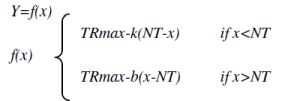
The parameters were determined using the Monte Carlo method, in the optimizing process the sum of deviation square was minimized. The correct conformation of the functions was determined by the greatness of the R-value and the standard error. We found that during six years of testing, the tendency of fertilization efficiency was similar in the case of both hybrids. There was an unfavorable weather interval and, in these years, the yields were low, fertilization did not have an effect and moreover, in extremely bad conditions resulted in an obvious yield decrease. With the improvement of conditions, which in the case of our country means an increase in precipitation, the efficiency of fertilization increases and reaches its peak at 13-14 t/ha. At this point, the yield increasing effect of fertilization is 4-4,5 t/ha. If the yield of the unfertilized treatments increases from 8-9 t/ha, then the efficiency of the applied fertilizer decreases.
Most likely, the k and b parameters depend on the soil of the experimental location (nutrient and water management) and on the amount of pplied fertilizer and the characteristics of the hybrid. With the increase of fertilizer dosage the k-parameter also increases. The greater value though does not obviously mean a more favorable situation. It is true that in medium and good years this means great fertilizer efficiency, but in low or extreme precipitation conditions it also means greater risk. With the increase of the k-parameter, the yield deviation also increases which, from a cultivation point of view, is quite unfavorable. If the value of the b-parameter is other than, zero then the effect is clearly unfavorable, because with the increase of this value, the yield decrease is also greater. The fertilizer reaction of the two examined hybrids can be well characterized by these two hybrids.
Examining the six years, our created model estimated the effect of fertilization on the yield accurately and with a high degree of safety. Both in highly unfavorable and extremely good years, it gave an exact estimate. In our opinion, it can be used well to evaluate the effects of fertilization on yield in the future. -
Changes in the Macro-, Mezo-, and Microelement Contents of Maize Hybrids in Relation to the Level of Nutrient Supply
126-130Views:234n my research, I measured the effect of NPK fertilisation on the macro- meso- and microelements content of maize hybrids in 2001. The experiment was set in the demonstration garden of the Department of Crop Production and Applied Ecology in the Agricultural Centre, at the University in Debrecen. The soil of the experiment is calcerous chernozem soil. Five fertilisation steps were applied. Besides the control the smallest rate was 40 kg N; 25 kg P2O5; 30 kg K2O of active ingredients. The largest rate was five times more than the smallest one: 200 kg N; 125 kg P2O5; 150 kg K2O, which is equal to 475 kg mixed active ingredients. The NPK treatment significantly influenced the macrolement content in several cases. The N content was the lowest in the control treatment. Compared to this the fertiliser treatments significantly increased the N content of hybrids. However the highest amounts of potassium and phosphorus could be measured in the control and the lowest amounts could be measured at the N 200+PK kg/ha treatment.
The Ca content of hybrids was the highest in the N 120+PK kg/ha treatment, while their Mg and Zn content was the highest in the control treatment. The lowest amounts were weighed in the N 200+PK kg/ha treatments, that in several cases resulted in statistically proved decreasement compared to the control or the lower fertilizer doses. Considering the two mesoelements and Zn the most favourable results were obtained in the case of the Norma SC and DK 366 SC hybrids.
Summing up what has been said moderate amounts of fertiliser doses (N 40-120+PK kg/ha) had a favourable influence on the micro- and macroelement content of hybrids. -
Hybrid-specific nutrient and water use of maize on chernozem soil
51-54Views:242The field research was set up on chernozem soil at the Látókép AGTC KIT research area of the University of Debrecen. The study focused on yield, water utilization, nutrient reaction and the amount of yield per kg fertilizer of corn hybrid NX 47279 in 2011 and 2012. Based on the yield results it can be concluded that the largest yield in 2011 was 15 963 kg ha-1 at level N120+PK, while in 2012, the maximum yield amounted to 14 972 kg ha-1 at level N90+PK. Surplus yield per kg fertilizer proved that in 2011 level N30+PK resulted in the highest surplus yield (42.3 kg kg-1) compared to the control treatment. In 2012, yield growth was 18.0 kg kg-1 compared to the control treatment. We measured at level N60+PK 17,5 kg kg-1 compared to at level N30+PK, at the N90+PK 17,7 kg kg-1 compared to at level N60+PK. level N30+PK kg kg-1, 17.5 kg kg-1 at level N60+PK and 17.7 kg kg-1 at level N90+PK compared to the control treatment.
Results of the regression analysis showed that the amount of nitrogen fertilizer was 117 kg ha-1 in 2011 and 111 kg ha-1 in 2012 in order to reach maximum yield. Doses of fertilizers above the amounts previously mentioned resulted in yield decrease. Our results indicated that in the drought year of 2012 the hybrid used available water more efficiently than in 2011. The hybrid produced 59 kg ha-1 yield in 2012 and 51.9 kg ha-1 in 2011 at an optimum nutrition level.
-
The effect of different compost rates on the yield of ryegrass (Lolium perenne L.)
95-98Views:393Protection of natural resources and sustainable natural resources management are essential for the long-term survival of humanity. This makes necessary nowadays the development of environmentally conscious living and spread of that in the future. The amount of organic waste materials, produced during human activities, could be decreased by composting instead of dispose them in landfills. Applying appropriate treatment technology and additives, the compost could be used as fertilizer for horticultural crops and it could increase the easily available nutrient content of soils. Compost utilization prevents nutrient deficiencies and by using the optimal rate, we could reach significant yield increases.
-
Land use, water management
81-87Views:773Due to the prognosed population increase to 9.2 billion people by 2050, the world’s crop production does not have any other chance than to increase production. This demand is a huge challenge for agriculture. Based on the forecasts, the growth rate of production of the main cereals will decrease as a result of the effect of soil, water, the increasing fuel and fertiliser prices and the impacts of climate change. Methods ensuring sustainability have to be preferred. Precision agriculture is the most effective method of crop production. We have to apply minimum cultivation in order to protect the soil surface, maintain its moisture content and increase its water reception ability. In addition to the localised use of fertiliser, sowing seed, irrigation and pesticides, it is also important to apply them in a targeted way on the basis of plot imaging. The use of the new technology results in significant cost saving and it could also reduce environmental load.
-
The effect of sowing date and plant density on the yield of maize (Zea mays L.) under different weather conditions
205-208Views:748Maize has high productivity and produces huge vegetative and generative phytomass, but this crop is very sensitive to agroecological (mainly to climatic, partly to pedological conditions) and agrotechnical circumstances. In Hungary, maize is grown on 1.1–1.2 million hectares, the national average yields vary between 4–7 t ha-1 depending on the year and the intensity of production technology. The longterm experiment was set up in 2015–2016 on chernozem soil in the Hajdúság (eastern Hungary). The maize research was set up on chernozem soil at the Látókép MÉK (Faculty of Agricultural and Food Sciences and Environmental Management) research area of the University of Debrecen. We examined the following commonly used hybrids of Hungary: SY ARIOSO (FAO 300), P9074 (FAO 310), P9486 (FAO 360), SY Octavius (FAO 400), GK Kenéz (FAO 410), DKC 4943 (FAO 410). The experiment was set up in three different plant densities. These were 60, 76, 90 thousand plant ha-1. The experiment was set up with three different sowing dates, early, average and late sowing. The yield was measured using a special plot harvester (Sampo Rosenlew 2010), measuring the weight of the harvested plot and also taking a sample from it. As a next step, we calculated the yield (t ha-1) of each plot at 14% of moisture content to compare them to each other. We evaluated the obtained data using Microsoft Excel 2015.
-
The dual function of soil: natural resources and production site
5-19Views:218First, we begin with a review of the global situation, followed by a description of that in Hungary itself. Next, we consider the conditions affecting soil utilization, and their relevant problems. Finally, we make a brief prediction of what can be expected in the coming two decades or so. For this latter reason, it is necessary to briefly illustrate the situation, processes and relationships.