
Évf. 7 szám 2 (2020)
Megjelent
szeptember 8, 2020
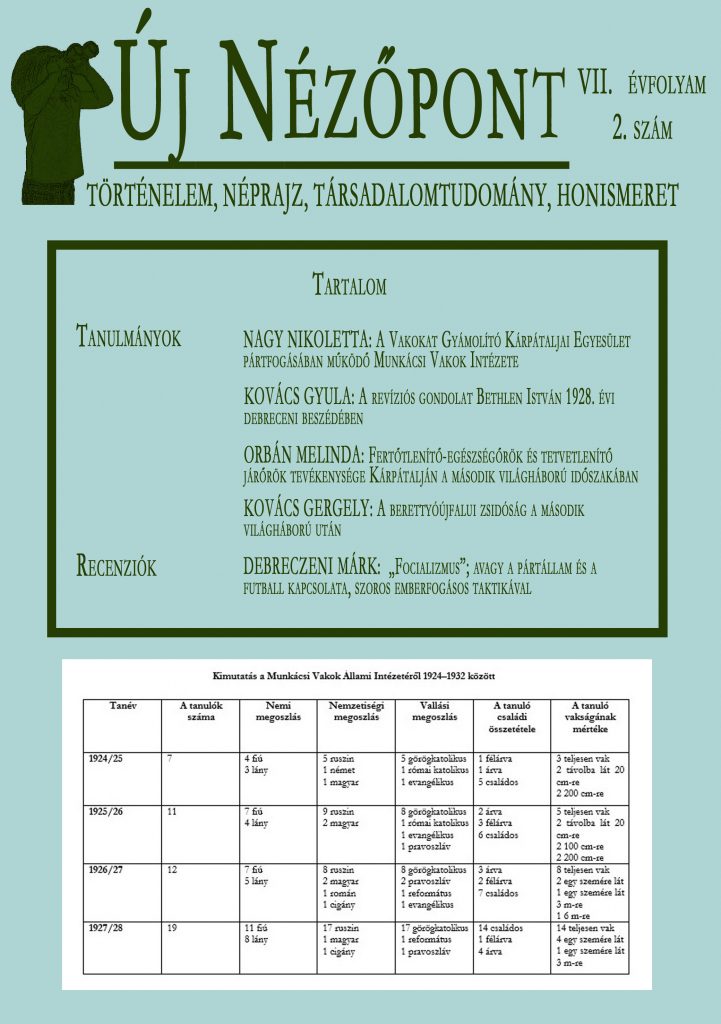
##issue.tableOfContents##
Tanulmányok
-
A Vakokat Gyámolító Kárpátaljai Egyesület pártfogásában működő Munkácsi Vakok Intézete
5-18Megtekintések száma:1Caring for the blind has always been an important part of the life of a society. This task was also performed by the Podkarpatská Ruszi (later Transcarpathian) Association for the Protection of the Blind. At the Munkács Institute for the Blind, operating under its wings, in grades 1-4, blind children were educated and those over 15 who had fallen out of state care were patronized. However, the association considered it important to support and provide occasional assistance to the disabled, the sick, the elderly and their family members. Under the patronage of the association, the Munkács Institute for the Blind grew into a nationally renowned girls' institute by 1941, and continued to operate uninterrupted until the fall of the Soviet troops occupying Transcarpathia in the autumn of 1944.PDF0 -
A revíziós gondolat Bethlen István 1928. évi debreceni beszédében
19-24Megtekintések száma:0István Bethlen's speech in Debrecen in March 1928 was an important event in the Hungarian revision policy between the two world wars. Among the foreign policy conditions that became more favourable at the end of the decade, the humble tone of the Prime Minister changed. In this speech, he formulated a demand for a more proactive revision policy by the Hungarian government. In the study, I covered the antecedents of the speech, and examined its content and most important ideas. My article focuses primarily on the statements in the speech that marked a shift from the cautious revision policy of the period 1920–1927, setting the tone for the foreign policy events of the 1930s.PDF0 -
Fertőtlenítő-egészségőrök és tetvetlenítő járőrök tevékenysége Kárpátalján a második világháború időszakában
25-35Megtekintések száma:1In this study, I would like to describe the activities of disinfection health guards and delousing patrols. The research was based on documents kept in the Beregszász Department of the Regional State Archives of the Transcarpathian Oblast, and on the collections of the Hungarian National Archives and the National Széchényi Library. The disinfectant health guards performed a preventive, monitoring, control and executive service in public health, epidemiological, trade fair and market policing matters referred to the authority of the district. Delousing patrols often performed their duties in the affected settlements, and continued to be active – during the epidemic-free period – for prevention purposes. Despite the disinfectant work done under difficult conditions, the expected results were achieved, as shown by the reduction in the number of infections.PDF0 -
A berettyóújfalui zsidóság a második világháború után
36-51Megtekintések száma:0The elaborations of the history of rural Jewry in general can be claimed to be clearly defined by the Holocaust. The property and partly legal retaliation of the pre-Soa period, followed by the return, resumption, and disappearance of the surviving Jewry from the rural society, is usually only briefly mentioned in the works written about it, as an aftertaste of the events of the emergency. In this study, I present these less researched resources of the disappearance of the Jews from Berettyóújfalu, comparing it with another Hajdú-Bihar county town, Hajdúnánás. At the end of the war, a small number of local Jews returned home deprived of their families. A few tried to restart their lives in Berettyóújfalu, but there were others who never returned to their birthplace. Some of them tried to reorganize their lives in the land of their ancestors, then called Palestine, later Israel. In my study, I am talking about the vicissitudes of those who stayed for a while in the hope of a new beginning, but later, having experienced the communist dictatorship, left.PDF0
Recenziók
-
„Focializmus”; avagy a pártállam és a futball kapcsolata, szoros emberfogásos taktikával
52-59Megtekintések száma:1PDF0
Adatbázis logók



Lapszámok éves bontásban
2026