
Évf. 5 szám 1 (2018)
Megjelent
május 1, 2018
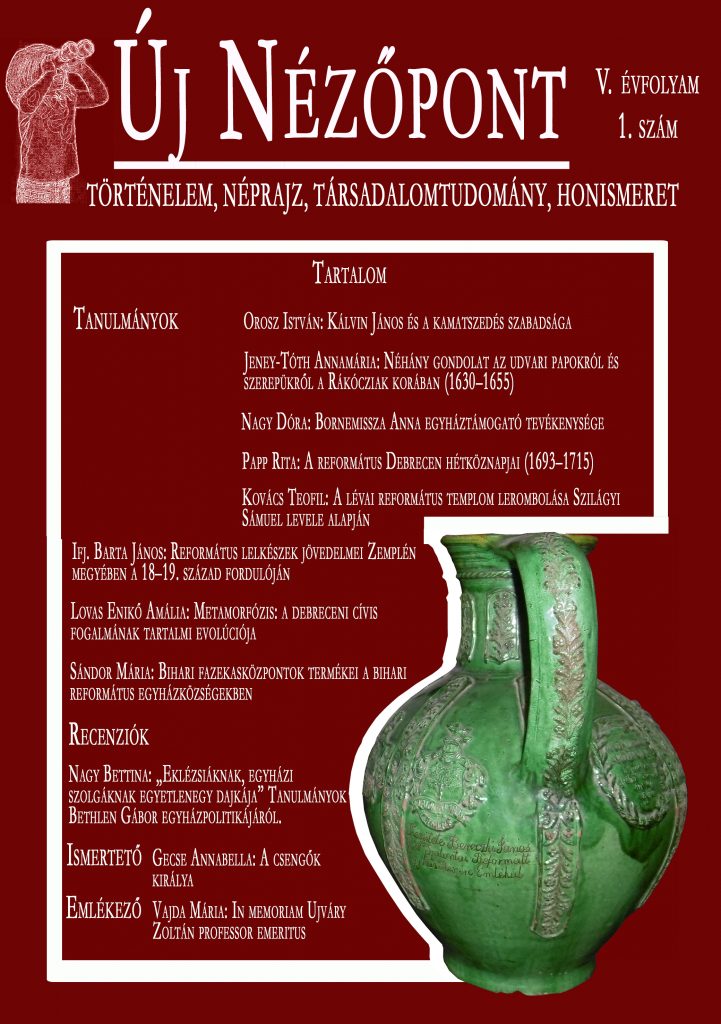
##issue.tableOfContents##
Tanulmányok
-
Kálvin János és a kamatszedés szabadsága
5-16Megtekintések száma:0On 7th November 1545, Calvin wrote a letter to a(n unnamed) friend, which has been included in the publication of all his works by the title “De usuris” (About the interestrate). The current study analyses this letter as the most comprehensive summary of Calvin’s judgement on interest rate. It is a well-known fact that based on statements in the Old Testament and the New Testament (Deut. 23/19, Luke 6/35), he not only banned thecollection of interest, but he did also not differentiate between interest and extortionate. The prohibitions of the Early Middle Ages were confirmed by the scholastic Fathers of Church as well as the legislation of the Synod, referring to Aristotle. (Corpus iuriscanonici, II. Lateran synod, 1139. The principle of “pecunia pecuniam parare non potest” was, however, infringed between the 13th and 16th Centuries in a number of ways. Basically, the collection of interest was disguised as ship loans (nauticum foenus), bills (cambium), and reverse bills (ricorsa), orbusiness deposit (depositum). All these, however, did not change the standpoint of the Church, even though they were widely used. Pope Gregory IX declared shipping loan extortionate already in the 13th Century; and deposit was condemned by V. Pius even in 1571. Most of the 16th Century Reformers shared similar views and did not approve collecting interest. Luther stuck to the principles of the Canon Law and condemned those that had not paid their debt referring to the prohibition of usury, while his opponent, Johannes Eck, argued for the collection of interest. The above-mentioned letter of Calvin meant a decisive turning point, and it made unnecessary for his followers to disguise the collection of interest in the usual formats. Following the ’sola scriptura’ principle, he denied the validity of the statements of the Fathers of Church claiming that money did not bear money. The sea or the earth did, it was only money that did not? And analysing the words of the Holy Bible (examining not only Moses and Luke, but the psalms and prophets, too), he concluded that “there was no evidence in the scripture regarding the fact that all interests would be censurable”. In this respect, it is not advisable to tie our conscience more than God wants us to. He still doesnot support if someone pursues lucre with interest as a job. He mentions seven exceptions that have to be kept when collecting interest, including the justness of the lender or that one should not ask for more interest than allowed by “the laws of the country or the location”. All this refers to the fact that he separates lawful interest from extortionate for the first time, and he also differentiates loan for the purpose of consumption from loan supporting the purpose of enterprise – he only does not approve the first case.PDF0 -
Néhány gondolat az udvari papokról és szerepükről a Rákócziak korában (1630–1655)
17-32Megtekintések száma:0In this study, I first analyse the population of the court and in that, the notion of thecourt preacher; and then I present, through the life of some former court preachers, what sociological background and qualifications the preachers here should have had, and what expectations had been there towards them. (The monarchs of Transylvania belonged to the Protestant confessions from 1604 till 1690, although this did not apply to all but most of their family members.) How did this change by the Rákóczi era? In what do and do not István Geleji Katona, Pál Medgyesi, György Csulai, János Dali, and Pál Keresztúri Bíró resemble their predecessors? Did their role change between 1630 and 1660 as opposed to the era of Gábor Báthory – Gábor Bethlen – Catherine of Brandenburg? This study aims to find the answers to these questions.PDF0 -
Bornemissza Anna egyháztámogató tevékenysége
33-44Megtekintések száma:0Anna Bornemissza, Princess of Transylvania found it important to aid the Reformed Church. Not only did she aid the church together with her husband, Mihály Apafi I, but she also continued this activity on her own. As a Patrone, she payed particular attention to the Reformed schools. This meant aiding the institution and the teachers, as well as some students. She meant to facilitate education and the spread of Reformed tenets by aiding book publishing. According to the sources, the monarch dealt with the election of the preachers of the estates subject to her supervision, she contributed to their salary in terms of material benefits, as well as benefits in kind. In her estate in Fogaras, she maintained a spital, where she gave food to the needy. Being the First Lady of Transylvania, the role of the Patrone was one of her duties on the one hand, and on the other hand, it was her volunteer task because of her deep religiousness. The presentation of her activities is very timely in the memorial year of the Reformation. -
A református Debrecen hétköznapjai (1693–1715)
45-56Megtekintések száma:0In my study, primarily based on the city’s magistrate reports, I aim to present how the administrative body of the city guarded the population in Debrecen around the turn of the 17th–18th centuries, being careful to be living a moral life that God likes. I include, but do not limit to the following in my enumeration: what tools they had and what penalty those faced that left the path considered right. I emphasize instances from the same sources that explain how belief and religion was present in people’s everyday life. In the introduction, I recall what role the city’s former preacher, Péter Méliusz Juhász played int he establishment of the moral rigor.PDF0 -
A lévai református templom lerombolása Szilágyi Sámuel levele alapján
57-71Megtekintések száma:0During the period of the Counter-Reformation, religious tension manifested even in connection with the ownership of churches. After the publication of the Carolina Resolutio II. in 1734, the taking away of churches was on the rise. This meant, for instance, in thecase of Győr, Pápa, Tata, Léva, Balassagyarmat and Fülek, that the official reason was that these settlements lost their identity as fortresses after the expulsion of the Turks. Even before the 18th century, the city of Léva experienced lots of religious conflicts. The ducal branch of the Esterházy family wanted to control the privileged city by jurisdiction, because of which the relationship between the lordship and the population was tense. Certain religious disagreements also occurred in the debate. The Calvinist Church of Léva was confiscated in 1719, and worship was banned. However, this was renewed, and the preacher of the time was cleared out only in 1739. The church, the school, and the building of the preacher’s house remained under the control of the congregation, they were demolished in 1740. I present these events through a letter written by Sámuel Szilágyi, the Protestant Hungarian agent of Vienna, on 16th July, 1740. From Szilágyi’s letter, it becomes clear that the events that happened in Léva becamenation-wide known. The notorious start of the demolition of the church in Léva wasmost probably initiated by the fall of part of the wobbly fence around the church in May 1740. The fence was restored by the Calvinists. This was considered an innovation by the administrator of Duke Esterházy, called Ferenc Birovszky, who, with a hundred odd of his men, cut the whole fence on 16th of the same month. The bell was tolled by the Calvinists, which was followed by quarrel and even a fight. The Calvinists interpreted this whole event the violation of the imperial decree about their religious freedom. After the incident, they took the opportunity to go into the church, toll the bells and hold a mass, although only singing and praying from a book, and without a preacher. This was no wise step in this extremely tense situation. First, they were interdicted by the judge of the county, and then by the deputy-lieutenant. The Calvinists’ answer was that they sent ambassadors to Vienna, and they were waiting for the imperial reply. The church, the school and the parsonage – together with the belfry – was demolished on 17th June 1740, the bell was taken and everything was confiscated by the men of the administrator. The Calvinist presented the letter of defence of Charles III in vain, even the noble received harsh atrocity and imprisonment. The present study uses archive resources to show what was it – on the local level – that had been behind such an event. Here, it seems that not the priests of the Catholic Church, but the administrator of the Catholic squire was who had initiated the events.PDF0 -
Református lelkészek jövedelmei Zemplén megyében a 18–19. század fordulóján
73-85Megtekintések száma:0The income of priests and teachers in Hungary became important for the state power when it wanted to impose tax even upon privileged groups that had up until then been exempt from state burden. Joseph II’s plan could eventually not be realized because of the resistance of the nobility, there had been attempts to demolish even the sheets of cadastral research. However, it turns out from the fragments preserved in Zemplen county that the Calvinists had 143 cadastral acres and 666 square feet of self-managed land. The census measuring the income of the different layers of society estimated the income of Calvinist priests to be 1515 Rhenish Guldens.The income of priests can be divided into 3 main groups: they had allowances determined in monetary terms (payment, stole, deposit interest), they had crop yield (mostly cereals, wine, cattle, hay, wood), and the villagers also owed agricultural work to their priest. Sometimes even the holder of the settlement contributed to the catering of the churchof the village, the priest, or the preacher (with produce). Although the censuses of priest income primarily showed the crop yield – according to the actual benefits –, with a fewexceptions, it was recalculated to cash. Comparing the data in the two censuses, it can be seen that, in most cases, the ploughland included in the cadastral research meant only part of the parochial land that the ecclesiastical tracking kept account of on the side of priests or teachers. Similarly, only part of the ecclesiastical income was allowed to be included in the tracking made in 1800. This was because it soon turned out that the income of priests could not necessarily be included in either of the income categories contained in the tracking, so they needed to be tracked in different ways (most often exactly stating their type and extent). The incomes stated in the two censuses were in most cases the same, supporting the authenticity of the resources. It can be considered a curiosity that out of the 46 Calvinist priests mentioned in the 1800 tracking, there are 36 names with the note “Does not have anything”, which of course verified the fact that they were not possible to be added to categories, rather than that there was income deficit. Even though the data contained in the two resources are not the same in every respect, they more or less supplement each other, so the research cannot ignore either of them.PDF0 -
Metamorfózis: a debreceni cívis fogalmának tartalmi evolúciója
87-99Megtekintések száma:0The notion of the ’Cívis’ is, for most people, some gossiped, unique Debrecen specialty. In fact, only a few think its real meaning, its origin, its local uniqueness over, and what changes this expression has gone through over history. This article tries to analyse this issue in a comprehensive manner, so that we can gain insight into who we really call a ’Cívis from Debrecen’ nowadays.PDF0 -
Bihari fazekasközpontok termékei a bihari református egyházközségekben
101-124Megtekintések száma:0There were several pottery centres in the historical Bihar county region, all of which look back at a long line of history. However, it is difficult to create a valid picture of the pottery of former centuries, since very few dishes remained in the collections of museums, the place and time of preparation of which is known. Therefore, the vessels of the Lord’s table play a crucial role regarding the research of ceramics, because as they are unique decorative pots, in most cases, their makers left their name, date and place of making on them. These pieces of data might mean a starting point to determine the origins of other pottery without a date, such as the products of the so far little researched pottery centres of Bihar with a long history. In my study, I analyse the vessels of the Lord’s table that were made for the parishes of Bihar in the olden pottery centres of Bihar: Belényes, Mezőtelegd, Oradea, Marghita and Salonta.PDF0
Recenziók
-
„Eklézsiáknak, egyházi szolgáknak egyetlenegy dajkája” Tanulmányok Bethlen Gábor egyházpolitikájáról.
125-128Megtekintések száma:0PDF0
Ismertető
Emlékező
Adatbázis logók




Lapszámok éves bontásban
2026