
Évf. 6 szám 3 (2019)
Megjelent
november 19, 2019
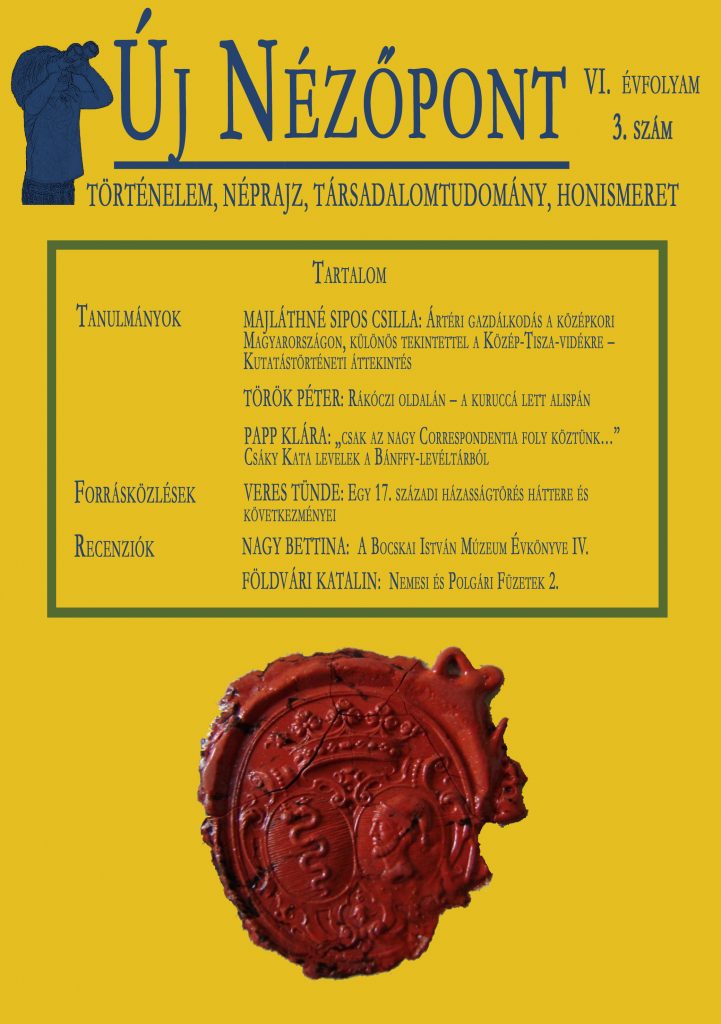
##issue.tableOfContents##
Tanulmányok
-
Ártéri gazdálkodás a középkori Magyarországon, különös tekintettel a Közép-Tisza-vidékre – Kutatástörténeti áttekintés
5-34Megtekintések száma:0Until the beginning of the great river regulations in the mid-1840s, most of the lowland areas were temporarily or permanently covered by water due to the expansive water network of the Carpathian Basin. This natural environment served as the basis of floodplain farming or ‘fok’ agriculture from the age of the Hungarian conquest, which also determined the settlement and economic structure in the Central Tisza region. The present study analyses from the perspective of research history the conditions and role of this multifaceted farming method in the Central Tisza region that can be considered as a floodplain farming area, taking into account the most significant research results to date. Interdisciplinarity is strongly emphasized in the research of the topic: In addition to written sources, topographical, geographic, hydrographic, environmental, legal and local history studies, ethnographic and archaeological studies of the region are also indispensable to answer issues related to floodplain farming.PDF0 -
Rákóczi oldalán – a kuruccá lett alispán
35-63Megtekintések száma:0After the outbreak of the War of Independence, hallmarked by the name of Ferenc Rákóczi II, István Buday (bölsei), who served as the deputy granger of Bihar county between 1688 and 1701, was among the first rebels. In the Tokaj vineyard, he came to the neighbourhood of both Rákóczi and Miklós Bercsényi, establishing the base that provided a loyal and soldier for the revolution. István Buday climbed the ladder quickly: he became court captain, then chief of the Hajdú towns of Szabolcs, and later commander of the regiment of the Hajdú towns. The depths and heights that characterize the war of independence can also be traced in the military career of the former deputy granger. We can examine these in the framework of the present study. István Buday, who served in the War of Independence until his death, was the appropriate type of soldier of the time: he was an underqualified but experienced fortress warrior, participating in raids and smaller campaigns. This paper focuses on the eight years of the War of Independence, with special attention payed to the military career of the captain of the Hajdú towns.PDF0 -
„csak az nagy Correspondentia foly köztünk…” Csáky Kata levelek a Bánffy-levéltárból
64-83Megtekintések száma:0The ten letters written by Countess Kata Csáky (1726–1794) in the Archives of the Bánffy family (Cluj County Directorate of the Romanian National Archives, Cluj-Napoca) are a good complement to the sources published in All My Joys Were Mingled With Sorrow. Kata Csáky’s correspondence in 2006. This study finds the place of the letters in the history of the Count's family on the one hand, and on the other hand, it discloses the writings that have survived as personal resources. It is clear that the Countess sent letters to Dénes Bánffy until 1780, and to her son, governor György Bánffy (1746–1822) in the last years of her life. Kata Csáky made good use of the family relationships, not only considering Dénes Bánffy as a relative, but also as a supporter to whom she could send even confidential news, and whose special intervention she could request. In her letter of 1767, however, she clarified the role of the Bethlen-Csáky relatives in the abduction of Ágnes Bánffy. A sign of intimacy was that the Countess had sought and received personal support from György Bánffy, and so did her daughter, Rozália Bethlen, who expected the governor to “help with all my troubles ...”.
Recenziók
Forrásközlések
-
Egy 17. századi házasságtörés háttere és következményei
84-94Megtekintések száma:0The Municipal Archives of Košice keeps the document containing the verdict of Judge István Csáky that reveals the story of the harassment of a noble woman in 1688. Klára Gatályi had been the wife of Vilmos Draheim, the former chamber prefect, and stood by him even during her arrest in 1685. Three years later, Klára Gatályi was arbitrarily imprisoned by the citizens of Košice. The charge: adultery. Although the text of the examined resource seems to be about the release of a woman of average importance who had been violated in her noble rights, and the self-righteousness of jury citizens in Košice, there is in fact a story in the background that cannot be called a general one. It is a story the event line of which had begun before 1685, and its aftermath could serve as the background to what happened in 1688. Focusing on these antecedents, the present study attempts to explore this part of Klára Gatályi's life and the events leading up to it.PDF0
Adatbázis logók




Lapszámok éves bontásban
2026