Vol. 3 No. 2 (2016)
Published
October 13, 2016
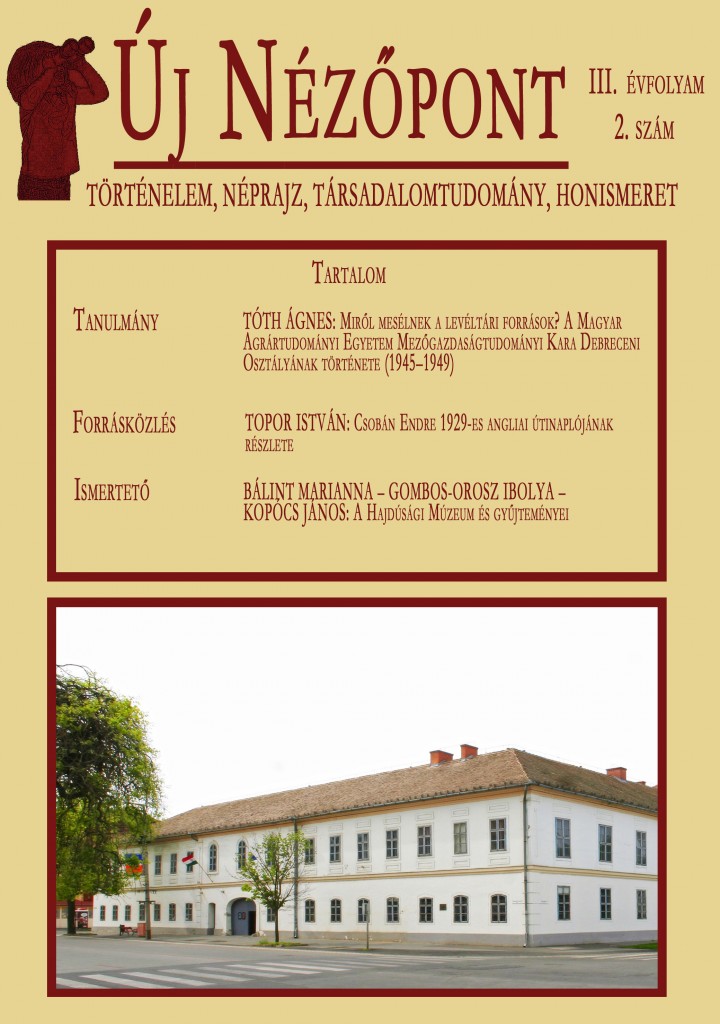
##issue.tableOfContents##
Research articles
-
Miről mesélnek a levéltári források? – A Magyar Agrártudományi Egyetem Mezőgazdaságtudományi Kara Debreceni Osztályának története (1945–1949)
5-23Views:0At the end of 1944, Debrecen became the capital of the country for the second time. The Provisional National Assembly was summoned here, and it established the Provisional National Government. The Provisional National Government's Regulation No. 8740/1945 M.E decided to set up the Hungarian Agricultural University. The university was established in Budapest with four faculties. One of the provincial departments of the Faculty of Agriculture opened in Debrecen on 1 October 1945. The Department of Debrecen faced great difficulties due to serious damages in the appliances as a result of the war. The department was in a constant financial deficit over the four years of its existence. Next to the farm, an experimental field, a horticulture, a poultry farm, an apiary, and a silkworm colony operated. The number of students registered in the department usually ranged from 160 to 260 people. In the Department of Debrecen, The North of Tiszántúl Agricultural Science Research Community was formed with five groups in March, 1949. The Minister of Agriculture terminated the operation of the departments in Debrecen, Keszthely and Mosonmagyaróvár at 12 o'clock on 17 March 1949. This measure was explained by the fact that the countryside departments had a relatively small number of students, therefore, supporting the operation of the high-cost departments was not economical. After a long time, the agricultural training terminated in Debrecen.
Ismertető
-
A Hajdúsági Múzeum és gyűjteményei
43-62Views:0The City Museum of Hajdúböszörmény was opened in 1924, which was a long-awaited event in the city’s cultural life. In 1949, the Museum was declared a public collection and became a scientific institute with full-fledged rights. In 1951, it picked up the Hajdúsági Museum name, and at that time, its first permanent exhibition was opened, which was followed by new ones on the expansion of the museum’s materials. The Museum took its place in the former Hajdú District Hall (which is a historical memorial since 1st January, 2012). As the largest regional museum of Hajdú-Bihar county, its primary task is to collect, preserve and process the material and spiritual values of the six „old” Haiduk towns (Hajdúböszörmény, Hajdúszoboszló, Hajdúnánás, Hajdúdorog, Hajdúhadház and Vámospércs) and to present those to the wider public. In addition, it performs a wide range museum education work, and takes part in the most important events of the museum profession, supported by civil associations and volunteers.
Forrásközlések
-
Csobán Endre 1929-es angliai útinaplójának részlete
25-42Views:0The story of Endre Csobán's trip to England is contained in three small-format pocketbooks, which are stored in The Hungarian National Archives Hajdú-Bihar County Archives. Csobán traveled to London to get acquainted with and learn the essential modern techniques of repairing diplomas in the National Archives of Britain, in the Public Record Office. The passage published here is from the first notebook. He recorded his journey starting from the preparations and the events that happened to him between 27 July 1929 and 16 August 1929 in a 16.5 x 10.5 cm, greenish-brown, cloth-bound, lined booklet. Endre Csobán's diaries are important contemporary documents that provide cultural history, political and literary additives. Moreover, they are also valuable from the point of view of researching and writing personal history, and generally, from the historical psychology side. The the finely toned image of the inner life of the writer unfolds from the entries which portray a man who is receptive about and responsive to the things of the world.
Database Logos



Issues by Year
2026