
Vol. 6 No. 4 (2019)
Published
December 27, 2019
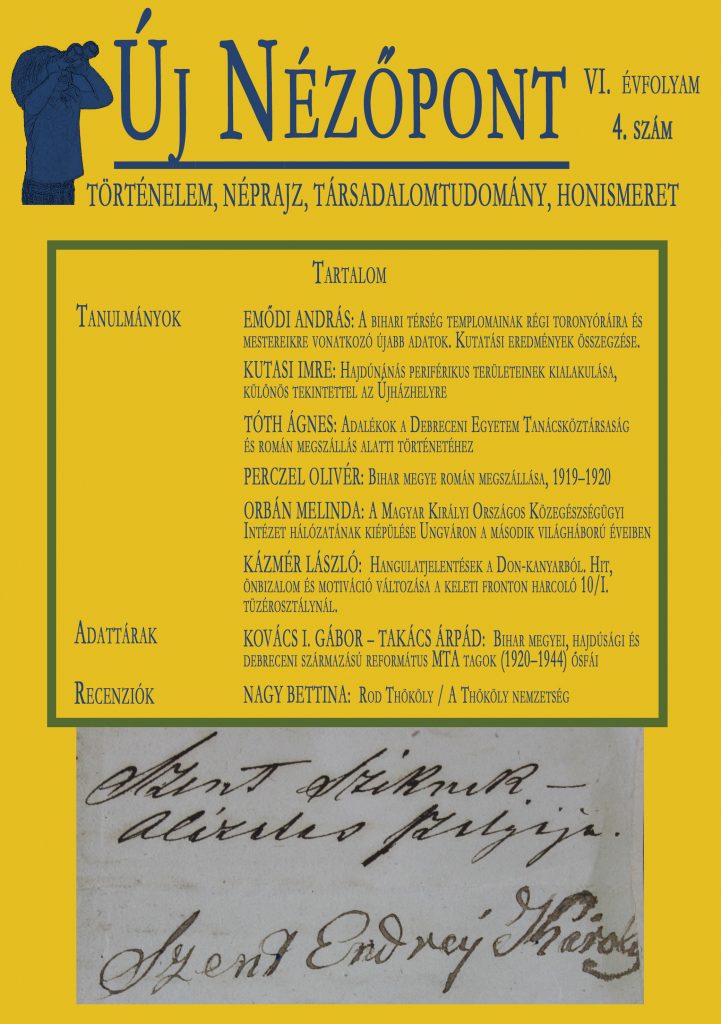
##issue.tableOfContents##
Research articles
-
A bihari térség templomainak régi toronyóráira és mestereikre vonatkozó újabb adatok. Kutatási eredmények összegzése
5-62Views:1This study presents recent data on old church tower clocks – from the 18th-19th century – and their master craftsmen in the Bihar region, as well as a summary of the results of our research in this topic. We recorded data or a series of data on our field trips, as well as on the basis of archival sources, relating to altogether 62 clockworks, and/or identified still existing clockworks and artefacts. Of these, 49 could be linked to a master-locksmith or workshop, which is the main benefit of our research. Most of the surviving artefacts, as well as the work of some of their masters, were largely unknown to the sparse literature on the topic. Significant additions have been made, first of all, to the work of the locksmiths of Nagyvárad (today Oradea – Romania) and Debrecen, as well as of Pankota (today Pâncota – Romania) and Nagykároly (today Carei – Romania). -
Hajdúnánás periférikus területeinek kialakulása, különös tekintettel az Újházhelyre
63-78Views:1In this paper I am trying to present the development of the peripheral areas of Hajdúnánás, with a special attention on Újházhely, which is located on the Northern part of the town. Furthermore, the present study applies and refers to previous works focusing on this area, as well as other sources, such as ethnographic collections, maps of military surveys, manuscript maps, historical sources, aerial photographs, and interviews. One topic might still be questionable, though: whether these areas of the town could be peripheral in other aspects in that specific time interval or not, for instance, in economic or in authority aspects. This is a topic that we should focus on in further research. -
Adalékok a Debreceni Egyetem Tanácsköztársaság és román megszállás alatti történetéhez
79-92Views:1When the Royal couple visited Debrecen on 23 October 1918 to attend the inauguration of the University “Clinic” site, nobody could have predicted that upcoming events would soon shatter the state order of Hungary and fundamentally determine the country’s fate. The town received the news of the monarch appointing Mihály Károlyi as head of government on 30 October. Citizens of Debrecen gathered in front of the Town Hall and demanded the display of the national flag. Soldiers pinned cockades in the national colours in place of their cap badges. The National Council of Debrecen was formed and joined the Hungarian National Council on 1 November. When the Republic of Councils was declared on 21 March 1919 in Budapest, the Directorate was also formed in Debrecen. However, the “glory days” of the Republic of Councils did not last long here, as
Romanian forces occupied the town only a month later on 23 April 1919. When the Romanian occupiers left on 11 March 1920, they left a ransacked and impoverished town in their wake. The University of Debrecen had three faculties in those days, namely the Faculties of Reformed Theology, Law and Liberal Arts. The Faculty of Medicine was under organisation. In October 1919, Béla Sz. Kun, dean of the Faculty of Law initiated an investigation into the conduct of every lecturer and employee of the University during the time of the Republic of Councils. The investigation was later extended to include the period of the Romanian occupation. This study set out to review the public disciplinary proceedings against lecturers non-exhaustively, mainly on the basis of sources in the archives. The author demonstrates through the examples of a number of disciplinary procedures how retaliations happened in the Horthy-period.PDF0 -
Bihar megye román megszállása, 1919–1920
93-109Views:0In our study, we concentrate on the Romanian occupation of the area of Bihar county. For this topic, we have used documents of deputy-lieutenants, and death records from the settlements of the county, the press data from Oradea and Salonta in Hungary, as well as the local history literature. For the time being, we have not been able to examine Romanian resources, so the occupation can only be described on the basis of Hungarian archival documents. We briefly discuss the conflicts in the region and their consequences, and we present everyday life. -
A Magyar Királyi Országos Közegészségügyi Intézet hálózatának kiépülése Ungváron a második világháború éveiben
110-123Views:0In Hungary, raising the standards of public health and immunization against certain infectious diseases began in the 1930s. The Royal Hungarian National Public Health Institute and the related institutional system played an outstanding role in this process. The primary mission was to diagnose and research communicable diseases. Therefore, a public health, a disinfection and infectious supplier, a malaria station and a vaccine production institute were established in Ungvár. The tasks included research, healing, counselling, defence and experimental work. Researchers at the institutes developed vaccines and new methods of diagnosis that were introduced later. As a result, the proportion of infectious diseases in the country decreased. -
Hangulatjelentések a Don-kanyarból. Hit, önbizalom és motiváció változása a keleti fronton harcoló 10/I. tüzérosztálynál.
Views:1In the great narrative of World War II, the individual soldiers become obscured. Behind the summarizing and almost statistical figures, there are unfairly marginalized individuals who bore the collision of large spheres of interest. Therefore, it is important to examine military events from other angles than just the wide-angle optics of leading events. In my study, I seek to explore the problems of battalion 10/I commanded to the Eastern Front in 1942, which might have affected their level of ambition. For this, I use mood reports and relevant logs recorded by the battalion commander. Of these, I group the revealed ideas based on subject matter, and then attempt to draw conclusions based on the relationships between them. My main aim is to determine the mental state of the subordinates and the factors that influence them from the perspective of the sub-commander. This is interesting because in an autocratically organized, hierarchically structured violence organization, one-man leaders are responsible for everything they have done or failed to do. Paradoxically, it is in the interest of a commander to flatter them in the eyes of senior executives, so that this can issue a positive “certificate” of themselves, too. The study contributes to the expansion of knowledge regarding the military history of the 2nd Army of Hungary, and it also helps the development of the knowledge of today’s military leaders, making it easier for them to understand the moral changes taking place in the subunits.
Recenziók
Database Logos




Issues by Year
2026