
Vol. 5 No. 4 (2018)
Published
December 30, 2018
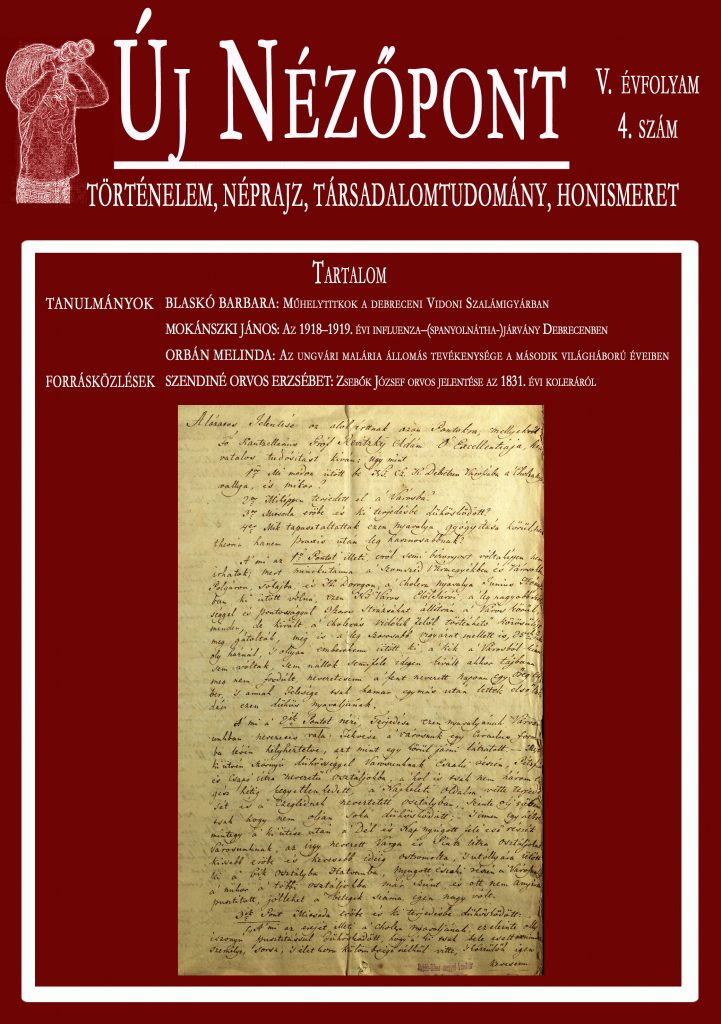
##issue.tableOfContents##
Research articles
-
Műhelytitkok a debreceni Vidoni Szalámigyárban
5-22Views:0The owners of Debrecen’s largest salami factory arrived to the city from the Italian Friuli, and brought with themselves from there not only the methods of making salami, but also the salami makers working in their factory. The workshop secrets of Vidoni lay exactly in these: procedure and craftsmanship. However, we should not forget about the local facilities that made production possible. The data, memoirs and interviews recorded in the era reveal the everyday life of the factory, the suppliers, and pastoral pig slaughters, all of which reflect the relationship between the factory and the countryside. Besides this, they provide information that other types of resources cannot provide. The aim of the study is then to present the factory from a new perspective, focusing on itseveryday life and the production process of the famous Vidoni salami. -
Az 1918–1919. évi influenza–(spanyolnátha-)járvány Debrecenben
23-40Views:1In 1918, the last year of the First World War, the Spanish flu epidemic, which spread worldwide and claimed the life of millions, reached the city of Debrecen. Based on the contemporary local newspapers, Debreczeni Ujság (News of Debreczen) and Debreczeni Független Újság (Intependent News of Debreczen), as well as Mayor and Chief Medical Officer reports, it is possible to outline how the city tackled the disease, what defense strategies were applied and how effective they were. In addition, the death registers reveal which social strata were most afflicted by the disease. In the study, I present the (primarily) press-based story of the Spanish flu pandemic in Debrecen on the one hand, and on the other hand, I use the quantitative methods to link up the statistics on victims. Based on all these, the question can be answered: How serious was the 1918 flu epidemic in Debrecen? -
Az ungvári malária állomás tevékenysége a második világháború éveiben
41-54Views:0From the 1920s-1930s, studies aiming to get acquainted with the biting mosquito fauna in Hungary were intensified. The endemic incidence of malaria particularly affected the Southwestern and Northeastern parts of the country. Because of this, several malariastations were set up during the Second World War, in the Transcarpathian area: in the city of Uzhhorod (Ungvár) and Beregszász. The Uzhhorod Station started its activities in February 1940. Their duties included the education of the public, the development and application of defense methods of the time, and the medical treatment of patients. In order to achieve the natural mosquito clearance, Gambusia affinis fish were installed in the deeper brickyard pits. Due to their insecticidal effect, methyl green and naphtha derivatives were used as chemical agents. In the more affected settlements, terrain and water management works were carried out after mapping the terrain, which affected swampy and riverbed areas. The stations contributed to eradicating the problem, but it was possible to suppress the endemic presence of malaria only by the early 1950s.PDF0
Forrásközlések
-
Zsebők József orvos jelentése az 1831. évi koleráról
55-86Views:1The cholera epidemic of 1831 came to Hungary from Galicia that belonged to the Austrian Empire. The epidemic broke out in Debrecen on 24th July 1831, and claimed thelives of 7.4% of the city's population, or more precisely, 2152 people. The resources detailing the events of the Cholera epidemic in Debrecen can be read in the Hajdú-Bihar County Archives of the Hungarian National Archives. This study presents the report of József Zsebők that shows in more detail the local event from the outburst of the epidemic to the release of the quarantine in October. The highly detailed report by Ádám Reviczky, General Chancellor, presented on 9th December 1831, nicely reflects what the contemporary medicine thought about the cholera disease and how they tried to cure it. This resource is essential not only from a point of view of local history, but also from a medical historical point of view, as – besides exploring the characteristics of the disease – it provides an authentic picture of the medical conditions, medical treatments, and even of the medicines of the time. In the bibliography, modern transcription was used, preserving the characteristic features of language or dialect.
Database Logos




Issues by Year
2026