
Vol. 13 No. 1 (2026) Current Issue
Full Issue
##issue.tableOfContents##
Research articles
-
Discourses around the Great Hungarian Plain in Early 19th-Century Travelogues
1-25Views:5Through examining Hungarian travel literature from the first half of the 19th century, the present
paper aims to explore the representations of the Great Hungarian Plain and the discursive transformations
surrounding it. Its premise is that travelogues are not merely descriptive sources, but
texts produced at the intersection of contemporary spatial perception, aesthetic norms, and the
formation of national identity, that transform the landscape into a culturally mediated experience.
The paper's central thesis is that the image of the Great Hungarian Plain underwent a significant
discursive transformation from the beginning of the century to the end of the Reform Era: the
plain, initially characterized by negative aesthetic terms (emptiness, monotony, formlessness),
gradually became one of the privileged spatial embodiments of national identity.
The study concludes that travelogues from the early 19th century depict the Great Plain not simply
as a geographical space, but as a complex mental and cultural construct. These texts contribute to
the formation of a national conception of space in which the Great Plain appears both as a periphery
and as a centre, a paradoxical territory of freedom and exposure, familiarity and alienation. -
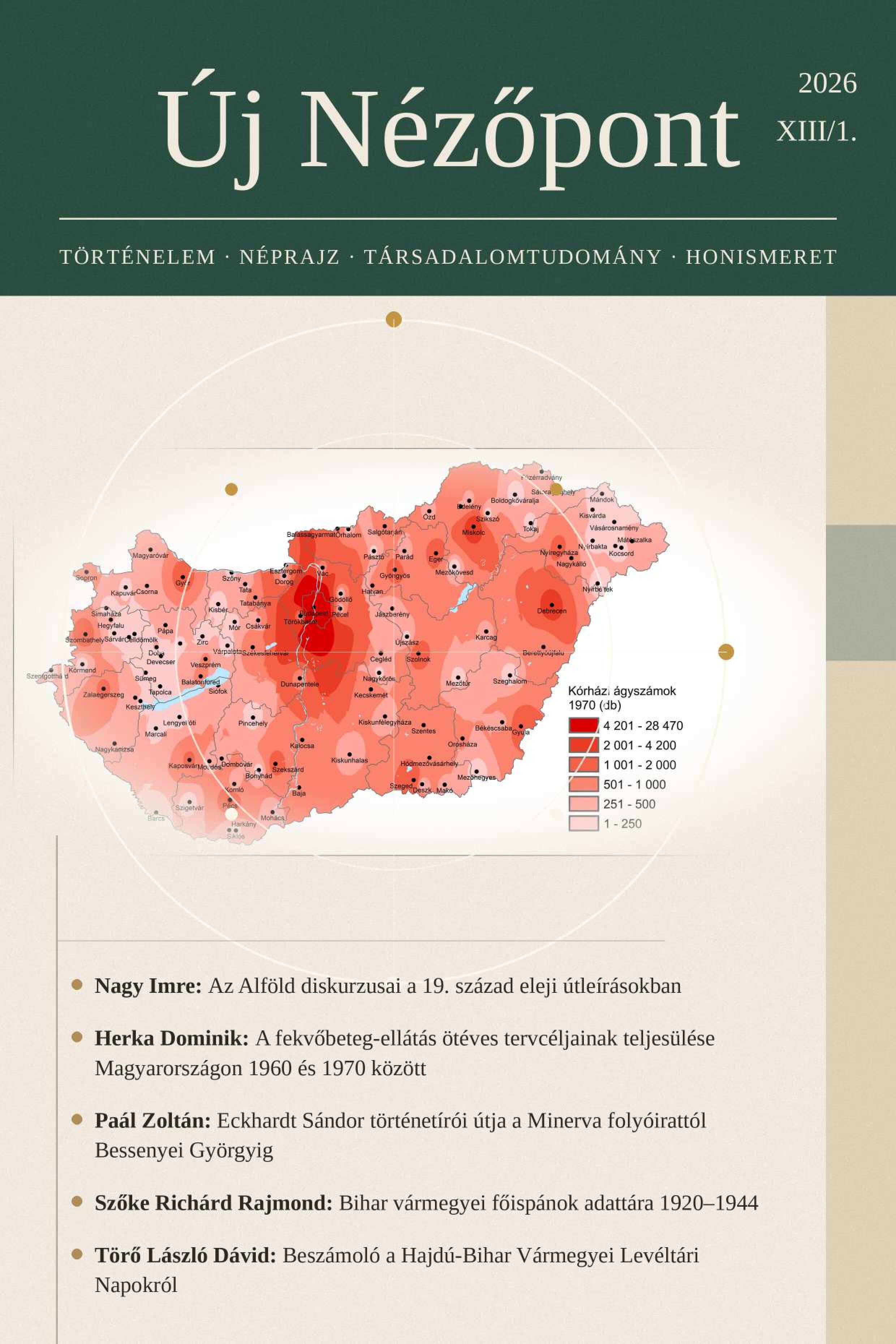
The Fulfilment of Five-Year Plan Objectives for Inpatient Care in Hungary, 1960–1970
26-47Views:3After 1945, the hospital care system had to be rebuilt and substantially expanded, as the health
insurance system was being extended. The paper examines the extent to which the targets set
during the second and third five-year plans were achieved, how the availability of hospital beds
differed between Budapest and rural areas, and what characterized the geographical distribution
of hospital beds. These questions are addressed using a comparative approach (by comparing the
planned objectives with their actual outcomes) and cartographic methods. The objectives of the
plan ending in 1965 were largely achieved, though the construction of new hospitals was the area
in which the targets were least successfully met. However, in the third five-year plan ending in
1970, there were shortfalls in almost every area. The ratio of general hospital beds between Budapest
and rural areas decreased from three-to-one to two-to-one, although the significance of this
change is context-dependent. Furthermore, mapping hospitals and bed numbers revealed which
areas were experiencing bed shortages. -
Sándor Eckhardt’s Historical Journey: From the Minerva Journal to György Bessenyei
48-57Views:3The present study examines the phase of Sándor Eckhardt’s career as a historian associated with
the journal Minerva during the first half of the 1920s. Throughout this period, Eckhardt primarily
worked as a member of the Minerva Society and as a contributor to the journal. The aim of this
paper is to interpret the theoretical writings published there within the narrower context of the
journal as well as within the broader framework of European historiography. Special attention is
given to studies on the Enlightenment and the ideas of the French Revolution, as well as to texts
related to György Bessenyei that, although not published in Minerva, fit organically into the contemporary
discourse on the Enlightenment.
Databases
-
Database of the Lord Lieutenants of Bihar County, 1920–1944
58-69Views:4During Miklós Horthy’s regency, the administrative structures of the counties and municipally
autonomous cities retained the structures established during the Dualist period, headed by lord
lieutenants. This structure remained in place until the introduction of the Soviet-style council system
in 1950. In the case of Bihar County, attempts have previously been made to identify the lord
lieutenants who held office between 1920 and 1944. However, the studies published to date have
not yielded satisfactory and comprehensive results. The present paper therefore draws on official,
state-published sources to identify the individuals who held this position during this period. In
addition, supplementary biographical and administrative data suitable for comparison are also
provided: the lord lieutenants’ dates and places of birth, religious affiliations, dates of appointment
and resignation, as well as their previous and subsequent administrative or political roles.
News
-
Beszámoló a Hajdú-Bihar Vármegyei Levéltári Napokról
70-73Views:5Az 53. Hajdú-Bihar Vármegyei Levéltári Napokat 2026. május 19–20-án rendezték
meg Debrecenben. Az eseményt az MNL Hajdú-Bihar Vármegyei Levéltára, valamint a
Debreceni Egyetem Egyetemi és Nemzeti Könyvtára szervezte. A rendezvény központi
témája a levéltári innovációk, a mesterséges intelligencia alkalmazása, valamint a kvantitatív
történetírás új lehetőségei voltak, de a történelem anyagiságának tapasztalata is viszsza-
visszatérő eleme volt az előadásoknak.