
Vol. 73 No. 1 (2024)
Published
March 31, 2024
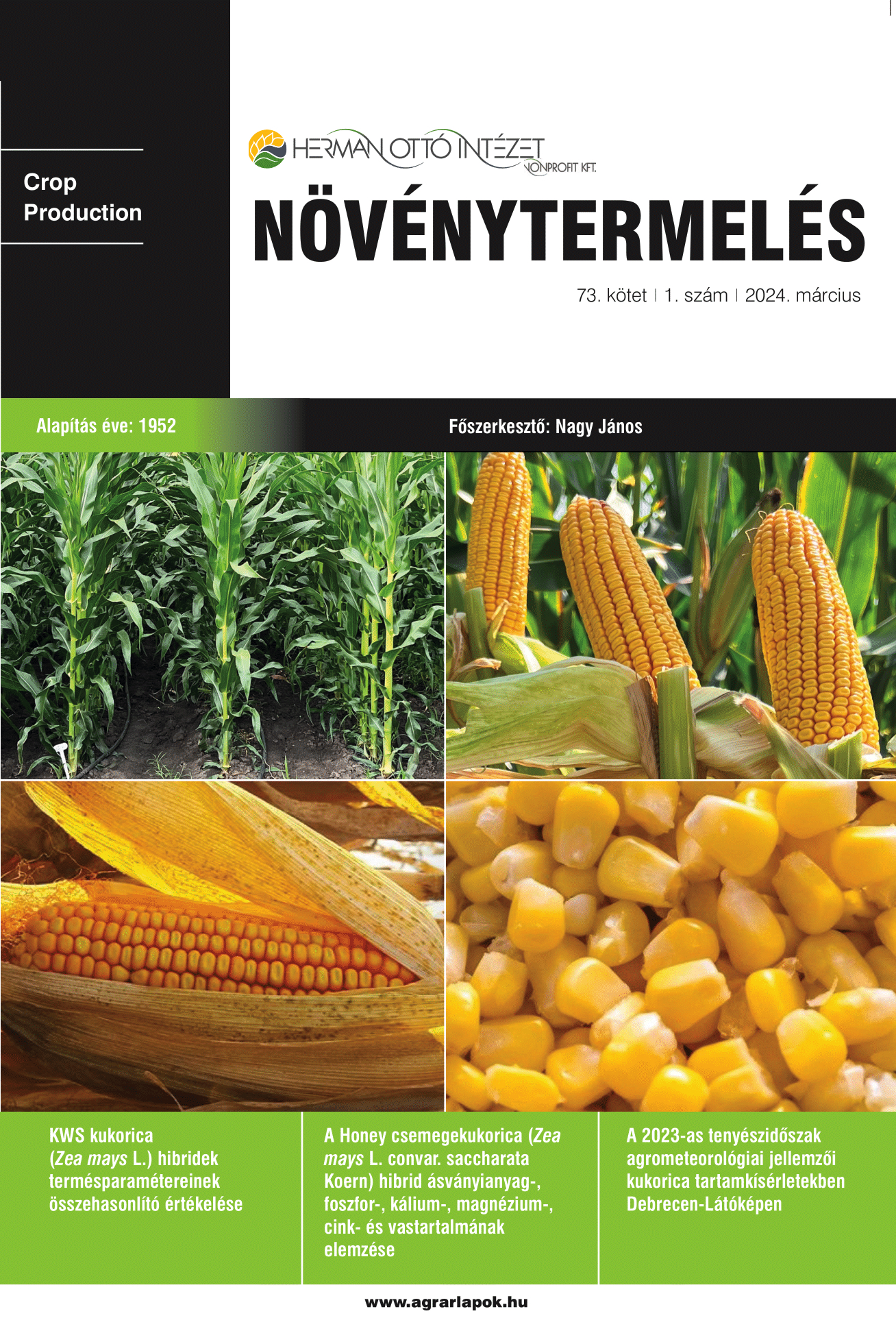
##issue.tableOfContents##
Folyóiratcikk
-
Comparative assessment of the yield parameters of KWS maize (Zea mays L.) hybrids
7-20Views:137Breeding maize hybrids is a slow and expensive process. Maize hybrids perform differently under different environmental conditions and agricultural management practices, making hybrid selection one of the most important management decisions for maize growers. Choosing the right maize hybrid with high yield potential for the location can improve profitability, grain yield and quality at harvest.
The experiment was carried out at the University of Debrecen Institutes for Agricultural Research and Educational Farm (AKIT), Debrecen Agricultural and Landscape Research Institute (DTTI), Látókép Crop Production Experimental Station to evaluate the yield parameters of three maize genotypes with different maturity (FAO 350, FAO 400 and FAO 460). Our studies evaluated the yield, quantitative and qualitative characteristics of maize hybrids and the yield determinants of yield.
In terms of yield, in the "potential" field experiments, the excellent FAO 400 maturity maize hybrid KWS FORTURIO achieved a peak yield with a record value of 20.05 t/ha, which exceeded the yield of the other genotypes tested by 12.29–14.83%, a significant difference.
Significant differences in starch content were measured among the tested hybrids, with the highest result obtained by the FAO 350 maturity KWS OLTENIO hybrid with 63.78%.
Based on our analyses, we found that some quantitative and qualitative yield traits are genotype specific, which results support the importance of selecting the most suitable maturity genotype for the production objective. -
Analysis of mineral, phosphorus, potassium, magnesium, zinc and iron content of the sweet maize (Zea mays L. convar. saccharata Koern) hybrid Honey
21-28Views:131The consumption of sweet maize is beneficial in the prevention of cardiovascular diseases, is effective in the prevention of lung diseases, stimulates brain function and its cellulose content helps the stomach and intestines. It is high in magnesium, phosphorus and iron and contains vitamins C, E and D in their natural form.
The Hungarian-bred Honey normal sweet maize hybrid is excellent for fresh consumption at a tender stage of development. Laboratory tests have shown that Honey sweet maize can play an important role in a healthy diet. It has a favourable mineral content, with a potassium content of almost 10 000 mg/kg, a phosphorus content of 3217 mg/kg, a magnesium content of more than 1300 mg/kg and an important source of iron and zinc with values of 20.3 and 26.5 mg/kg. -
Agro-meteorological characteristics of the 2023 growing season in long-term maize experiments at Debrecen-Látókép
29-39Views:132The agrometeorological characteristics of the 2023 maize growing year were analysed and evaluated primarily on the basis of meteorological measurements at Debrecen-Látókép. Our results are also valid for the wider Debrecen area, since – at least this year – the water supply of the crop was not mainly dependent on local rainfall.
Following the exceptional drought of 2022, the very significant precipitation in the period September-January was sufficient to saturate the soils to field water capacity. Most of February and March 2023 were dry, allowing soil preparation, but the weather only became favourable for sowing in the second half of April, following a cool, wet period. Temperatures and sunshine conditions in May, which were in line with the long-term average, provided favourable conditions for the early vegetative development of maize, and there was no water deficit despite less rainfall than usual. In June, the weather continued to be moderate and warm, with above average rainfall, which is considered ideal for the second half of the vegetative development phase. July was warmer and drier than average, but without extremes such as in the summers of 2021 or 2022, and the slightly cool and moderately wet weather of the first decade of August had a positive effect on yield development. The warmest period of the summer, after the sensitive phenophase of maize, only resulted in a spectacular acceleration of ripening in mid-August. Record warm, dry weather in September favoured grain water release and harvesting.
The initial water supply was adequate for field water capacity, the moderately warm growing season, balanced temperatures and around average precipitation in the Debrecen area provided overall favourable agro-meteorological conditions for maize. -
Effect of different fungicides on yield and seed infestation of white lupin (Lupinus albus L.) and common vetch (Vicia sativa L.)
41-58Views:48A fungicide study was carried out in lupin (Lupnis albus L.) and common vetch (Vicia sativa L.) plants on the sandy soil of the AKIT Nyíregyháza Research Institute of the University of Debrecen, Hungary, the number of literature sources on plant protection in these small crops is limited. Various fungal diseases can set back plant development and negatively affect yields, and the vitality of harvested seeds is also important. In both crops, three treatments were applied in mid-June: tebuconazole + prochloraz, mefenoxam + mankoceb and azoxistrobin + cyproconazole. NDVI data were collected using the Trimble GreenSeeker HCS-100 device to monitor vegetation changes. After harvest, the harvested crop was cleaned in the Westrup Kamas laboratory seed cleaner and the amount of crop residue was documented. In addition, we documented the different seed yields and then placed the seeds on Papavizas substrate for seed infection testing. According to the NDVI values recorded in the lupin plots, the highest average NDVI value was recorded in the tebuconazole + prochloraz treated plots after fungicide treatment. The least infested seed according to both dates of recording also came from plots treated with tebuconazole + prochloraz, but these plots did not perform particularly well in terms of seed yield. Based on NDVI values following common vetch fungicide treatment, the highest average NDVI values were found in plots treated with tebuconazole + prochloraz. In the seed infestation test, the control plots had the lowest number of infected seeds at the first evaluation, and at the second evaluation, seeds from plots treated with azoxistrobin + cyproconazole had the lowest number of fungal infected seeds. Based on harvested seed yield values, none of the fungicide treatments caused yield increases in any of the examined plants. No significant difference was found, but the average seed yield of the control plots was the highest for both crops. Some of the active substances used have been or will be removed soon, therefore, new active substances should be included in the research. -
Evaluation of the efficiency of the Debrecen Wastewater Treatment Plant
59-81Views:44Proper collection and treatment of wastewater is a priority today to protect environmental values and aquatic ecosystems. In the process of doing so, sewage sludge is produced, which is a by-product of the treatment process. Proper treatment, disposal and disposal of sludge must be ensured in all cases. Wastewater treatment is carried out in several stages, using several methods simultaneously.
The data show that in both years under review, the treated effluent discharged complies with the limits for BOI5, COD, total nitrogen and total phosphorus set in Decree 28/2004 (25. 12. 2004) of the Ministry of Public Works and Water Management, and therefore does not cause any environmental damage at the receiving site.
The sewage sludge produced by the treatment plant may be suitable as a substitute for macro- and micro-nutrient fertilisers on the basis of its content. Due to its favourable properties, it could allow a sustainable and economical agricultural use in the long term.
The performance of the Debrecen Wastewater Treatment Plant meets the requirements in terms of the parameters examined. It can be concluded that, if the quality and quantity of raw sewage arriving at the plant are not changed, and no technological changes are made, the treatment efficiency will not change. -
The breadmaking quality and anthocyanin content of the purple and blue colored grain wheats
83-92Views:40The performed tests aimed at measuring the farinographic value, loaf volume and anthocyanin content of white flours and wholemeal flours from 2 purple (GK Bíbor), 2 blue (GK Kék) colored winter wheat strains and the GK Csillag winter wheat variety (non-colored control) harvested in 2020, 2021 and 2022.
The different crop years significantly influenced the farinographic value of white flour and wholemeal flour and the volume of loaves made from them. The farinographic value of the flours and the volume of the loaves made from the grain harvested in the extremely dry year 2022 were smaller than those of the wetter years (2020, 2021). The flour quality and loaf-baking quality of purple and blue colored grain wheats were generally similar to the standard variety (GK Csillag), but in 2022, the flour quality of GK Bíbor-2 and Kék-1 line was significantly lower than the standard. The best farinograph value (100FE) in 2020 and 2021 was obtained for the GK Bíbor-1 and GK Kék-2 lines. Due to the significant bran content, the farinographic value of whole-grain flour is always lower than that of white flour, and the volume of loaves made from them is also approx. 30% smaller.
The anthocyanin content of the whole-grain flour of blue wheats often reached 100 mg/kg, while it was 6.7–14.7 mg/kg in their white flours. The anthocyanin content of purple wheats was much less (20.7 and 36.1 mg/kg), and in their white flour it was only 2.7–8.57 mg/kg. The anthocyanin content is also significantly affected by the given crop year and the site of production. Since the anthocyanin content is the highest in whole grain flours, this flour can be used to improve effectively and increase the anthocyanin content of pasta and bakery products. -
Impact of different production techniques with different intensities on the on the quality of winter wheat (Triticum aestivum L.)
93-108Views:54Interactive effects of crop models, crop rotation and fertiliser application on the quality parameters of winter wheat grain yield in a long-term experiment on calcareous chernozem soil in the growing season of 2023. The results of our research showed that different intensity of technological models (different fungicide use, foliar fertilisers and growth regulators) had no or only partial (tri-culture) significant effects on the quality parameters (protein, starch, dry and wet gluten content, Zeleny index, grain hardness) of wheat. Protein and starch content showed a negative correlation. Higher values of protein, dry and wet gluten, Zeleny index and grain hardness were measured in the tri-culture rotation than in the biculture rotation. Of the quality indicators, only starch content was higher in biculture. The highest significant effect of fertilisation on the quality parameters was observed. The protein, dry and wet gluten contents increased with increasing fertiliser rates in the intervals 7.58–13.42%, 4.48–11.32%, 12.06–31.10% in biculture and 7.93–14.41%, 5.45–12.85% and 13.86–34.79% in triculture, respectively. In biculture, in the N200+PK (highest) fertiliser treatment, the wet gluten content reached the milling category I (31.13–32.10%), which is of good quality, while in triculture, the milling category I (31.22–32.62%) was already reached in the N100+PK fertiliser treatment, and in the N200+PK treatment, these values (34.55–34.79%) were in the premium quality category. In triculture crop rotation, protein, dry and wet gluten contents were significantly increased in the control (without fertiliser and foliar fertiliser) treatment due to the physiological activating effects of foliar fertilisers when super intensive technology was applied. Zeleny index and grain hardness values were lower in biculture (4.66–34.51 ml and 10.9–86.1, respectively) than in triculture (12.86–39.61 ml and 29.0–93.1, respectively), and significantly increased with fertiliser application in both rotations. -
Effect of some agrotechnical factors on maize (Zea mays L.) on the chemical composition of grain yields
109-120Views:56In a long term experiment (established in 1983), we investigated the grain yield parameters of maize in the year 2023 with favourable water supply on chernozem soil with calcareous loess. The tests were carried out with the DA 7250 NIR instrument. Crop rotation did not significantly affect protein, oil and starch content. The effect of irrigation varied depending on the rotation. In mono- and tri-cultures, irrigation decreased protein content (mono: dry 7.20%, irrigated 6.90%; tri: dry 7.44%, irrigated 7.24%), while starch content increased (mono: dry 64.97%, irrigated 65.22%; tri: dry 64.78%, irrigated 65.06%). Opposite effects were observed in bicultural conditions (protein - dry: 6.88%, irrigated: 7.21%; starch - dry: 65.16%, irrigated 64.18%). Among the agrotechnical elements, fertilisation had the highest significant effect on protein and starch content of maize. In all three crop rotations, increasing fertiliser rates increased the protein content (mean of dry and irrigated treatments from 6.51% to 7.39% in monoculture, from 6.56% to 7.35% in biculture, from 6.97% to 7.35% in tri-culture), 55%), while, on the contrary, the starch content was reduced (from 65.99% to 64.55% in monoculture, from 65.78% to 63.94% in biculture, from 65.15% to 64.42% in triculture). The oil content was not affected by fertilisation.
Review
-
Prospectives of grass pea (Lathyrus sativus L.) production in the context of its drought and salt tolerance
121-137Views:71Unfavourable climatic and soil conditions, as well as climate change, force us to grow crops that are inherently resistant to abiotic stresses, thus ensuring the maintenance of food security. Legumes are the second most important food source after cereals. Legumes are preferred not only for their nutritional (mainly high protein content) and health (bioactive compounds) value but also for their economic (cheap meat replacement, especially in poorer regions) and ecological (nitrogen fixation) advantages. This study is intended to analyse the significance of grass pea (Lathyrus sativus L.), with special regard to its drought and salt tolerance. Grass pea is a plant with a short growth cycle, which has excellent adaptability to adverse environmental factors. Thanks to its drought, cold, and moderate salt tolerance, grass pea can be grown in diverse climatic and soil conditions, even in places where other cultivated plants cannot. The production and breeding of drought- and salt-tolerant grass pea varieties should be considered in many places to adapt to abiotic environmental stress factors and maintain production capacity.
Database Logos


Keywords
Make a Submission
Issues by Year