
Vol. 73 No. 3 (2024)
Published
September 30, 2024
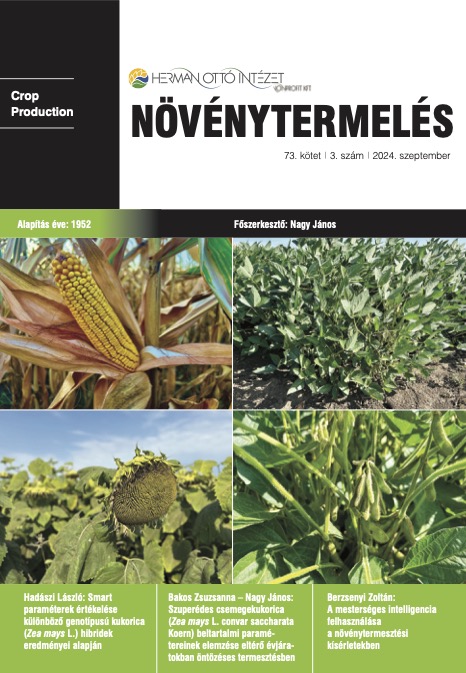
##issue.tableOfContents##
Folyóiratcikk
-
Evaluation of smart parameters based on results from maize (Zea mays L.) hybrids of different genotypes
5-28Views:50In Hungary, the efficiency of arable crop production is significantly determined by the quality of maize production practices. The comparative study of maize hybrids and the establishment of a field trial was initiated in 1977 by the KITE in Nádudvar at the Faculty of Agricultural Sciences of the predecessor University of Agricultural Sciences in Debrecen. This is also the reason why the University of Debrecen, in a unique way in Europe, has all the conditions for field experiments (tillage × irrigation × fertilisation × plant number × hybrids × sowing date interactions) at its Látókép Experiment Site. The results of field experiments are suitable for the state-of-the-art development of precision farming technologies. The new scientific findings, in particular the reliable parameters measured in comparative experiments on maize hybrids, will serve the practical application and effectiveness of precision farming.
Using the results of field experiments, we evaluated the smart parameters of four maize hybrids of different genotypes. These parameters help in hybrid selection and adaptation of hybrid-specific precision farming technology. The examined maize hybrids showed excellent phenological traits, i.e. plant height: 320–340 cm, ear height: 138–151 cm, stalk diameter: 20.5–21.5 mm. Leaf area indices varied significantly (3.6–4.7 m2/m2). The highest yield was obtained by hybrid P 9985 (17.53 t/ha), which exceeded the other hybrids by 1.48–2.37 t/ha. The parameters SPAD, NDVI, grain number, thousand grain weight, grain moisture, grain number per ear and ear weight were studied in the experiment. The hybrids had excellent content values: protein content: 5.7–6.5%, starch content: 75.2–76.5%, oil content: 3.1–3.6%. -
Analysis of the yield parameters of super sweet maize (Zea mays L. convar saccharata Koern) in different crop years under irrigation
29-46Views:135The success of sweet maize production is mainly determined by the significant variation in the effects of the crop year. In Hungary, a large number of drought periods justify the use of irrigation. Without irrigation, cultivation is risky, and in a severely drought year, even the return on costs is uncertain. Our tests were carried out in three different years (2020, 2021, 2022). In the growing season (May-August), the rainfall was 138 mm more in 2020, 65 mm less in 2021 and 140 mm less in 2022 compared to the long-term average. The water requirements of sweet maize were met by drip irrigation throughout the period. Based on the experimental results, compared to the yield of 11,359 t/ha in the extreme dry year of 2022, the yield was 5,828 t/ha higher in 2020 and 7,127 t/ha higher in 2021. Based on the results of the scientific research, it has been concluded that sweet maize production without irrigation is risky, but in extreme drought years irrigation cannot fully compensate for the weather effect due to high heat stress. -
Use of artificial intelligence in crop production experiments
47-66Views:47Understanding the relationships between crop yields, soil properties, weather patterns and input applications is important for optimising agricultural production. Sustainable intensification aims to increase productivity and input-use efficiency while enhancing the resilience of agricultural systems to adverse environmental conditions through improved management and technology. Artificial intelligence (AI) in precision agriculture (PA) enables growers to deploy highly targeted and precise farming practices based on site-specific agro-climatic field measurements. Recent advances in sensing, machine learning (ML) and modelling offer opportunities for novel smart digital technologies to enable sustainable intensification.
Through the review of the newest scientific publications the application of digital technology in crop production experiments was demonstrated in three topics: (i) continues monitoring of crop and soil characteristics, (ii) quantification of spatial and temporal variability of crop response and (iii) forecasting of crop yield by the use of machine learning approaches. It was concluded that the variation analysis and machine learning approaches can help identify and understand the practices that optimise yield. -
The effect of nitrogen splitting in sweet maize (Zea mays L. convar. saccharata Koern) hybrids on plant physiological traits and yield
67-88Views:52A small plot field experiment was established to examine the hybrid-specific effects of split N fertilisation and irrigation on chernozem soil with calcareous deposits on the Hajdúság loess ridge. We tested the effect of different rates of the optimum 75 kg N/ha N rate established in our previous experiments at the given site. Irrigation increased the height of both hybrids in all treatments by an average of 13.0 cm. There was no statistically confirmed difference in leaf area between irrigated and non-irrigated hybrids. The different nutrient responses of the hybrids are shown by the fact that all nitrogen split treatments resulted in yield increases (7.5–17.5%) for the Tyson hybrid, whereas Dessert R78 yielded 1–7.9% less than the control in two treatments. The irrigation response of the two genotypes was different, with Dessert R78 yielding 2868 kg and Tyson 2066 kg more than the non-irrigated treatment, averaged over the fertilisation treatments. -
Quantitative genome size estimation as a tool for plant variety testing
89-104Views:48In plant sciences, flow cytometry (FCM) is the most commonly used method for estimating ploidy levels and genome size. The vast majority of data currently available for more than 12,000 plant species in the Kew Plant Genome Size Database was estimated by using by FCM. However, available data on perennial grass species are scarce.
We estimated the genome size (2C value) from seedlings of two registered cultivars with known ploidy levels of two native grass species (tall fescue, Festuca arundinacea and red fescue, Festuca rubra) by FCM, with rye (Secale cereale) and pea (Pisum sativum) plant controls. We compared our results to the published data of the Kew Database, and calculated the difference in genome size between the two fescue species.
Our estimated genome size data were similar to that in the Kew Database. In the case of red fescue, there was a 1.4-fold 2C value-difference between the hexaploid (12.25±0.81 pg DNA) and the octoploid variety (17.12±0.58 pg DNA). However, the genome size of the two tall fescue accessions with different ploidy were almost identical (13.93±0.15 and 13.53±0.14 pg DNA), which questioned the genetic purity of one of the varieties. We calculated a DNA length of 5990 (6n) and 8371 (8n) Mbp for red fescue varieties, and 6810 (6n) Mbp for the tall fescue sample. According to the Kew Database, the average monoploid genome size of tall fescue accessions is higher by 29% compared to red fescue data. In our investigation, we could verify less difference (6–11%) between the two species. FCM method is a useful tool for detecting the inter-species and intra-species variability of the genome size in botanical studies, plant breeding and variety maintenance, but it is also promising for testing the genetic purity of registered varieties. -
Real-time soil ammonia gas monitoring with IoT technology
105-118Views:49Today, environmental monitoring is increasingly important in arable crop production due to the importance of weather, sustainable nutrient and water management. This paper presents a new innovative technology based on wireless data link and transmission and its results for monitoring soil ammonia emissions using Internet of Things (IoT) technology based on the measurement of environmental characteristics could be a practical method in the future. It is a monitoring system for sustainable and environmentally friendly crop production. The sensors used will ensure the monitoring of soil ammonia emissions, a method that provides fast and accurate monitoring. The results show a periodic trend in NH3 fluxes, with higher amounts in the spring (warmer) periods after nitrogen fertilisation. Results of multivariate linear regression analyses indicate that soil moisture, temperature, humidity and air pressure significantly influence NH3 emissions. -
Evaluation of soil penetration resistance in different tillage systems
119-140Views:121In addition to traditional tillage systems, more biologically based farming systems have emerged. New tillage systems can be developed using various scientific results and technical technological possibilities. This research started six years ago and the results of the last two years are presented here. In the examination, four different tillage systems have been established on the same site. Measuring penetration resistance is a common technique for evaluating field effects and the effects of tillage systems on soil can be evaluated using this value.
The performed measurements show that conventional tillage systems based on ploughing develop a fundamentally different structure in the soil section up to 50 cm than the three different no-tillage systems examined.
Database Logos


Keywords
Make a Submission
Issues by Year