
Folyóiratcikk
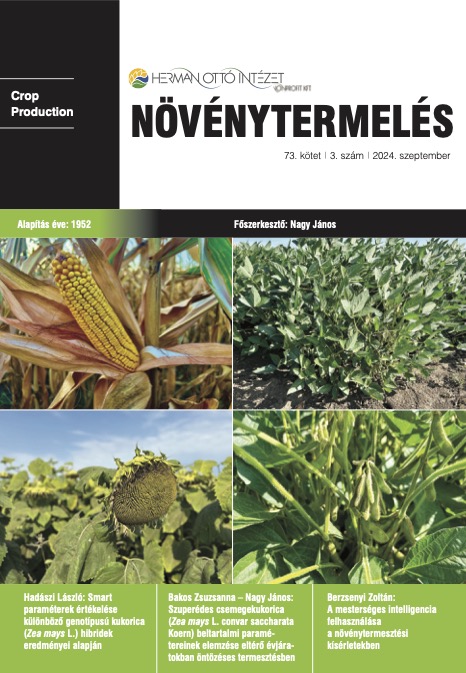
Evaluation of smart parameters based on results from maize (Zea mays L.) hybrids of different genotypes
Published:
2024-09-30
 https://doi.org/10.12666/yjpnrg44
Author
View
Keywords
License
Copyright (c) 2024 László Hadászi

This work is licensed under a Creative Commons Attribution 4.0 International License.
How To Cite
Selected Style:
APA
Hadászi, L. (2024). Evaluation of smart parameters based on results from maize (Zea mays L.) hybrids of different genotypes. Növénytermelés, 73(3), 5-28. https://doi.org/10.12666/yjpnrg44
Abstract
In Hungary, the efficiency of arable crop production is significantly determined by the quality of maize production practices. The comparative study of maize hybrids and the establishment of a field trial was initiated in 1977 by the KITE in Nádudvar at the Faculty of Agricultural Sciences of the predecessor University of Agricultural Sciences in Debrecen. This is also the reason why the University of Debrecen, in a unique way in Europe, has all the conditions for field experiments (tillage × irrigation × fertilisation × plant number × hybrids × sowing date interactions) at its Látókép Experiment Site. The results of field experiments are suitable for the state-of-the-art development of precision farming technologies. The new scientific findings, in particular the reliable parameters measured in comparative experiments on maize hybrids, will serve the practical application and effectiveness of precision farming.
Using the results of field experiments, we evaluated the smart parameters of four maize hybrids of different genotypes. These parameters help in hybrid selection and adaptation of hybrid-specific precision farming technology. The examined maize hybrids showed excellent phenological traits, i.e. plant height: 320–340 cm, ear height: 138–151 cm, stalk diameter: 20.5–21.5 mm. Leaf area indices varied significantly (3.6–4.7 m2/m2). The highest yield was obtained by hybrid P 9985 (17.53 t/ha), which exceeded the other hybrids by 1.48–2.37 t/ha. The parameters SPAD, NDVI, grain number, thousand grain weight, grain moisture, grain number per ear and ear weight were studied in the experiment. The hybrids had excellent content values: protein content: 5.7–6.5%, starch content: 75.2–76.5%, oil content: 3.1–3.6%.
Using the results of field experiments, we evaluated the smart parameters of four maize hybrids of different genotypes. These parameters help in hybrid selection and adaptation of hybrid-specific precision farming technology. The examined maize hybrids showed excellent phenological traits, i.e. plant height: 320–340 cm, ear height: 138–151 cm, stalk diameter: 20.5–21.5 mm. Leaf area indices varied significantly (3.6–4.7 m2/m2). The highest yield was obtained by hybrid P 9985 (17.53 t/ha), which exceeded the other hybrids by 1.48–2.37 t/ha. The parameters SPAD, NDVI, grain number, thousand grain weight, grain moisture, grain number per ear and ear weight were studied in the experiment. The hybrids had excellent content values: protein content: 5.7–6.5%, starch content: 75.2–76.5%, oil content: 3.1–3.6%.

