
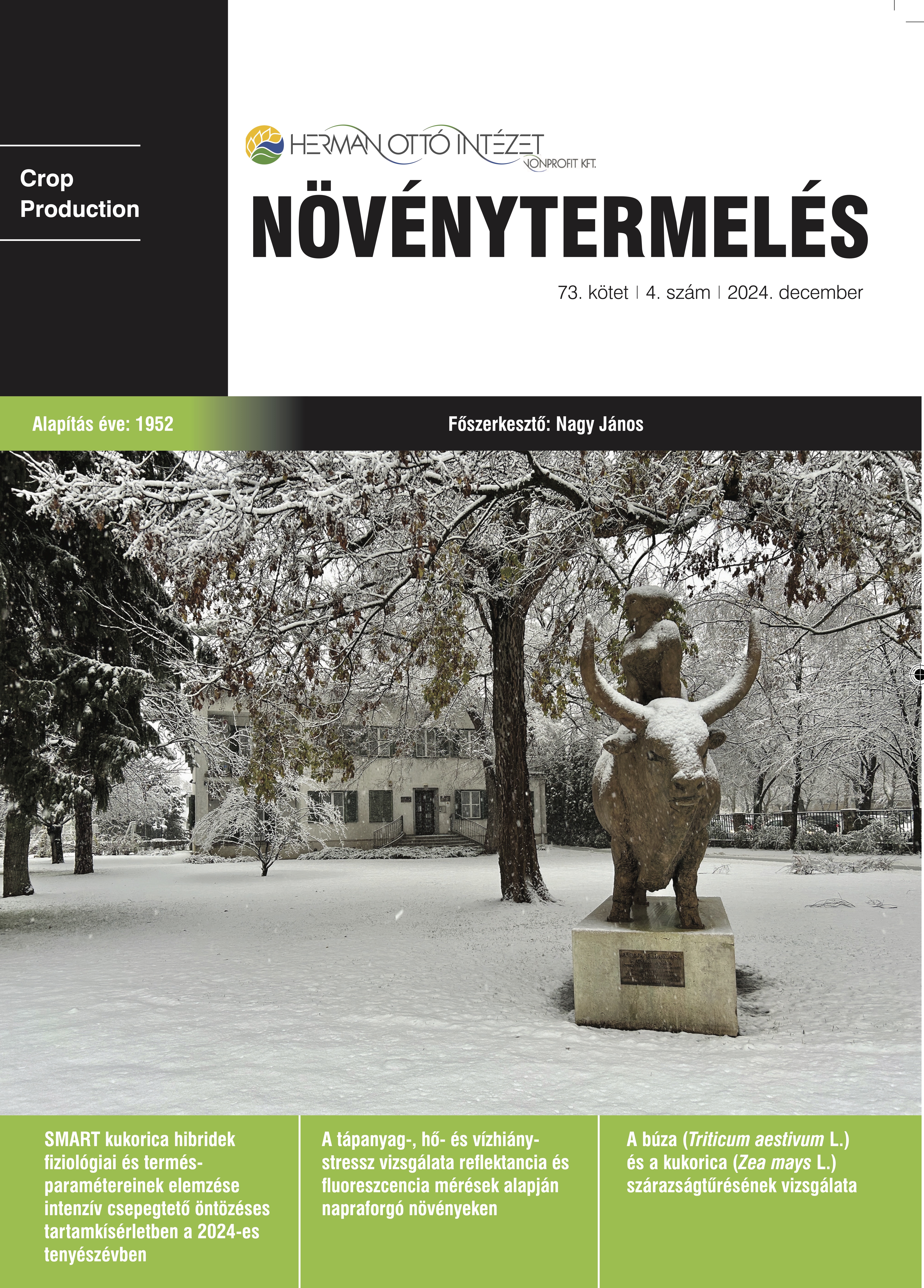
Folyóiratcikk
Agrometeorological characteristics of the 2024 maize growing season in Debrecen-Látókép
Published:
2024-12-31
 https://doi.org/10.12666/9jar2n08
Authors
View
Keywords
License
Copyright (c) 2024 Béla Gombos, János Nagy

This work is licensed under a Creative Commons Attribution 4.0 International License.
How To Cite
Selected Style:
APA
Gombos, B., & Nagy, J. (2024). Agrometeorological characteristics of the 2024 maize growing season in Debrecen-Látókép. Növénytermelés, 73(4), 67-78. https://doi.org/10.12666/9jar2n08
Abstract
The impact of weather on yields is realised in a complex interaction with agrotechnical factors. In this agrometeorological study for the year 2024, the main meteorological factors determining yields were analysed in relation to the agrotechnical elements and phenophases. The research was based on air temperature, soil temperature and precipitation measurements at the Látókép Experimental Station of the University of Debrecen and on sunshine duration data from the HungaroMet Debrecen Airport Station.
It can be concluded that the year 2024 was characterised by a marked duality in terms of maize production. The weather was favourable until June. Water availability was still adequate (partly due to favourable initial water availability in the soils) and temperatures were mostly above the multi-year average, without periods of extreme heat. Overall, this resulted in a well-developed stand with high yield potential. Subsequently, the weather changed fundamentally. Both July and August mean temperatures were close to record highs (24.2 °C). One of the heatwave peaks was in mid-July, coinciding in several places with the most heat stress-sensitive flowering phenophases of maize. The persistent, extremely hot weather in July-August was primarily responsible for the yield depression in the 2024 growing season. The below-average rainfall, combined with a significant soil depression, mainly during the maturing period. The combination of the soil trough, the atmospheric drought and the extremely high air temperatures caused the significant yield losses.
It can be concluded that the year 2024 was characterised by a marked duality in terms of maize production. The weather was favourable until June. Water availability was still adequate (partly due to favourable initial water availability in the soils) and temperatures were mostly above the multi-year average, without periods of extreme heat. Overall, this resulted in a well-developed stand with high yield potential. Subsequently, the weather changed fundamentally. Both July and August mean temperatures were close to record highs (24.2 °C). One of the heatwave peaks was in mid-July, coinciding in several places with the most heat stress-sensitive flowering phenophases of maize. The persistent, extremely hot weather in July-August was primarily responsible for the yield depression in the 2024 growing season. The below-average rainfall, combined with a significant soil depression, mainly during the maturing period. The combination of the soil trough, the atmospheric drought and the extremely high air temperatures caused the significant yield losses.

