About the Journal
Grassland Studies is one of the official journals of the Hungarian Academy of Sciences. It provides common platform for agricultural, ecological, economical and technical issues. Papers focus on botany, agronomy, animal sciences, agro-economics and engineering sciences. There are sections for full researches and reviews but case studies and short communications are also welcome. Grazing, nature conservation, nutrient management, biodiversity, forage science are frequent topics but new approaches like energetics, carbon sequestration, environmental psychology and soil mechanics are also interesting fields of our interest.
Vol. 23 No. 2 (2026): Grassland Studies (GS-31) Current Issue
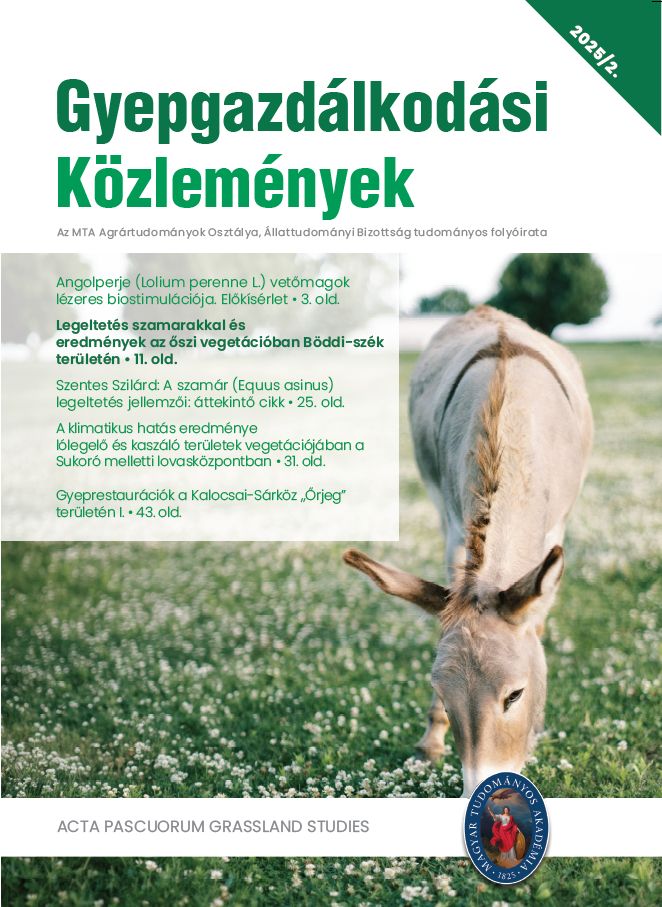
##issue.tableOfContents##
Cikk (Article)
-
Laser biostimulation of perennial ryegrass (Lolium perenne L.) seeds in a pilot study
3-9Views:174In our pilot study, perennial ryegrass seeds were exposed to 0, 1, 2, 4, and 8 minutes of single-wavelength red laser (660 nm, 150 mW) irradiation, and were grown to 13 weeks of age. No statistically significant effects were observed in germination rate or seedling shoot length. However, the 2- and 4-minute treatments significantly increased shoot length in 13-week-old plants by 28% and 19%, respectively, compared to the control. There were no significant differences in shoot or root weight of the 13-week-old plants, though shoot dry weight was 57% to 65% higher across all treatments. The shoot-to-root dry weight ratio increased in all treatments compared to the control, with the 1-minute treatment significantly exceeding the control by 54%. The protein content of the entire seedlings was notably lower in the 1- and 2-minute treatments and higher in the 4-minute treatment than in the control, as measured by NIRS analysis. The fiber fractions examined (NDF, ADF, hemicellulose) surpassed the control values in the shoots of 13-week-old plants under all treatments, but these differences were not statistically significant.
pdf94 -
Effects of donkey grazing on the autumn vegetation aspect of the Böddi-szék area
11-24Views:451The aim of this study was to assess the short-term effects of conservation-oriented grazing by the Hungarian domestic donkey (Equus asinus) on the botanical composition of the Böddi-szék alkali grassland. The investigation covered the period between 26 July and 31 October 2025, during which 76 donkeys grazed an area of 72 hectares, of which approximately 20 hectares constituted the sampled study area. Vegetation surveys were conducted using the Braun–Blanquet method in 2×2 m quadrats. Grazed and ungrazed stands were compared within four distinct microtopographical units (bare alkali flats, alkali pans, bench slopes, and bench tops) in an area that has been subject to grazing management for five years.
The evaluated sites were analysed using relative ecological indicator values. The results showed a measurable decrease in the cover of Crypsis aculeata L. on bare alkali flats as a consequence of grazing. On alkali pans, Puccinellia limosa remained the dominant species on both grazed and ungrazed plots. Vegetation on bench slopes was most strongly influenced by donkey activity: trampling in grazed areas enhanced soil erosion, leading to an increased proportion of degradation-indicator species. In contrast, the naturalness of bench tops appears to be maintainable under donkey grazing, as indicated by the increased abundance of the Achilleo-Festucetum pseudovinae or Artemisio-Festucetum pseudovinae associations on grazed sites.pdf (Hungarian)133 -
Climatic impacts on the vegetation of horse pastures and hay meadows at the equestrian centre near Sukoro
31-42Views:178The study was conducted on the grassland areas of the Sukoró Equestrian Centre. Phytosociological surveys carried out in 2023 were repeated in 2024 on both the rocky grassland horse pasture and the hay meadow. The objective was to assess the extent to which year effects are reflected in vegetation patterns. The year 2023 represented a dry year, whereas 2024 was characterised by a wet year. Phytosociological data were collected using the Braun-Blanquet (1964) method, applying 2×2 m quadrats, with vegetation cover estimated as percentage values. Quadrats were placed randomly within the study sites. Four sampling areas were investigated. Three were hay meadows: (I) mesic hay meadow; (II) alkali grassland dominated by Festuca pseudovina; and (III) marsh meadow. The fourth sampling area (IV) was a siliceous rocky grassland used as a horse pasture, which remained ungrazed in 2023. Based on the results, increased moisture availability led to a higher abundance of species with greater nitrogen and water requirements in the mesic hay meadow (Alopecuro-Arrhenatheretum) and in the Achilleo setaceae Festucetum pseudovinae grassland. Classification analyses clearly demonstrated the year effect in these vegetation types. In contrast, relevés from the marsh meadow did not show a clear separation between the two years. In the rocky grassland, only the proportion of nitrogen-demanding species increased. Nature conservation–based analyses also revealed a distinct pattern for the marsh meadow, where the proportion of disturbance-tol erant species decreased, while it increased in the other three vegetation types. From a grassland management perspective, the abundance of economically important grasses (Poaceae) declined only in the marsh meadow, whereas it increased in the other three vegetation types, accompanied by higher forage value indices. Overall, with the exception of the inherently wet marsh meadow, the wetter conditions of 2024 had a positive and clearly detectable effect on the studied vegetation types.
-
Grassland restoration practices in the Őrjeg area of the Kalocsa-Sárköz region I.
43-49Views:330The conservation and sustainable management of grasslands are of key importance from both nature conservation and grassland management perspectives. The aim of this study was to evaluate the long-term effects of grassland restoration interventions carried out in areas with a well-documented land-use history. The study was conducted at two sample sites located in the Őrjeg area of the Kalocsa-Sárköz landscape unit of the Great Hungarian Plain, near Homokmégy. Following unsuccessful afforestation attempts, both sites were subjected to shrub removal over several years, after which cattle grazing was introduced. At one site, grazing was complemented by regular maintenance mowing, whereas at the other site this practice was omitted. One of the sample sites was further subdivided into a drier and a more mesic section in order to assess the influence of microhabitat differences.
In 2025, six phytosociological relevés were recorded at each site. Our results indicate that mechanical treatments following shrub removal, combined with grazing and maintenance mowing, promote the regeneration of grassland structure and species composition more effectively than grazing alone. From both conservation and grassland management perspectives, treatments integrating grazing with regular maintenance mowing proved to be more successful. Under the studied conditions, the absence of maintenance mowing limited the achievement of restoration objectives, suggesting that its reintroduction should be considered in future management practices.
Szemle (Review)
-
The grazing characteristics of the donkey (Equus asinus)
25-30Views:386This review paper focuses on the grazing ecology of the donkey (Equus asinus). It addresses the species’ origin and traditional as well as contemporary uses, with particular emphasis on its grazing behaviour. The review examines feeding habits, including diet composition, plant species selection, and the degree of grazing selectivity exhibited by donkeys. In addition, it discusses the role of donkeys in grassland management and their broader ecological and practical benefits. Based on a synthesis of relevant literature, the paper analyses the significance of grazing as an ecological process. The review aims to provide a comprehensive overview of current knowledge on donkeys – or closely comparable large ungulates – and to outline general ecological principles that support the interpretation of donkey grazing behaviour.
pdf145
Vita (Discussion)
-
The roots of environmental management: Foundations in the hstory of science, resource protection, and a landscape ecological critique of sustainability indicator systems
53-55Views:141This paper argues that environmental protection, in its original and scientifically consistent sense, is not the conservation of isolated elements or states, but the preservation of the operability of natural systems. From this perspective, sustainability is not an independent normative goal, but a necessary consequence of maintaining the functioning of the environment.
Building on the scientific-historical development of Earth system thinking – from the principle of actualism through evolutionary-scale interpretations and systems-oriented approaches – the study emphasizes the primacy of processes, dynamics, and spatial organization over static descriptions. The paper adopts the operational concept of environment = landscape, in which natural, social, and economic processes interact within a common spatial framework, forming an integrated, functioning system. Within this framework, current sustainability indicator systems are critically examined. These systems predominantly rely on social and economic performance metrics, while largely neglecting the physical, chemical, and biological processes that constitute their natural foundations. A similar conceptual distortion is identified in the prevailing practice of water management, where water is treated primarily as a stock or resource, rather than as the outcome of a functioning landscape-scale hydrological system. The paper further argues that ecosystem services and water resources should be interpreted as consequences of landscape functioning, not as primary objects of protection. Protecting outcomes instead of underlying processes inevitably leads to systemic instability. In its concluding synthesis, the study highlights the Carpathian Basin as a paradigmatic case where environmental processes form an integrated, transboundary system shaped by basin-scale geology, hydrology, and landscape structure. Consequently, sustainability and environmental protection in this region can only be meaningfully addressed through coherent, landscape-based, and system-level approaches that transcend administrative boundaries.