
Évf. 9 szám 3-4 (2022)
Megjelent
december 31, 2022
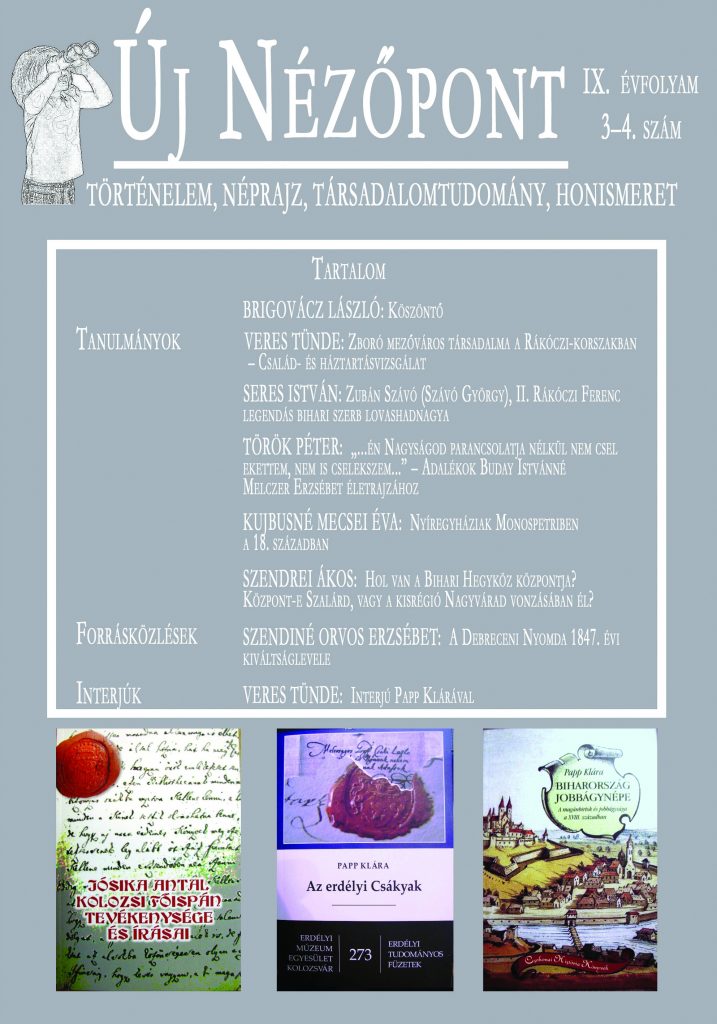
##issue.tableOfContents##
Tanulmányok
-
Zboró mezőváros társadalma a Rákóczi-korszakban – Család- és háztartásvizsgálat
7-27Megtekintések száma:0In the 17th century, Zborov was not a market town with a long history, it acquired this title around 1670. We can therefore safely say that the development of the city was due to the Rákóczi family. Its members continuously developed Zborov, which development formed the basis of our study of Zborov's society. The purpose of our study is to answer questions such as how the population of the market town changed during the 17th century, how the proportion of serfs, squires, and skilled workers changed, and their financial situation. We extended the research to family and household research, which was made possible by the special detailedness of the 1688 urbarium concerning the estates of the royal branch. Therefore, our social investigation is complemented by questions such as what types of households we can talk about in contemporary Zborov. How were the households distributed according to household type and livestock?PDF0 -
Zubán Szávó (Szávó György), II. Rákóczi Ferenc legendás bihari szerb lovashadnagya
28-34Megtekintések száma:0Teacher Klára Papp's main research area is Bihar, the settlement and population history of Bihar. The protagonist of my short article also comes from this region, but he is a special figure. Szávó Zubán, or as it is usually written: György Szávó (or Száva) was actually a Hungarian nobleman of Serbian origin, from Pécska on the bank of Maros in Arad. Despite his origin, he was the first lieutenant of Rákóczi’s War of Independence. We know that he was a Hungarian nobleman from Gálospetri, but he declared himself to be of Rác (Serbian) ethnicity. He fought through the Kuruc freedom struggle, and then in 1717, he went to war against the Crimean Tatars invading from the North-East. Throughout the War of Independence, he was a senior lieutenant in the cavalry regiment of Sándor Károlyi, the commanding general in Tiszántúl.PDF0 -
„…én Nagyságod parancsolatja nélkül nem cselekettem, nem is cselekszem…” – Adalékok Buday Istvánné Melczer Erzsébet életrajzához
35-44Megtekintések száma:0István Bölsei Buday, the former deputy of Bihar, joined Ferenc Rákóczi II immediately after the outbreak of Rákóczi’s War of Independence. The nearly 50-year-old man supported the future prince according to his best talent, and his wife, Erzsébet Melczer, also helped him in this. The research conducted in connection with Rákóczi’s War of Independence focuses more on questions of military, economic and social history. Micro-historical explorations have received more emphasis in recent decades, concentrating on groups and individuals who fell outside the scope of traditional research models. With the help of such an in depth analysis focusing on one person, we aim to bring the wife, mother, family member behind the soldier closer to the reader.PDF0 -
Nyíregyháziak Monospetriben a 18. században
45-60Megtekintések száma:0In the 18th century, migration was continuous in Nyíregyháza. In addition to the organized settlers from the 1750s, spontaneous arrivals also increased the population, which continued to grow. At the same time, the difficulties of personal prosperity, the hindrance of free religious practice and the promises of new settlements contributed to emigration and onward migration, one of the destinations of which was Bihar County. In accordance with migration, the misinterpreted descriptions of the specialized literature occasionally lead to the drawing of inaccurate conclusions, but the lack of resources does not always allow the exploration of the causes of migration, the knowledge of its course, and the analysis of its consequences. In the 18th century history of Nyíregyháza, it is also an open question why so many people moved to Monospetri in 1794, how they fit in there, why they did not become as dominant in public life as the people from Békés who also came here, and also, who and when returned, and why they did so. An overview of the past of the two settlements by comparing the nomenclature allows interesting conclusions to be drawn, the proof of which, however, requires the discovery of new resources.PDF0 -
Hol van a Bihari Hegyköz központja? Központ-e Szalárd, vagy a kisrégió Nagyvárad vonzásában él?
61-72Megtekintések száma:0The development or stagnation, regression of market towns can be interesting not only from the point of view of urban development for history or social sciences, but can also largely determine/reflect the life and possibilities of a given region, thus, the market towns themselves are closely related to the history of the region around them. The aim of my study is to outline the process during which the trajectory of a region that had been developing for centuries and had several urban settlements and market towns was broken, and the demographic and urbanization processes that had been noticeable within the region until then regressed and withered away. At the end of the review, I would also like to find an answer to why this phenomenon occurred. In the first half of the article, I present the demographic development of the region. There was no major break in the population of the Hegyköz settlements until the first third/middle of the 17th century, its population was approx. 10,000. After this, by the end of the Turkish era, the number of people living here decreased considerably (1692: 6,000 people). Then, in the 18th century, the area inhabited almost exclusively by Hungarians was repopulated with the help of a significant number of Romanians and a smaller Slovak and Swabian population, and in 1787 the number of inhabitants was already 18,000 (Hungarians made up approx. 70%). In parallel with the demographic and ethnic development of the population, the religious affiliation of the people living there also largely changed. While almost only Roman Catholics lived in the region until the Turkish era, in the 17th century, as a result of the rapid spread of the Reformation, the majority of Hungarians became Reformed. The majority of the Romanians, who appeared in large numbers during the resettlement, represented an Orthodox but growing Greek Catholic population, while the Slovaks and Swabians were Roman Catholics. The industrialization and modernization that took place in the second half of the 19th century had a positive effect on the number of people living here, which already exceeded 30,000 by 1910. In the 20th century, however, there was first a further increase of less intensity (1941: 34,196 people), then a large-scale decrease in the population. As a result, according to the data of the 2002 census, the number of inhabitants does not even reach 25,000, which corresponds to the level of 1880. Meanwhile, by the beginning of the 21st century, the number of Hungarians decreased to approx. 60%, and that of Romanians to approx. 36%. 75% of Hungarians are Reformed, 25% are Roman Catholic, and Romanians – as a result of the banning of Greek Catholicism in 1948 – are almost entirely adherents of Orthodoxy. Based on the demographic and historical geographical changes of the region, we can see that the settlements of the ’Bihari Hegyköz’, which played a central role in certain stages of the period between the 10th and 17th centuries, Bihar (Biharia), Adorján (Adrian), Szentjobb (Sâniob), Szalárd (Sălard), as well as Hegyközcsatár (Cetariu) and Micske (Mișca), halted in their development during and after the Turkish conquest. And after that, even though they kept their viability thanks to resettlement in the 18th century, they completely lost their central roles during the modernization that began in the last third of the 19th century, the disintegration of historical Hungary and the changing systems ofthe 20th century. Nagyvárad (Oradea), located in the immediate vicinity of Bihari Hegyköz, became the central place of the region.PDF0
Forrásközlések
-
A Debreceni Nyomda 1847. évi kiváltságlevele
73-83Megtekintések száma:0Since its founding in 1561, the City Press has been enhancing the reputation of Debrecen. It used to be managed by the city council, the rulers did not interfere in its affairs until 1835. At that time, the Governor's Council forcefully demanded that it present their royal patent. However, the Debrecen Press - similarly to the other printing houses in Hungary - did not have a separate patent. Nevertheless, in order to suppress civil aspirations, the government wanted to abolish printing presses that operated without a royal permission. The city fathers of Debrecen argued in vain that Leopold I confirmed the use of the printing press when he elevated Debrecen to the rank of free royal city, King Ferdinand rejected their request. There was no other solution, the issue of the privilege letter had to be requested. The charter of the Debrecen Book Printing Institute was announced on August 12, 1847. Due to the amount paid for it, the printing house closed that year with a significant loss. The present study not only follows the struggle to obtain the privilege letter, but also provides relevant archival resources, including the correspondence of the Debrecen City Council and the Council of Governors between 1835 and 1847.PDF0
Interjúk
Adatbázis logók




Lapszámok éves bontásban
2026