
Évf. 7 szám 3 (2020)
Megjelent
november 23, 2020
##issue.tableOfContents##
Tanulmányok
-
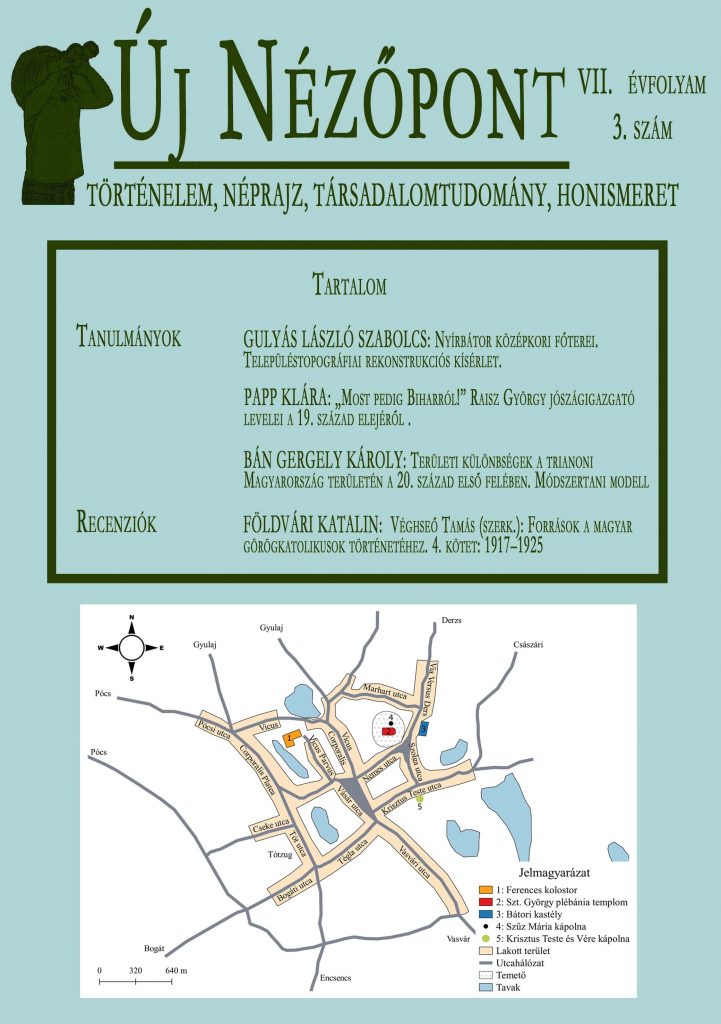
Nyírbátor középkori főterei. Településtopográfiai rekonstrukciós kísérlet.
5-39Megtekintések száma:1Nyírbátor was one of the most important market towns of the Great Hungarian Plain in the Middle Ages. This status of importance was the result of a combination of several factors. On the one hand, the settlement served as the residence of the Ecsed branch of the Bátori family, which gained national significance from the 14th century onwards, as evidenced by the high-quality medieval built heritage. The other reason that increased its importance is that the market town played a prominent role in the system of trade relations between Transylvania and Upper Hungary, which was also helped by high-level royal privileges that were not entirely considered credible in Hungarian historical research. Several certificates from the 14th–15th centuries report in detail on the medieval settlement structure of Nyírbátor, but their interpretation is still problematic. The study attempts to reconstruct the medieval street network, and at the same time tries to answer the complex question of the circumstances and time of the construction of the today still existing huge main square, which has a regular floor plan, and which is considered to be unique among Hungarian market towns.PDF0 -
„Most pedig Biharról!” Raisz György jószágigazgató levelei a 19. század elejéről
40-53Megtekintések száma:0The Bihar estates of the Csáky family were still received from Sigmund of Luxembourg, and they became the ancient, shared estates. When their headquarters were transferred from the Principality of Transylvania to the Kingdom of Hungary in the 17th century, the estates in the Uplands and Transdanubia gained more importance. In the middle of the 17th century, Count László Csáky returned to Transylvania and established the so-called a Transylvanian branch that possessed the Bihar properties undisturbed until the middle of the 18th century. Then, during the bishopric of Miklós Csáky in Oradea, the members of the upland branch regained the manors, and after a short time, those manors were pledged again to the Transylvanian landowners. However, from 1784 they were finally taken into their hands, and from the first years of the 19th century, the members of the upland branch shared them among themselves, trying out joint possession. The family correspondence contains writings from the trustee contacting his widow after the death of János Csáky, the principal representative of the upland branch, the director of the family. From this, we can get additions about the intention and plans on the division of the estate. And also, on the basis of the three letters published here, about how the best manors got into the hands of Mrs. János Csáky (Jozefa Zichy), and what the role of the property manager was in this.PDF0 -
Területi különbségek a trianoni Magyarország területén a 20. század első felében. Módszertani modell
54-69Megtekintések száma:1The topic of the present methodological dissertation is the examination of Hungarian territorial differences in the context of modernization and development. In the background of my choice of topic lies the scientific importance of the issue, the growing domestic quantitative research and the illumination of the Trianon trauma from a new perspective (Demeter 2018, Szilágyi 2018). I also consider this to be a novel approach, because it is a fact that June 4, 1920 significantly affected our country in all areas, but approaches have come to light (Tomka 2018) that already paint a more nuanced picture of Trianon and the subsequent economic downturn. So I consider it justified to carry out an empirical research on a quantitative basis with the involvement of the settlement network. Thus, we can approach the relationship between development and Trianon from new perspectives. Writing of which, the 100th anniversary itself is another motivation.PDF0
Recenziók
-
Véghseő Tamás (szerk.): Források a magyar görögkatolikusok történetéhez. 4. kötet: 1917–1925.
70-73Megtekintések száma:0PDF0
Adatbázis logók




Lapszámok éves bontásban
2026