Vol. 1 No. 2 (2014)
Published
August 8, 2014
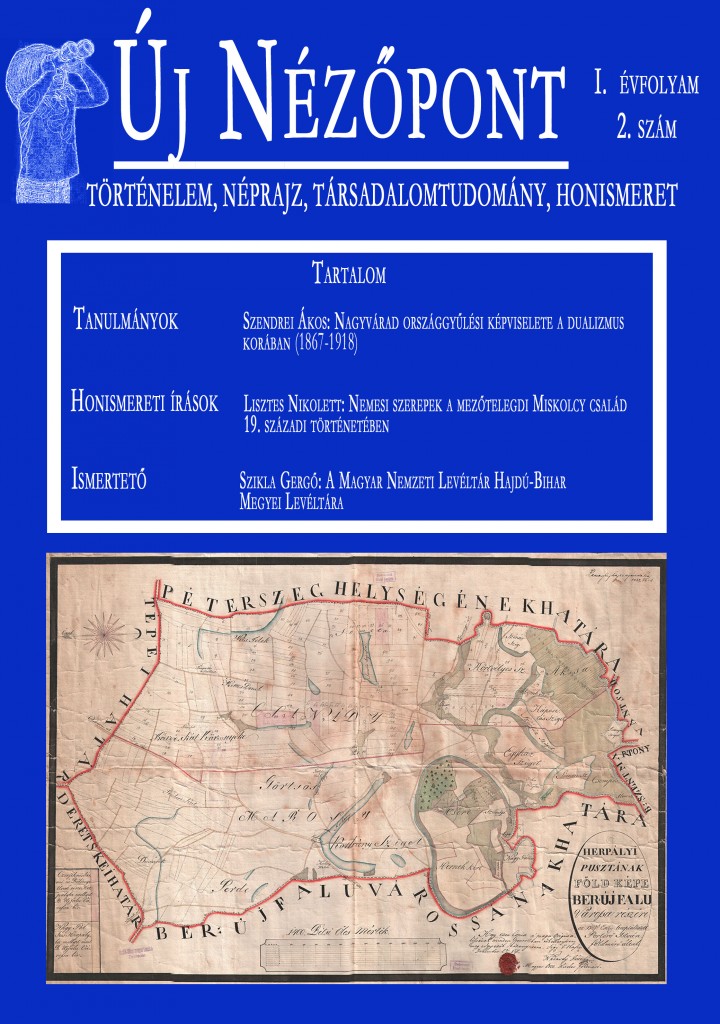
Full Issue
##issue.tableOfContents##
Research articles
-
Nagyvárad országgyűlési képviselete a dualizmus korában (1867–1918)
5-18Views:0The study looks at the issue of Nagyvárad's parliamentary representation in the AustroHungarian Empire period, focusing primarily on the proportionality of the city's
mandate numbers and the elected parliamentarians. In the first part of the paper, I
examine the one parliamentary mandate owner Nagyvárad's elective franchise and
elective geographical position in comparison with other cities having one mandate, and
with similarly populated cities having two mandates. The consequence of the findings is
that Nagyvárad (as well as Arad and Temesvár, which have similar social and economic
geography features) could not get more seats in the Hungarian House of
Representatives seeking a social status quo conservation due to its "modern bourgeois
city" nature, and not because of the city's ethnic makeup.
In the second part of the study, I analyze the party affiliation of Nagyvárad’s
representatives, and through this, the urban voter behavior and the representatives
themselves (Imre Szacsvay, György Lukács, Ágoston Tokody, Gyula Győrffy, István
Teleszky, Kálmán Tisza, Béla Barabás, Endre Hlatky, Tamás Szokoly, Géza Hoványi).
Ismertető
-
A Magyar Nemzeti Levéltár Hajdú-Bihar Megyei Levéltára
35-51Views:0The State Archives of Debrecen – the predecessor of the National Archives of
Hungary's Hajdú-Bihar County Archives – was established in 1952 by the integration of
the three municipality's archives: Debrecen city, Bihar and Hajdú counties. In 1968,
after a 17-year-old state history, the archives were returned to the counties, and after
that, the State Archives of Debrecen has functioned as the Hajdu-Bihar County
Archives. In 1981, a branch archive was established in Hajdúböszörmény where the
Hajdú district's documents were returned to. In effect from 1st January 2012, the
Archives returned to state maintenance, and the National Archives of Hungary was created on 1st October of the same year. Thereby, the institutional autonomy of the
county archives ceased, but the contents of public service provision have not changed.
The documentary materials of the Archives allow an insight to the history of
Debrecen city and the former counties of Hajdú and Bihar since 1950, Hajdú-Bihar
county and its settlements.
The Archives maintains a research service at three places. The researchers have the
opportunity to get photo- and digital copies, or to take photos of the documents.
The Archives, operating also as a scientific institution since 1969, takes care of
several series besides the special publications; and since 1973, it organizes the Archives
Day of Hajdú-Bihar County Archives, as well as numerous conferences and smaller
events associated with the institute. Within and outside the borderlines of the county,
the Archives regularly appears with travelling- and temporary exhibitions.
Honismereti írások
-
Nemesi szerepek a mezőtelegdi Miskolczy család 19. századi történetében
19-33Views:0he members of the Miskolczy family of Mezőtelegd were the key members of the
public life of Bihar county in the 18–20th century. The present study analyzes three roles
related to the 19th century elite counciousness, based on the family's document legacy.
The first example is jr. Lajos Miskolczy, the county's opposition politician, then
through the life of Sándor Miskolczy, we examine a soldier career, finishing with
presenting Károly Miskolczy's decades long history-themed collecting activities.
Database Logos




Issues by Year
2026