
Vol. 1 No. 1 (2014)
Published
May 10, 2014
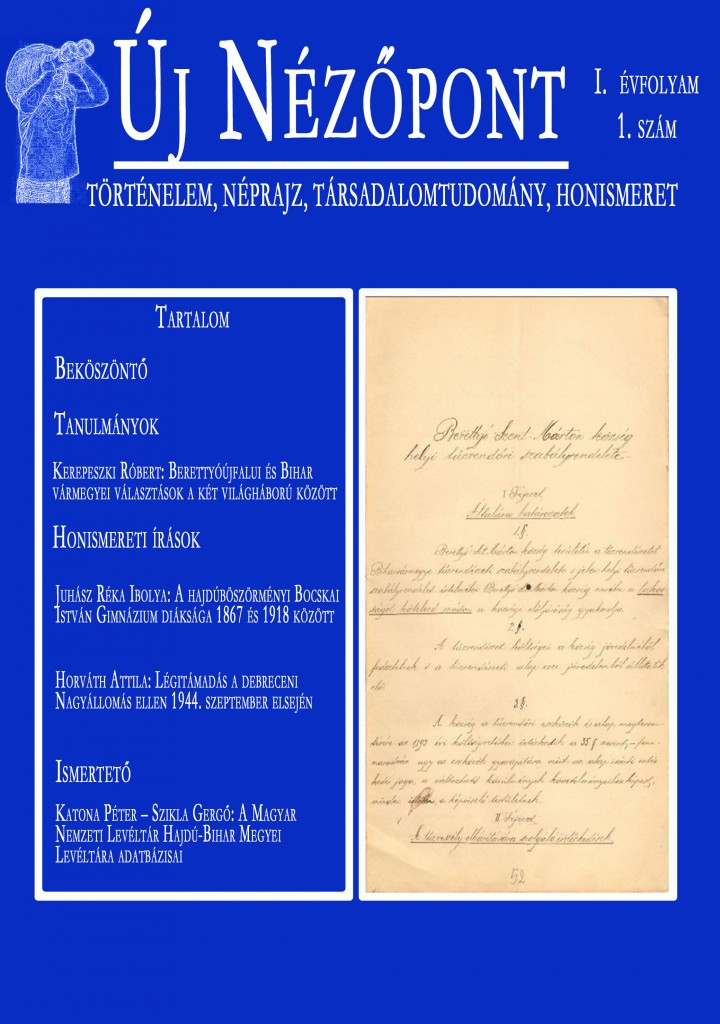
Full Issue
##issue.tableOfContents##
Research articles
-
Beköszöntő
5-6Views:1A Hajdú-Bihar Megyei és Debreceni Honismereti Egyesület 2014 tavaszán elindított egy teljesen elektronikus kiadású, tudományos és ismeretterjesztő folyóiratot. A tervek szerint negyedévente megjelenő lap táji-térségi szinten, a Biharra, Debrecenre és a Hajdúvidékre irányuló kutatások fórumaként fog működni. A magyarországi kutatók mellett várja a határon túliakat, és biztosítja a lehetőséget az eredmények angol nyelvű bemutatására is. -
Berettyóújfalui és Bihar vármegyei választások a két világháború között
7-19Views:1The historian profession has, by now, clarified that the so-called Horthy-regime was an
authoritarian political structure where one-party dominance prevailed but other political
trends could also organize themselves with relative freedom.
One of the most interesting feature of this system was the operation of the limited
parliamentary system, which was provided by the suffrage between 1922 and 1938.
Until 1938/39, all constituencies of Bihar county voted openly, just like in the county
seat town, Berettyóújfalu. The secret ballot was restored in 1938 (1938th XIX. Tc.) and
the last election of the era was held based on this in May 1939. Primarily due to the
open voting, Bihar was considered a ruling party side county, although during the
1930’s, some opposition political movements such as the support of Smallholders and
the far-right (Nazi) party were also in rise here, just like in many other counties of the
Great Plain region.
Ismertető
-
A Magyar Nemzeti Levéltár Hajdú-Bihar Megyei Levéltára adatbázisai
61-81Views:1The National Archives of Hungary’s Hajdú-Bihar County Archives, the Méliusz Ju-
hász Péter Library and Oradea’s Mayor’s Office won a 110 million HUF tender in the
framework of the Hungarian-Romanian cooperation (HURO) in 2009. The work
started on 1st May 2010 and lasted for a year, and the sustainability of the undertaken
work must be granted for five more years. Besides the devices, the institutes have spent
the amount on events, publications, data digitization and on the construction of
databases.
In the National Archives of Hungary’s Hajdú-Bihar County Archives, the staff made
five detached databases, in which the documents of the historical Bihar County’s past
have been processed: diplomas, manuscript maps, rule regulations, hydrological records
and church registers. The data and/or attachment upload is still in progress.
One of the partner institutions: Oradea’s Mayor’s Office created a database for
those Council Proceedings that were created before the unification of the four sections
of the town in 1850.
In the Méliusz Juhász Péter Library, more than 450 local history-themed books,
journals, school year books and school-records, etc. were digitized into database that is
assigned to a search engine and a browser.
Honismereti írások
-
A hajdúböszörményi Bocskai István Gimnázium diáksága 1867 és 1918 között
21-36Views:1In my dissertation, I examine the social composition of students at Bocskai István
Grammar School between 1867 and 1917. The starting point of the research was
provided by a database based on the registrars that contained all the students attending
in the given period. After a short historical summary, I will discuss the changes in the
number of students, the school catchment area, the denominational proportion of
students, social stratification of parents, and the question of female students. -
Légitámadás a debreceni Nagyállomás ellen 1944. szeptember elsején
37-59Views:1This study presents the second american air raid carried out against Debrecen’s
railway station. In the prologue, it discusses the purpose of the attack in detail, and the
action’s aviation historical aspects in the first chapter. The statements of the latter are
based on the documents from the archives of the U.S. Air Force, specially focused on
the air photos taken during the attack. In the third section, the damages of the attack
will be presented. So much as the sources allowed, the study shows the new serious
devastation of the city from street to street. The closing section of the paper presents
the tactical success of the bombing, which is followed by the list of victims where the
readers get the possibility to find their relatives.
Database Logos




Issues by Year
2026