
Vol. 5 No. 2 (2018)
Published
July 31, 2018
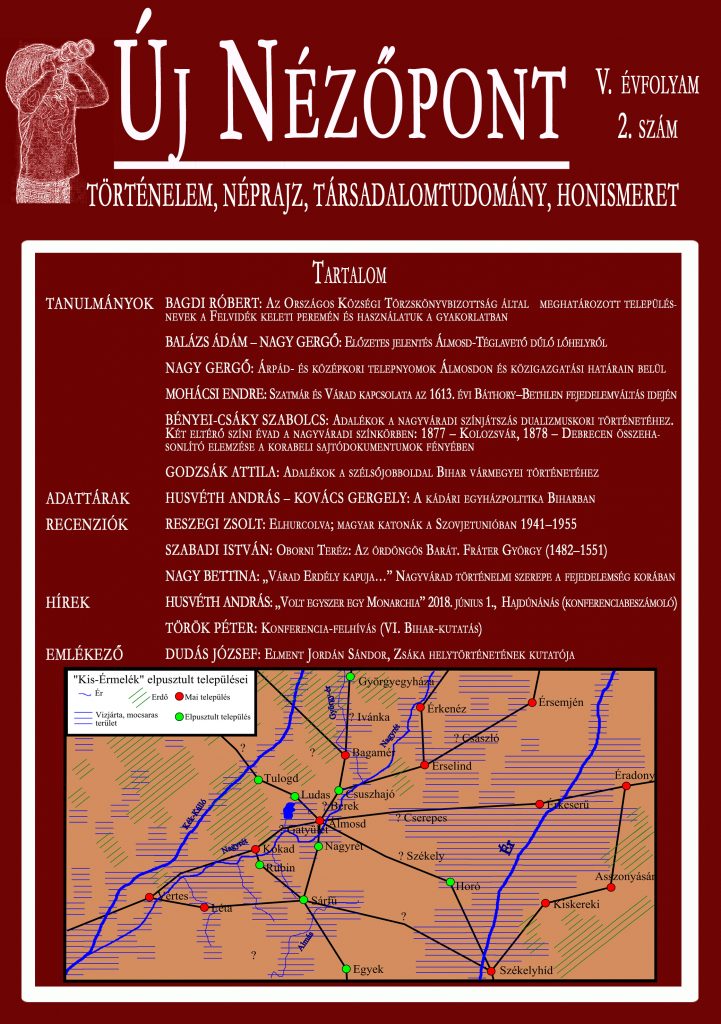
##issue.tableOfContents##
Research articles
-
Az Országos Községi Törzskönyvbizottság által meghatározott településnevek a Felvidék keleti peremén és használatuk a gyakorlatban
5-27Views:0In Hungary, it was during the era of Dualism that the historically developed names of settlements got systematized, as numerous names were in use that denoted not just one settlement. The framework of registration was defined by the 4th Law Article of 1898. In 1904, Zemplén county, while in 1905, Abaúj-Torna and Sáros counties received officially registered names, among which the rate of the changed names ranged from 55.7% (Abaúj-Torna) to 66.9% (Sáros) around the Eastern edge of Upper Hungary. In ourstudy, we aim to systematize the registered settlement names of these three counties on the basis of what methods prevail in the naming conventions, also showing on maps the real spatial distribution of those settlements. It can be verified based on the 1906 registers of Sátoraljaújhely in what rates the new settlement names had been adapted. Ultimately, it can be stated that the new settlementnames had not or very vaguely got adapted into practice. -
Előzetes jelentés Álmosd-Téglavető dűlő lelőhelyről
29-45Views:0This article describes the 2017 archaeological investigation of the site called Álmosd-Téglavető-dűlő Álmosd, carried out by the Déri Museum in preparation for the installation of an OGD gas pipeline. The site in question was discovered to include ceramic evidence of Neolithic, Bronze Age, Iron Age, Sarmatian Roman-Empire Age, and Medieval Ages during the preliminary field survey. A Scythian bronze arrowhead was discovered concurrent to the survey via metal detection. Furthermore, this report details the findings of the site's two-phase excavation. The initial excavation phase discovered seven objects, including six Bronze Age pits and one Mediaeval pit. The second phase was needed because OGD located three additional archaeological objects; the ensuing excavation ascertained that one object dated to the Bronze Age, one came from an unknown time period, and the remaining object was a Sarmatian warrior grave. In summation, this article details the archaeological significance and broader implications of the site and further promotes the importance of considering the materials found therein within the context of local parallels. -
Árpád- és középkori telepnyomok Álmosdon és közigazgatási határain belül
47-61Views:0The archaeologically researched nature of Álmosd is rather interleaved, the settlement has been an inhabited area since the prehistoric times up to nowadays because of its geographical location. The written sources from the Árpád Era and from the Middle Ages began to proliferate after the 14th Century, but these do not really tell too much. This results that we need to take other resources into consideration in this field: the geographical names and physical memories provide further information for the study of the settlement, with the help of which we can get closer to the settlement network of Érmellék in the Árpád Era and the Middle Ages.PDF0 -
Szatmár és Várad kapcsolata az 1613. évi Báthory–Bethlen fejedelemváltás idején
63-69Views:01613 is an important date both in the history of the Royal Hungary and of the Principality of Transylvania. In this year, the Turks put an end to the reckless and inordinate political career of Gábor Báthory, helping his former devotee, Gábor Bethlen, into the throne of Transylvania. With this, a long blooming started in the life of the Principality. The centre of Bihar county, the castle of Várad played an important strategical role already during the 15-Year War, Várad meant the gate to Transylvania. The Royal Hungary put efforts into getting the castle back – in vain – even after the death of Gábor Báthory. András Nagylucsei Dóczy received order for the turning over of Várad first as a royal commissioner, and then as the chief of the Castle of Szatmár. In my study, I present the relationship of the two castles in the closing days of the principality of Gábor Báthory based on the extensive correspondence of the chief of Szatmár. -
Adalékok a nagyváradi színjátszás dualizmuskori történetéhez. Két eltérő színi évad a nagyváradi színkörben: 1877 – Kolozsvár, 1878 – Debrecen összehasonlító elemzése a korabeli sajtódokumentumok fényében
71-82Views:0In my study, I aim to provide additions to the history of acting in the era of Dualism. I contrastively examine two summer acting seasons before the stone theatre of Oradea was built, mainly emphasizing the exploration of press documents. The literature of theatrical history only touched the two seasons I study. Therefore, the articles of the local press of the time that were of smaller scale, and provided a micro perspective, put into a new philological and historical perspective the migration movements of acting in Oradea in this period of a couple of decades. From a philological and literature-sociological point of view, I have processed all the articles, news, advertisements and other pieces of information from the two local newspapers, the political and economic Oradea, and the political Freedom dailies from the period between May 1877 and September 1878. During my work, I also used the Theatrical Pocketbook documenting the season of ClujNapoca, as well as the Acting Pocketbook of 1877 from Oradea, which remained in the local archives. Unfortunately, no other theatrical resource remained in Oradea from the 1870s and 1880s. I have experienced that the newspaper articles of the time are authentic documents, as they correspond about the life, theatre events, forming public taste, and opinions of theatre critics of the period. The articles, as micro-resources, provide an insight into the logic and expectations of the local audience. Analysing the gazette resources shed light on certain new correlations. During my research, I came to the conclusion that the Theatre of Cluj-Napoca continued classical acting and represented this as the oldest troupe of Transylvania during their tours. Similarly, to the travelling troupe of Debrecen, this was a guild of actors and actresses from several locations, led by one common goal: the successful guest appearances. During consecutive years in Oradea that had already been on the track of turning into a bourgeois settlement, of the two different troupes, the Debrecen-Oradea troupe accommodated more successfully to the circumstances and audience of the city than the Cluj-Napoca troupe. Perhaps this was the reason why Béla Mándoky’s troupe was called back in 1879, as well as 1880 to the city. -
Adalékok a szélsőjobboldal Bihar vármegyei történetéhez
83-96Views:0We know very little about the history of the extreme right in Bihar, the literature has never dealt with it, just like what the case was with other areas. Bihar county never belonged to the nests of the extreme right (unlike Zala, Szabolcs, or the not very far-off city of Debrecen). Nevertheless, three important events can be emphasized. One is that the main delegate of the Scythe Cross movement was from Bihar and wanted to clear theground for their ’military’ putsch in Bihar. The second event was that here was the first time that a candidate with a National Socialist programme ran for office at an interim parliamentary election. And last, the last open election of the Hungarian history took place here: it was an interim election in 1939, less than 4 months before the first and at the same time last secret parliamentary election of the era, at which one of the candidates was a National Socialist candidate. I aim to deal with these topics, enumerating a couple of pieces of data first as an introduction about the extreme right embedded nature of the county. Next, I introduce the sued Lajos Hatvani, who lived through the lawsuits against scythe crossers as the mainaccused person. In the third section, I review the interim elections of September 1933 and 2nd February 1939. In 1933, Zoltán Böszörmény himself, the leader of the scythe crossers, ran inefficiently, and in 1939, there were two challengers of the ruling party: a yeoman and an arrow-crosser also ran. The day of the latter election, as it turns out from the press of the period, was rather eventful, and it provides a great report on the political arrangement of the Horthy Era. -
A kádári egyházpolitika Biharban
97-115Views:0The supremacy of the church traditionally spread out to the whole life of people till the end of World War II. However, this was straight against the atheist views of the communist leadership that was gradually gaining power after 1945, so the churches like the ’Clerical Reaction’ became the number one ideological rivals and pursued by all means their fight off. The proceedings taking place in several arenas started off with the elimination of the economic power of the churches, the fighting off of their public and political acts and of their educational position. The complete bled out of the denominations continued with the formation of one priestpastor layer that was mostly loyal to and dependent on the realm, until the forceful turn to irreligiousness, which the original aim was, took place in the mid-70s. In the present study, we show the local manifestations of this event in Bihar, comparing them via several examples with country-wide events.
Recenziók
News
Emlékező
Databases
-
Elhurcolva; magyar katonák a Szovjetunióban 1941–1955
117-149Views:0At the end of the 1990s, early 2000s, the Russian Federation handed over to Hungary a database of 66 281 entries: a database of some of the names of Hungarian prisoners of war and civilian interned people who had died in Soviet POW and internment camps. The database was written in Russian, with Cyrill letters, and was in an Excel format, in which the picture of a personal data sheet, the so-called ’ucsetnoje gyelo’ can be ordered to each name. On the occasion of the GULAG Memorial Year, the Museum of Military History compiled a database that is reachable also on the internet for those interested, and with the help of which one can learn the names of people as well as settlements, military corps, ranks, and Soviet POW camps without the need for the researcher to dig into the literature. The database contains information on 240 people born in the Districts of Berettyóújfalu and Derecske. Among those, the Hungarian records of loss contain data on only 53, the destiny of the others can be learned from the new database.
Database Logos




Issues by Year
2026