
Vol. 4 No. 3 (2017)
Published
November 1, 2017
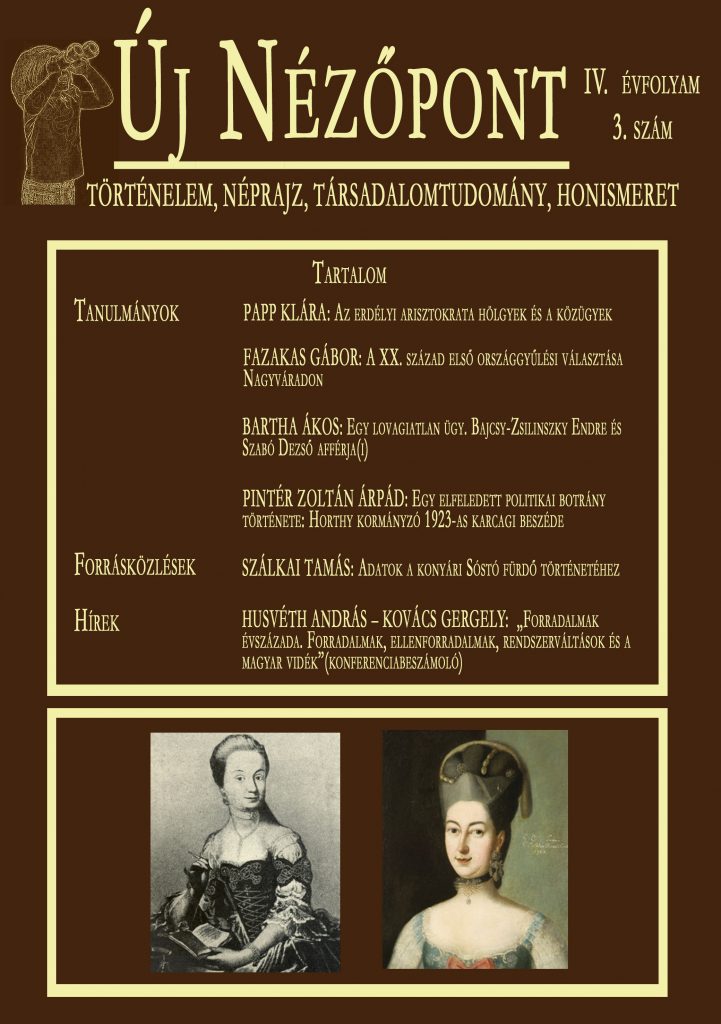
##issue.tableOfContents##
Research articles
-
Az erdélyi arisztokrata hölgyek és a közügyek
5-19Views:0This study examines the activities of Transylvanian aristocratic women based on personaldocuments (correspondence) from the second half of the 18th and first half of the 19thcentury. The members of the Csáky, Bethlen, and Jósika families were erudite, they were interestedin the problems of their environment, while also sensitively paying attention to the intentions of the Viennese Court besides politics. The aristocratic ladies gained useful knowledge regarding the social life primarily during social events, showers, and travels. They could also receive important information and judgement from letters discussing the foreign travels and meetings of men in their families. The aristocratic women showed interest in newspapers, and they also played a role in ordering certain press products. In the public life, it was the society of men that undertook a leading role. The accepted fields of activities for women were charity, aiding schools and the poor. Based on their literacy and political relations, Transylvanian aristocratic women (like Kata and Rozália Csáky) emerged, who drew attention by their interest, initiative, and theirown ventures, and became the founders of emerging civil initiatives. -
A XX. század első országgyűlési választása Nagyváradon
21-49Views:0The structure of the study is characterized by duality: it presents the whole election of 1901, and it also analyses the social distribution of the population participating in the parliamentary elections in Oradea. The appearance of the working class is one of the peculiarities of the parliamentary elections in Oradea. With the single vote they got, they did not really have a say in the competition, but they forecast their future presence in the political life of Hungary. Another characteristic feature is the outcome of the election of representatives: based onthe cast votes, the independentist Béla Barabás won against Kálmán Tisza. Based on a comparison of the list of electors and the number of votes, it became possible to examine the political behaviour and social distribution of those having the right to vote. According to the data, Tisza was supported by industrialists, a narrow spectrum of leaders in the administrative apparatus, and some part of the middle class, and he was less supported by the lower middle class. Barabás got support from the part of the middle class that was devoted to the conception of independence, and the majority of the lower middle class and peasantry. -
Egy lovagiatlan ügy. Bajcsy-Zsilinszky Endre és Szabó Dezső afférja(i)
51-78Views:1During his 1934 lecturing tour, Dezső Szabó read out a declaration on his 7th November presentation – coming as a surprise to the outsiders – in which he accused with peculation the so-called “Slovak Politician”, Endre Bajcsy-Zsilinszky, who had also been severely criticized for his political activity. The threads lead to the cooperation of Bajcsy-Zsilinszky and Szabó in 1928, and to the ambiguous sponsorship of the newspaper, Előörs (Outpost). In my study, I analyse the (changing) ideologies of these two bilious public figures and the meeting points of their lives, and then I detail the legal proceedings initiated by Bajcsy-Zsilinszky and his circle. Besides the fact that litigation gives insight into the functional mechanisms of public life of the day, the particular identity of the seething studentship of the 30s (which is hard to describe using traditional political categories, and which is usually depicted in a distorted manner in reminiscence) is outlined from the judicial materials of the lawsuits in Debrecen and the press reception of the period.PDF0 -
Egy elfeledett politikai botrány története: Horthy kormányzó 1923-as karcagi beszéde
79-92Views:1The long-known axiom in the world of politics is that not only written but spoken word, too, has weight and power. This is even more so when the words of a representative statemajesty are echoed in his own political environment, among his antipodes, and in the public opinion of other nations. Even at an event with a so marginal role as the 1923 inauguration of yeomen in Karcag, a scandal can be born and get international echo, if the first man of the state, Governor Horthy, who had been considered as the cornerstone of the system of counter-revolution, makes his thoughts and conviction public bluntly in ecstasy. But what a labyrinthine way does the uncertain content of a speech in Karcag take to get into the attention of the National Assembly, and then Little Entente diplomats? How does what was said in Karcag make its way into press in Prague, Paris, and London? How does the history of an interwar press scandal develop, and how does state powercover it up when it swells into an already unpleasant size? And what did the infamous speech contain? The author aims to provide answers and explanations to all this – in the light of resources.
Forrásközlések
-
Adatok a konyári Sóstó fürdő történetéhez
93-100Views:1The documents presented in this article, which can be found among the documentation of the office of the deputy lieutenant of Bihar county, provide additives to a more thorough study of the 20th century story of the bath operating in Sóstó. These documents reveal – among others – that almost half a century after the legal regulation, the institution illegally used the term “spa”, and that food and drink prices competed with those of Aranybika Debrecen. And of course, they include important information as to the sanitary situation of the bath in the period.
Database Logos




Issues by Year
2026