
Vol. 4 No. 1 (2017)
Published
April 13, 2017
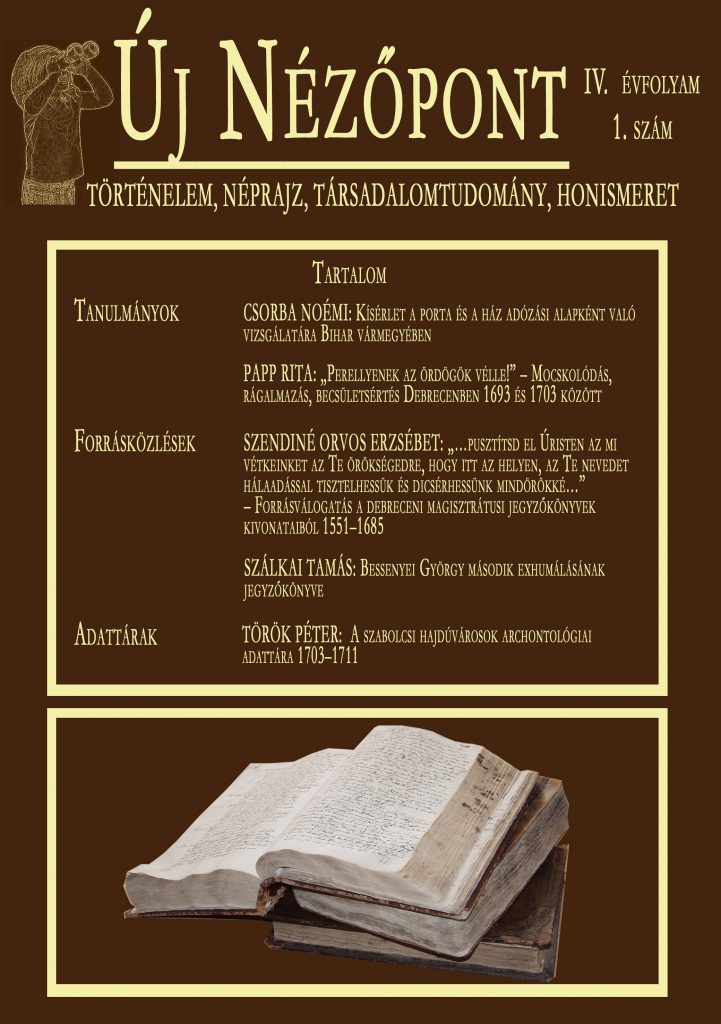
##issue.tableOfContents##
Research articles
-
Kísérlet a porta és a ház adózási alapként való vizsgálatára Bihar vármegyében
5-19Views:0A county which had continuously been exposed to Turkish incursions lying between the Kingdom of Hungary and Transylvania, and in which there were far-reaching fights for its possession provides an excellent research opportunity. The reason for this is that inthe second half of the 16th century, not only the Principality of Transylvania was beingformed, but Partium was also emerged by the name of Tiszántúl Parts largest region ofwhich was Bihar County. In the present study, I examined the site censuses of the 16th Century Bihar County preserved between 1552 and 1597, and the house censuses between 1598 and 1599. Most importantly, I would like to show – by using unpublished, primary sources and merging the results of the literature up to the present day – howimportant data can be retrieved by examining the site- and house censuses. My future goal is to map the society of holders, based on the censuses. -
„Perellyenek az ördögök vélle!” – Mocskolódás, rágalmazás, becsületsértés Debrecenben 1693 és 1703 között
21-34Views:0In my study, I examine litigations in the city of Debrecen on insults and slanders basedon magistrate and courthouse minutes between 1693 and 1703. First, I present the various insults and abuses based on examples, then the slanders and false accusations. The libel was considered a delicta privata act, that is, it was a private crime, and it was taken very seriously in the era, as in many cases, the subsistence of the contemporary citizens depended on their reputation.
Forrásközlések
-
„…pusztítsd el Úristen az mi vétkeinket az Te örökségedre, hogy itt az helyen, az Te nevedet hálaadással tisztelhessük és dicsérhessünk mindörökké…” – Forrásválogatás a debreceni magisztrátusi jegyzőkönyvek kivonataiból 1551–1685
35-58Views:0The text corpus collects the reformation related protocol records of Debrecen’s magistrate from the time between 1551 and 1685. The exact start date of the reformation in Debrecen is unknown, however, it certainly took its roots during the times of reformer Márton Kálmáncsehi Sánta in the 1550’s. Péter Méliusz Juhász had the most important role in the consolidation of the reformed religion. His work was supported by the rapidly spreading printing press and the reformed school, which served the propagation of Calvinism even more vividly. The organizational and doctrinal establishment of the reformed church ended by the Reformed Constitutional Synod in 1567 in Debrecen, where the Second Helvetic Confession was adopted. From this time on, Debrecen has become the main hub of Hungarian Calvinism. The change in the life of the city came when Debrecen acquired the free royal city status. The prerequisite of this was the admission of Catholics to the completely Hungarian, reformed city population. As a reply to the actions of the government and the church, the inhabitants of Debrecen responded with forceful adherence to the traditions of the civic city – which is also referred to as „Debreceniség”. The herein published sources show the most importantmoments of this process, and we can get an insight into the everyday life of Debrecen’s inhabitants.PDF0 -
Bessenyei György második exhumálásának jegyzőkönyve
59-66Views:0Since Bihar County's archival material preserved from the early 18th century therefore it is a real treasure for local history researchers. Its old pages are reporting about the history of the county and several settlements but also about significant, important, and sometimes simply interesting events. An example of the latter are the second exhumation protocol minutes of György Bessenyei, "the hermit of Bihar", who was one of the most dominant personalities of the Enlightenment. The document was lurking for decades and the coffin spike right next to it was also long-forgotten. I present the minutes by the occasion of the poet's 270th birth anniversary as a first stage of an ongoing research.
Databases
-
A szabolcsi hajdúvárosok archontológiai adattára 1703–1711
67-87Views:0The studies about the historical role of the seven Szabolcsian Haiduck towns (Böszörmény, Nánás, Dorog, Szoboszló, Hadház, Vámospércs, Polgár) are mostly concentrated around the 17th century. Therefore, the Rákóczi War of Independence period still has a number of open questions in store for the researchers. The archontological data bank covers the eight years of the War of Independence, laying the foundation ofthe urban elite’s identification. While collecting the names of the officers, we used the current literature data in addition to city documents, but the creation of the comprehensive list – due to resource facility – still awaits and requires further studies. The Haiduck towns elected their officials on an annual basis. They served the settlementsfrom St. George’s Day (24th April) to St. George’s Day. The lieutenant was the leader of the city, and his work was helped by the minimum 12-member council, the town clerk, the street lieutenant and various supervisors. The current data bank is a good basis forfurther studies to present the urban elite.
Database Logos




Issues by Year
2026