
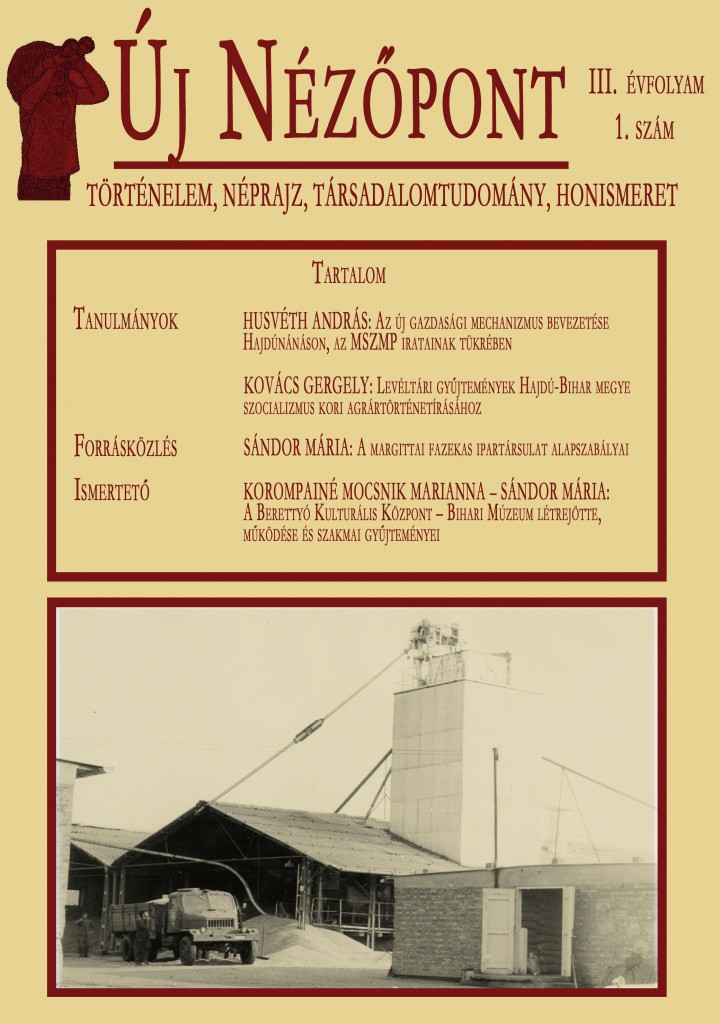
Tanulmányok
Az új gazdasági mechanizmus bevezetése Hajdúnánáson, az MSZMP iratainak tükrében
Megjelent:
2016-04-25
Szerző
Megtekintés
Kulcsszavak
Licenc
Copyright (c) 2016 András Husvéth (Author)

This work is licensed under a Creative Commons Attribution 4.0 International License.
Absztrakt
The study examines through the example of Hajdúnánás, a plainsfolk agricultural-like town, that due to the political lessons of the 1956 revolution and the failure of the previous economic policy, the new economic management implemented a complex reform which was unique among the Soviet bloc countries: the New Economic Mechanism. The thesis also evaluates the role of the state party's local organization in the preparation and implementation of the program. The research shows that in Hajdúnánás, just like on the state level, the reforms mostly brought advancement. This made it fundamentally possible for the agriculture to become the success industry of the Kádár era, and for the city’s industrial factories to make a big step forward from the rigid system of plan directions to a business-like management. Although the New Economic Mechanism was finally blown, its effect left a significant mark on the economy of the Kádár era, and thanks to that Hungary became one of the most livable states in the socialist camp as „the happiest barrack”.