
Vol. 73 No. 4 (2024)
Published
December 31, 2024
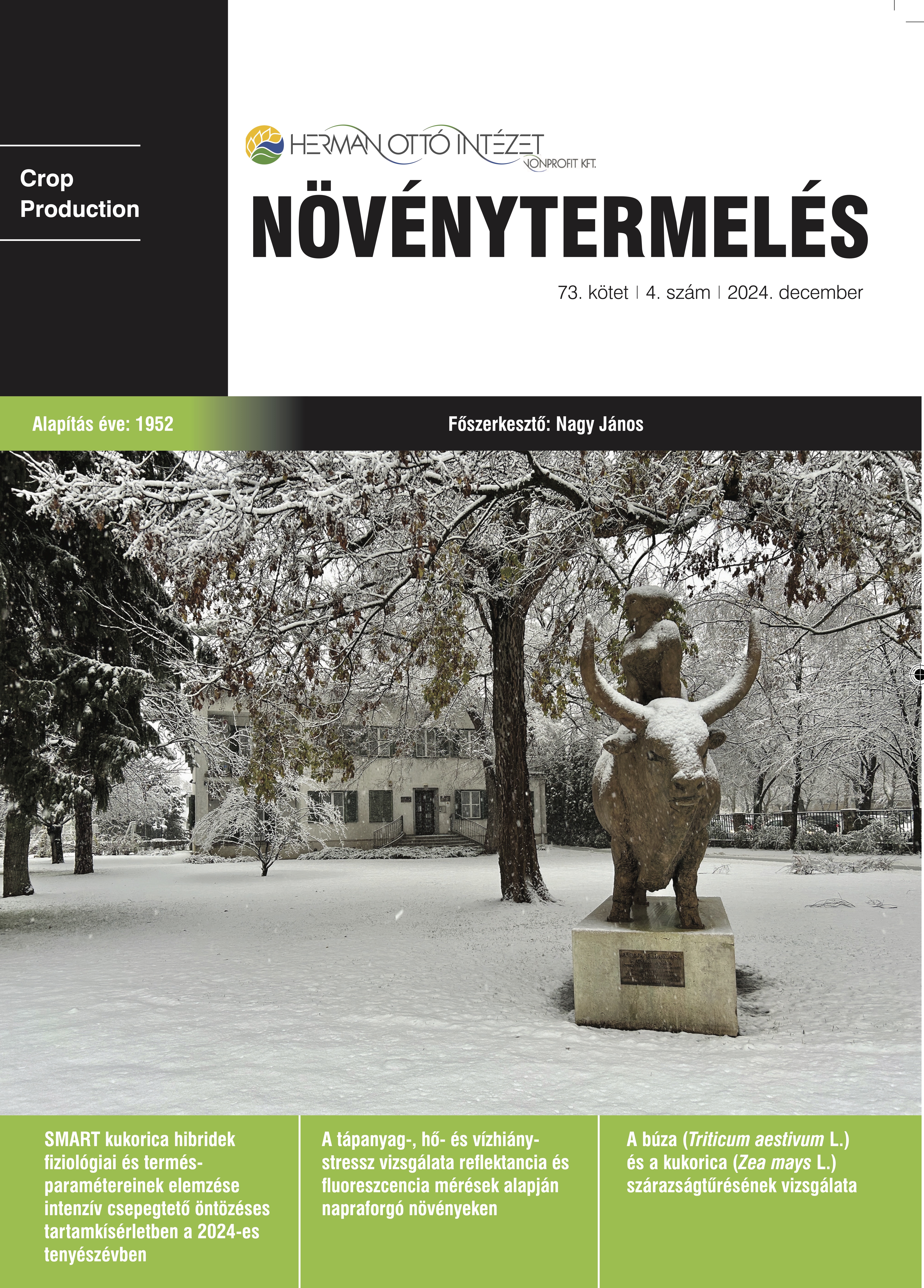
##issue.tableOfContents##
Folyóiratcikk
-
Analysis of physiological and yield parameters of smart maize hybrids in an intensive drip irrigation long-term experiment in the growing year 2024
5-24Views:65The yield and plant physiological parameters of different FAO maize hybrids grown over a large area in Hungary were examined under drip irrigation conditions. The results of the study showed that hybrid H4 was the best performing hybrid in terms of yield, specific grain weight, ear weight and thousand kernel weight. Hybrid H6 showed similarly good results, especially in grain number, suggesting that it may also play a role in increasing yield. The medium performance of hybrids H5 and H3 indicates that they are potentially competitive. The trends observed in the analysis of NDVI values provide important information on the growth patterns of the examined hybrids. For hybrid H1, the sharp decline in the second half of the growing season is indicative of the stress situation of the plants. Hybrids H1, H2 and H3 developed under optimal conditions in the V12 phenological phase, but could not maintain the early growth stage in the later phases. In contrast, hybrid H4, which had a longer growing season, was able to maintain its vegetative activity after the V12 phase. When SPAD values were examined, the H1, H5 and H6 hybrids maintained growth until the V12 phase, then declined after the R4 phase. Hybrid H4 showed the highest SPAD values in the R5 phase, while hybrids H1, H5 and H6 showed more stable SPAD values, but decreased in the later phases. Overall, the outstanding performance of hybrids H4 and H6 suggests that these hybrids should be preferred in intensive production environments with good yield potential. -
Analysis of nutrient, heat and water deficit stress by reflectance and fluorescence measurements in sunflower plants
25-42Views:59During the experiment we used several types of data collection, reflectance measurements, fluorescence measurements, photosynthesis measurements and pigment content measurements. We calculated vegetation indices from the reflectance spectra and selected the most useful ones from the fluorescence data. Photosynthesis and pigment content measurements were correlated with vegetation indices. Among the indices, the VIgreen index proved to be effective in detecting and partitioning abiotic stresses and in determining nitrogen supply. The PRI index correlated best with the level of photosynthesis and the mNDVI index showed a strong correlation with pigment content.
By examining several fluorescence parameters, we conclude that the Fs value can be useful for detecting water stress, especially when measured in parallel with reflectance measurements from which the sensitivity to senescence index (PSRI) can be calculated.
This observation may also be useful in field conditions, as short-term water deficit stress increases, while long-term stress decreases (due to loss of pigmentation) fluorescence (Fs). -
Examination of drought tolerance in wheat (Triticum aestivum L.) and maize (Zea mays L.)
43-46Views:63The experiments were set up in the foil tent in Szarvas, at the Galambos experimental site belonging to the MATE KÖTI Department of Irrigation Development and Land Improvement. 10 liter white plastic buckets were used as cultivation pot. The diameter of the bucket is 27.5 cm, so the ground surface is 593.6 cm2. The wheat experiment was set up on November 4, 2020, with 3 wheat varieties, at 3 water supply levels (Field Water Capacity „FWC”; FWC40%, FWC60% and FWC80%) in 3 repetitions, in a total of 27 cultivation pots. The maize experiment was set up on April 19, 2021, with 5 maize hybrids, at 3 water supply levels, in 3 repetitions, in a total of 45 cultivation pots.
In the soil we use, the amount of parts that can be silted is 31.6%, so it is a sandy loam physical type soil, the chemistry is weakly acidic (pHH2O 6.54), based on the total salt content soluble in water, it has a low salt content (salt%<0.1).
In the experiment, the drought tolerance of 3 different wheat varieties (MV Nemere, GK Szilárd and Sothys) and 5 maize hybrids (GKT 4486 (Lehel), GK SILOSTAR, GKT 372, GKT 376, GKT 3385) was investigated under conditions deprived of natural precipitation.
The following phenological parameters were measured in the experiment: Relative chlorophyll content (SPAD) with a Konica SPAD 501 instrument, Leaf area (cm2) (CI-203 Handheld Laser Leaf Area Meter), Leaf area index (LAI m2/m2), Plant height (cm), Leaf and stem weight (g), Root weight (g), Ear/Tube weight (g) and yielding parameters.
In the experiment, all three wheat varieties responded very well to the increase in water content. Total biomass and root mass also increased, but the change from FWC40% to FWC60% was on a larger scale than from FWC60% to FWC80%.
When examining the amount of grain yield, in the case of the lowest water supply (FWC40%), the most yield was produced by Sothys (34.15 g/cultivation pot; 5.75 t/ha), while the lowest yield was given by Mv Nemere (26.69 g/cultivation pot); 4.50 t/ha). The largest yields were obtained in the case of the best water supply. Sothys produced a very good yield (69.58 g/cultivation pot; 11.72 t/ha) with a water supply of FWC80%, and the lowest yield here was also achieved by MV Nemere (56.70 g/cultivation pot; 9.55 t/ha) with yield.
The quality test results of the wheat showed that the quality parameters of the three investigated varieties uniformly deteriorated as a result of the increased water supply. The value of the larger amount of available water increases the yields, which negatively affected the quality.
From the results of the maize experiment, it can be deduced that the chlorophyll content of the maize hybrids was higher with good and average water supply (FWC80% and FWC60%), and that the hybrids remained green longer and photosynthesized longer, that is, the growing time of the maize hybrids was extended with good water supply.
In dry conditions (FWC40%), the performance of two hybrids was outstanding. Under these conditions, the maize hybrids GKT 372 and GKT 376 gave 65% more cob mass than the hybrids following them. The other important investigated property is the "irrigation reaction" of the hybrids. Based on our tests, GK SILOSTAR is a maize hybrid with a good reaction to irrigation but sensitive to drought, while GKT 376 is a maize hybrid with an excellent reaction to irrigation and also drought tolerance. -
Agrometeorological characteristics of the 2024 maize growing season in Debrecen-Látókép
67-78Views:154The impact of weather on yields is realised in a complex interaction with agrotechnical factors. In this agrometeorological study for the year 2024, the main meteorological factors determining yields were analysed in relation to the agrotechnical elements and phenophases. The research was based on air temperature, soil temperature and precipitation measurements at the Látókép Experimental Station of the University of Debrecen and on sunshine duration data from the HungaroMet Debrecen Airport Station.
It can be concluded that the year 2024 was characterised by a marked duality in terms of maize production. The weather was favourable until June. Water availability was still adequate (partly due to favourable initial water availability in the soils) and temperatures were mostly above the multi-year average, without periods of extreme heat. Overall, this resulted in a well-developed stand with high yield potential. Subsequently, the weather changed fundamentally. Both July and August mean temperatures were close to record highs (24.2 °C). One of the heatwave peaks was in mid-July, coinciding in several places with the most heat stress-sensitive flowering phenophases of maize. The persistent, extremely hot weather in July-August was primarily responsible for the yield depression in the 2024 growing season. The below-average rainfall, combined with a significant soil depression, mainly during the maturing period. The combination of the soil trough, the atmospheric drought and the extremely high air temperatures caused the significant yield losses. -
Dry matter incorporation and water loss dynamics of different FAO maize hybrids
79-102Views:163Based on the results of our field experiments, we evaluated the most important values and parameters of four different FAO maize hybrids. For the evaluation of the performance and quality of the hybrids, we used the useful heat sum (HU) values for the developmental stages as a novel approach.
For each of the four different FAO hybrids, we investigated in a novel and unique way the useful heat sum requirement of maize hybrids in the most important phenophases preceding dry matter incorporation and water loss dynamics. We also recorded the number of days from emergence at each phenophase, allowing comparison with literature data. Dry matter incorporation was assessed at R2, R4 (wax maturity) and physiological maturity, and at harvest. The dry matter incorporation dynamics study was started on 31/07/2023 for the four different FAO hybrids to meet the requirement of a reliable comparison.
The reliable sampling data allowed the analysis of the water release dynamics in the light of thermal energy use. Three water discharge intervals were evaluated between the four sampling dates.
The yields of four maize hybrids with different FAO numbers were significantly different. The highest yields were obtained by the hybrid with excellent ability FAO 480 (19.53 t/ha).
In all cases, the grain moisture content at harvest of the maize hybrids tested was closely related to the length of the growing season. The grain moisture content of the hybrids differed significantly at harvest.
Starch content was closely related to yield, with the FAO 480 hybrid having the highest yield and starch content, while the FAO 350 hybrid had the lowest yield and starch content. Specific protein content showed a strong inverse correlation with yield. The FAO 350 hybrid had the lowest yield (13.62 t/ha) and the highest protein content (7.69%), while the FAO 480 hybrid had the highest yield (19.53 t/ha) and the lowest protein content (5.78%). In all cases, the oil content of the maize hybrids tested showed a strong correlation with yield. The oil contents of the hybrids were significantly different.
The new research results suggest a strong correlation between oil synthesis and yield per hectare, but further field experiments and laboratory tests are needed to confirm this. -
Correlation between quality and quantity of winter wheat (Triticum aestivum L.) in different crop years
103-118Views:75Winter wheat is one of the most popular arable crops in Hungary and worldwide. Its cultivation dates back thousands of years and it is one of the most versatile crops. Its most important role lies in human nutrition, as it is an important staple food for mankind. The global population boom has led to an increasing demand for food raw materials of sufficient quantity and quality. The most important quality parameters for winter wheat are protein content, gluten content, gluten content, starch content and Zeleny index.
In this comparative genotype experiment, the quality parameters and the relationship between the quantity and quality of winter wheat of different genotypes were investigated in two different rainfall years: a drought year (2021/2022) and a rainfall year (2022/2023). The obtained results show that in the rainy year, the genotypes had significantly higher yield averages and on average higher values for moisture and protein content. Pearson's correlation analysis was used to examine the relationship between the quantity and quality of yield for each genotype in both growing seasons and averaged over the two growing seasons. It was found that quality parameters were negatively correlated with yield quantity when averaged over the two examined years and genotypes. -
Innovative nutrient conservation techniques in horticultural practice
119-134Views:53In recent decades, drought-induced crop losses have caused significant losses for farmers. Therefore, it is an urgent task for researchers to find innovative solutions that can mitigate crop losses and can be successfully applied in agricultural practice.
Our aim was to transform chicken manure from large-scale poultry farming, which is considered hazardous waste, into composite products by further additions that increase soil organic matter content and have a positive effect on mineralisation processes.
In our experiments, superabsorbent polymers were added as additives to the fermented chicken manure in two different doses (S1 and S2) and their effects on soil parameters were investigated. The results obtained were compared with the control (K) and chicken manure only (KNEX) treatments.
Soil analyses were carried out every six weeks to check the effect of the treatments applied. The results obtained showed that the composite products were effective in increasing soil organic matter content compared to the control.
Our results show that the composite products increase the soil organic nitrogen content over time and have a positive effect on mineralization processes.
In brown forest soils with a poor nutrient supply capacity and a sand texture, we measured a nitrate content of 140–170 mg/kg in the topsoil in the treatments.
This confirms the idea that these composite products are useful for enhancing mineralization and increasing water retention, especially in soils with low nutrient sources and low organic matter content.
Book review
Database Logos


Keywords
Make a Submission
Issues by Year