
Folyóiratcikk
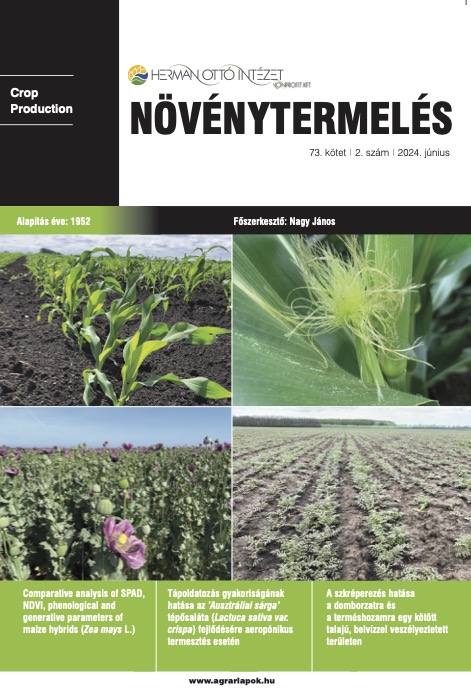
Effect of basal and top-dressing fertilisation and irrigation on leaf area index and yield in maize stands
Published:
2024-06-30
 https://doi.org/10.12666/21qqfz52
Authors
View
Keywords
License
Copyright (c) 2024 Péter Zagyi, Éva Horváth, András Tamás, Károly Simon, Adrienn Széles

This work is licensed under a Creative Commons Attribution 4.0 International License.
How To Cite
Selected Style:
APA
Zagyi, P., Horváth, É., Tamás, A., Simon, K., & Széles, A. (2024). Effect of basal and top-dressing fertilisation and irrigation on leaf area index and yield in maize stands. Növénytermelés, 73(2), 101-118. https://doi.org/10.12666/21qqfz52
Abstract
The effects of basal and top-dressing fertilisation and irrigation on leaf area index (LAI) and yield in maize in an extreme dry year (2022) were investigated. The studies were carried out in Hungary, at the University of Debrecen Látókép Experiment Site on calcareous chernozem soil. In the field experiments, nitrogen (N) was applied as a basal and top-dressing fertiliser in split rates in a non-fertilised control (A0). The spring application rates of 60 and 120 kg N/ha (A60, A120), applied as spring basal fertiliser, were followed by two top dressings at V6 and V12 phenophases (V690, V6150 and V12120, V12180), at rates of +30 and +30 kg N/ha, respectively. The application rate was 115 mm of irrigation water. Based on the results of the test year, it can be concluded that in the different phenological stages (V8, V10, V12, Vn, VT, R1 R3, R6), averaged over the hybrids and treatments, LAI values increased in the vegetative development stage. The highest value was observed in the Vn phenological phase (irrigated 3.074±0.595; non-irrigated: 2.495±0.324) (p<0.05). The lowest LAI values were measured in the A0 treatment (irrigated: 1.663±0.633; non-irrigated: 1.324±0.455), while the highest values were measured in both irrigated (2.620±0.928 m2/m2; p<0.05) and non-irrigated (1.702±0.622; p<0.05) conditions in the A120 treatment. There was no significant increase in LAI as a result of top-dressing. The lowest fertiliser rate (A60) increased yield by 92.3% under irrigated conditions and by 64.7% under non-irrigated conditions compared to the A0 treatment. The 120 kg N/ha basal treatment resulted in a further yield increase compared to the 60 kg N/ha basal treatment (irrigated: +19.8%; non-irrigated: +24.4%). The highest significant yield was obtained with the A120 treatment (irrigated: 11.863±1.104 t/ha; non-irrigated: 8.649±0.971 t/ha; p<0.05). A different degree of correlation between LAI and yield was found as the phenological stages progressed. Under irrigated conditions, LAI values measured at the VT (r=0.753***) phenophase had the greatest effect on yield. Under non-irrigated conditions, the Vn (r=0.602***) phenological stage showed the strongest correlation between the two factors. The research carried out contributes to increase the target yield, to achieve sustainable production and to make appropriate decisions in extreme dry years.

