
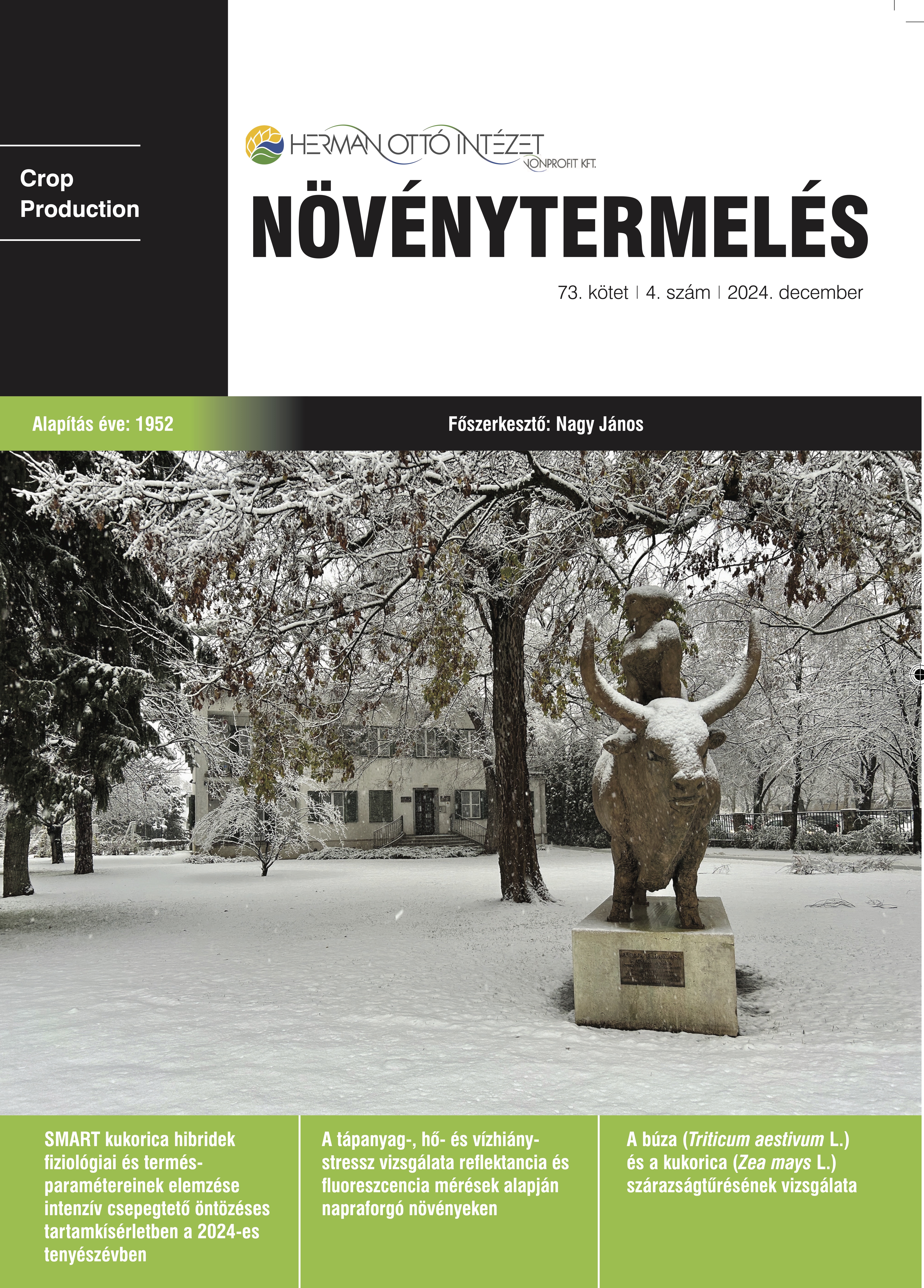
Folyóiratcikk
Eltérő FAO számú kukorica hibridek szárazanyag-beépülési és vízleadási dinamikája
Megjelent:
2024-12-31
 https://doi.org/10.12666/v4azdp18
Szerzők
Megtekintés
Kulcsszavak
Licenc
Copyright (c) 2024 Endre Harsányi, Zsuzsa Erdős, János Nagy

This work is licensed under a Creative Commons Attribution 4.0 International License.
Hogyan hivatkozzuk
Kiválasztott formátum:
APA
Harsányi, E., Erdős, Z., & Nagy, J. (2024). Eltérő FAO számú kukorica hibridek szárazanyag-beépülési és vízleadási dinamikája. Növénytermelés, 73(4), 79-102. https://doi.org/10.12666/v4azdp18
Absztrakt
A szántóföldi tartamkísérleteink eredményei alapján értékeltük négy eltérő FAO számú kukorica hibrid legfontosabb értékeit, paramétereit. A hibridek teljesítményének és minőségének értékeléséhez újszerűen a fejlődési fázisokhoz felhasznált hasznos hőösszeg (HU) értékeket használtuk.
Mind a négy eltérő FAO számú hibridnél újszerűen és egyedülálló módon vizsgáltuk a szárazanyag-beépülési és vízleadási dinamikát megelőző legfontosabb fenofázisokban a kukorica hibridek hasznos hőösszeg-igényét. Az egyes fenofázisokban rögzítettük a keléstől eltelt napok számát is, lehetőséget adva az irodalmi adatokkal való összevetésre. A szárazanyag-beépülést vizsgáltuk az R2, az R4 (viaszérés) és a fiziológiai érés állapotában, valamint a betakarítás időpontjában. A szárazanyag-beépülési dinamikai vizsgálatát 2023. 07. 31-én kezdtük meg a négy eltérő FAO számú hibridnél, a megbízható összehasonlítás követelményének megfelelve.
A megbízható mintavételi adatok lehetővé tették a vízleadási dinamika elemzését a hőenergia felhasználásának tükrében. A négy mintavételi időpont között három vízleadási intervallumot értékeltünk.
A négy eltérő FAO számú kukorica hibrid terméseredményei szignifikánsan különböztek. A legnagyobb terméseredményt a FAO 480 (19,53 t/ha) kiváló képességű hibrid érte el.
A vizsgált kukorica hibridek betakarításkori szemnedvesség-tartalma minden esetben szoros összefüggést mutatott a tenyészidőszak hosszával. A hibridek szemnedvesség-tartalma szignifikánsan különbözött a betakarítás idején.
A keményítőtartalom szorosan összefüggött a terméseredménnyel, a FAO 480 hibrid a legnagyobb terméseredményt és a legmagasabb keményítő tartalmat érte el, ugyanakkor a legkisebb termést és legkisebb keményítőtartalmat a FAO 350 hibrid mutatta. A fajlagos fehérjetartalom szoros, fordított összefüggést mutatott a terméseredménnyel. A FAO 350 hibrid a legkisebb terméseredményt (13,62 t/ha) és a legmagasabb (7,69%) fehérjetartalmat, a FAO 480 hibrid a legnagyobb terméseredményt (19,53 t/ha) és a legalacsonyabb (5,78%) fehérjetartalmat érte el. A vizsgált kukorica hibridek olajtartalma szoros összefüggést mutatott minden esetben a termésmennyiséggel. A hibridek olajtartalmai szignifikánsan eltérőek voltak.
Az új kutatási eredmények szoros összefüggésre utalnak az olajszintézis és a hektáronkénti terméseredmények között, ezek igazolására további szántóföldi kísérletek és laborvizsgálatok szükségesek.
Mind a négy eltérő FAO számú hibridnél újszerűen és egyedülálló módon vizsgáltuk a szárazanyag-beépülési és vízleadási dinamikát megelőző legfontosabb fenofázisokban a kukorica hibridek hasznos hőösszeg-igényét. Az egyes fenofázisokban rögzítettük a keléstől eltelt napok számát is, lehetőséget adva az irodalmi adatokkal való összevetésre. A szárazanyag-beépülést vizsgáltuk az R2, az R4 (viaszérés) és a fiziológiai érés állapotában, valamint a betakarítás időpontjában. A szárazanyag-beépülési dinamikai vizsgálatát 2023. 07. 31-én kezdtük meg a négy eltérő FAO számú hibridnél, a megbízható összehasonlítás követelményének megfelelve.
A megbízható mintavételi adatok lehetővé tették a vízleadási dinamika elemzését a hőenergia felhasználásának tükrében. A négy mintavételi időpont között három vízleadási intervallumot értékeltünk.
A négy eltérő FAO számú kukorica hibrid terméseredményei szignifikánsan különböztek. A legnagyobb terméseredményt a FAO 480 (19,53 t/ha) kiváló képességű hibrid érte el.
A vizsgált kukorica hibridek betakarításkori szemnedvesség-tartalma minden esetben szoros összefüggést mutatott a tenyészidőszak hosszával. A hibridek szemnedvesség-tartalma szignifikánsan különbözött a betakarítás idején.
A keményítőtartalom szorosan összefüggött a terméseredménnyel, a FAO 480 hibrid a legnagyobb terméseredményt és a legmagasabb keményítő tartalmat érte el, ugyanakkor a legkisebb termést és legkisebb keményítőtartalmat a FAO 350 hibrid mutatta. A fajlagos fehérjetartalom szoros, fordított összefüggést mutatott a terméseredménnyel. A FAO 350 hibrid a legkisebb terméseredményt (13,62 t/ha) és a legmagasabb (7,69%) fehérjetartalmat, a FAO 480 hibrid a legnagyobb terméseredményt (19,53 t/ha) és a legalacsonyabb (5,78%) fehérjetartalmat érte el. A vizsgált kukorica hibridek olajtartalma szoros összefüggést mutatott minden esetben a termésmennyiséggel. A hibridek olajtartalmai szignifikánsan eltérőek voltak.
Az új kutatási eredmények szoros összefüggésre utalnak az olajszintézis és a hektáronkénti terméseredmények között, ezek igazolására további szántóföldi kísérletek és laborvizsgálatok szükségesek.

