
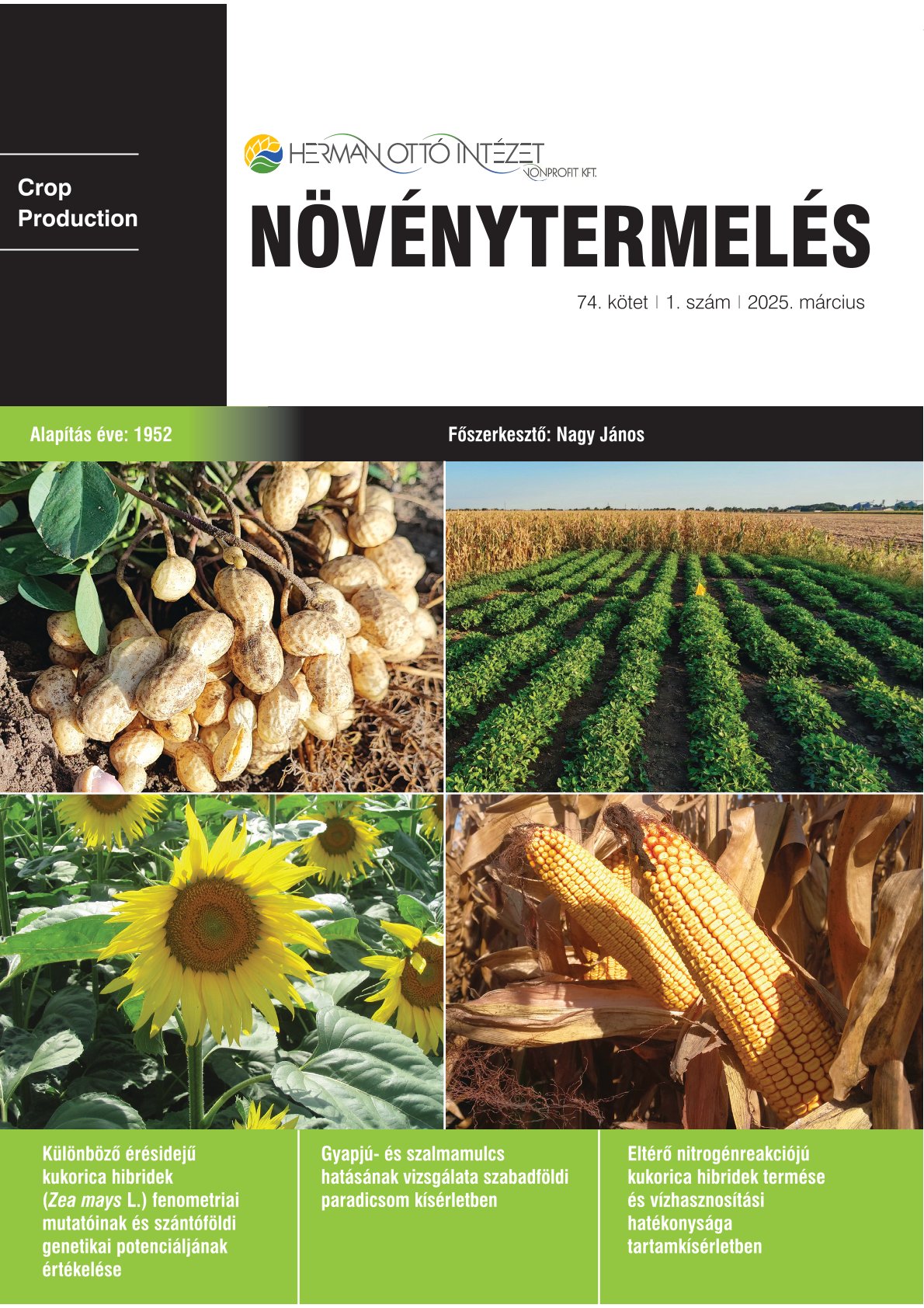
Folyóiratcikk
Yield and water use efficiency of maize hybrids with different nitrogen responses in a long-term experiment
Published:
2025-03-31
 https://doi.org/10.12666/yjdydg29
Authors
View
Keywords
License
Copyright (c) 2025 Zoltán Bódi, János Nagy

This work is licensed under a Creative Commons Attribution 4.0 International License.
How To Cite
Selected Style:
APA
Bódi, Z., & Nagy, J. (2025). Yield and water use efficiency of maize hybrids with different nitrogen responses in a long-term experiment. Növénytermelés, 74(1), 35-48. https://doi.org/10.12666/yjdydg29
Abstract
Precision crop production and precision nutrient supply are essential factors in modern agricultural practice. The positioning of new maize hybrids is possible with accurate knowledge of the nutrient needs and responses of plants. As our climate becomes increasingly extreme, the exposure of crop production to weather conditions continues to increase, which requires the cultivation and breeding of hybrids that successfully adapt to the environment. In this study, we tested two Syngenta maize hybrids in a long-term experiment at six nitrogen rates (control N0 kg/ha dose and level 60 kg/ha with nitrogen doses increasing to 300 kg/ha), on irrigated and non-irrigated platforms. The experiment was carried out in a drought year (2021), which is not ideal for maize, with poor rainfall. Based on the results, the hybrids showed two different fertilizer reactions.
We can classify SY Minerva as a “workhorse”. This group of hybrids is characterized by the fact that they give sufficient yield even on variable soils, their nitrogen response is already marked at low doses (possibly even without nitrogen application, N0+PK 7.23 t/ha and 9.55 t/ha on non-irrigated and irrigated platforms), at higher doses the nitrogen response is more moderate, and yield depression is also experienced, as in the experimental results (the difference between N240+PK and N300+PK levels was -1.77 t/ha on the non-irrigated platform). The initial (N0 kg/ha active ingredient) nitrogen response of the “racehorse” SY Solandri hybrid is low, however, by increasing the nitrogen dose to a high level, they show an outstanding increase in yield under ideal, near-ideal environmental conditions. This can be seen from the yield response to No+PK and N240+PK levels on both platforms.
On non-irrigated and irrigated platforms, N0+PK levels were 4.62 t/ha and 6.11 t/ha, respectively. N240+PK also produced yields of 10.94 t/ha and 13.25 t/ha under non-irrigated and irrigated conditions. SY Minerva showed outstanding water use results in both treatments with values of 44.4 kg and 40.1 kg/mm in the control plots (N0+PK). SY Solandri had significantly better WUE (Water Use Efficiency) and IRRWUE (IRRigated Water Use Efficiency) values (28.3 and 25.7 kg/mm). Irrigation showed outstanding results for both hybrids in both platforms with optimal N240+PK supply. SY Solandri had an extremely high value of 67.1 kg/mm in the non-irrigated treatment.
Based on results, it can be concluded that genotype plays a major role in the development of water use efficiency, fertilization positively influenced the WUE and IRRWUE values of both tested hybrids related to the control plot.
We can classify SY Minerva as a “workhorse”. This group of hybrids is characterized by the fact that they give sufficient yield even on variable soils, their nitrogen response is already marked at low doses (possibly even without nitrogen application, N0+PK 7.23 t/ha and 9.55 t/ha on non-irrigated and irrigated platforms), at higher doses the nitrogen response is more moderate, and yield depression is also experienced, as in the experimental results (the difference between N240+PK and N300+PK levels was -1.77 t/ha on the non-irrigated platform). The initial (N0 kg/ha active ingredient) nitrogen response of the “racehorse” SY Solandri hybrid is low, however, by increasing the nitrogen dose to a high level, they show an outstanding increase in yield under ideal, near-ideal environmental conditions. This can be seen from the yield response to No+PK and N240+PK levels on both platforms.
On non-irrigated and irrigated platforms, N0+PK levels were 4.62 t/ha and 6.11 t/ha, respectively. N240+PK also produced yields of 10.94 t/ha and 13.25 t/ha under non-irrigated and irrigated conditions. SY Minerva showed outstanding water use results in both treatments with values of 44.4 kg and 40.1 kg/mm in the control plots (N0+PK). SY Solandri had significantly better WUE (Water Use Efficiency) and IRRWUE (IRRigated Water Use Efficiency) values (28.3 and 25.7 kg/mm). Irrigation showed outstanding results for both hybrids in both platforms with optimal N240+PK supply. SY Solandri had an extremely high value of 67.1 kg/mm in the non-irrigated treatment.
Based on results, it can be concluded that genotype plays a major role in the development of water use efficiency, fertilization positively influenced the WUE and IRRWUE values of both tested hybrids related to the control plot.

