
Folyóiratcikk
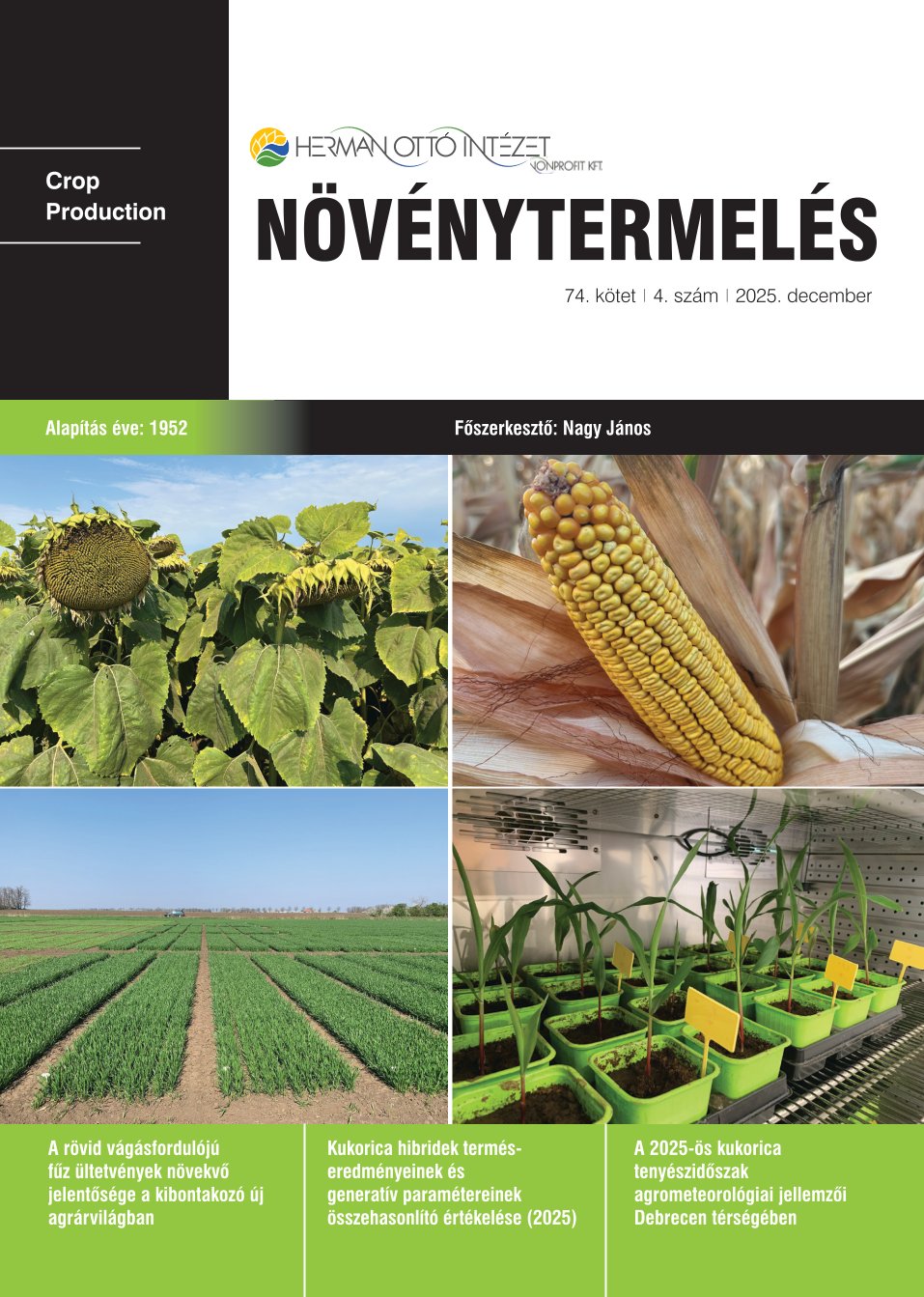
Comparative evaluation of yield results and generative parameters of maize hybrids (2025)
Published:
2025-12-31
 https://doi.org/10.12666/hw3k0z82
Authors
View
Keywords
License
Copyright (c) 2025 László Hadászi, Dávid Horváth

This work is licensed under a Creative Commons Attribution 4.0 International License.
How To Cite
Selected Style:
APA
Hadászi, L., & Horváth, D. (2025). Comparative evaluation of
yield results and generative parameters of
maize hybrids (2025). Növénytermelés, 74(4), 21-44. https://doi.org/10.12666/hw3k0z82
Abstract
There were significant differences in yield and morphology among the maize hybrids included in the experiment based on the 2025 growing season. The H6 hybrid proved to be the best performing genotype, excelling in terms of yield (21.20 t/ha), individual grain weight (258.19 g), number of kernels, and thousand kernel weight (488.72 g), and achieved significantly better results than the other hybrids in several traits. The H3 hybrid also showed high yield potential (19.36 t/ha) and resulted in high grain weight and favorable SPAD values, proving to be the second most productive genotype. The H5, H4, and H2 hybrids can be classified as normal performers, producing stable but more moderate yield levels and grain weight, but there were significant differences in yield among these hybrids. SPAD values and NDVI values showed clear differences between the hybrids. The H4, H3, and H5 hybrids achieved outstanding SPAD values during the vegetative stage, indicating rapid initial development, while the H6 and H2 hybrids showed balanced SPAD dynamics throughout the entire growing season. Based on NDVI values, the H2 and H5 hybrids proved to be the most stable in the generative stage, indicating their good stress tolerance. Overall, the study showed that yield is influenced by grain weight, grain number, and plant condition indicators, and that the H6 and H3 hybrids represent outstanding agronomic value based on several parameters. Based on these findings, it can be concluded that different genotypes responded differently to the agrometeorological effects present during the unfavorable growing season of 2025, even with the use of drip irrigation.

