
Vol. 72 No. 1 (2023)
Published
March 31, 2023
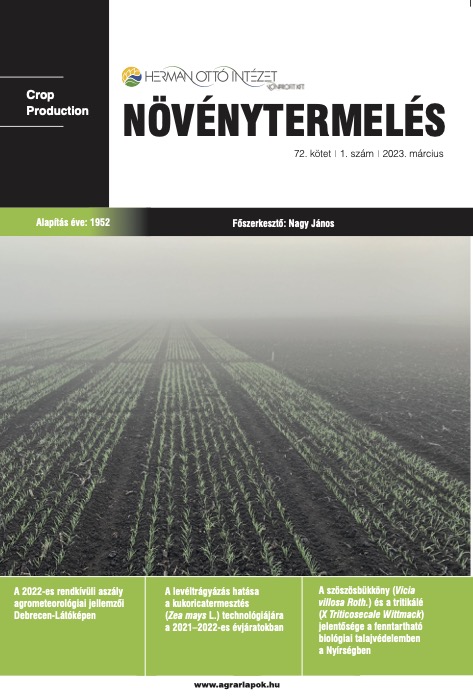
##issue.tableOfContents##
Folyóiratcikk
-
Agrometeorological characteristics of the extreme drought of 2022 in Debrecen-Látókép
5-18Views:158A large part of Hungary, including the Debrecen area, was facing a very severe drought in 2022. Our research examined the weather conditions that led to maize yield losses on a scale not seen in decades.
In the winter before the growing season, deeper soil layers were not able to replenish water, and the spring water availability of maize was particularly low. April was cool with average rainfall. Thereafter, the weather was warm or very warm, sunny and extremely dry practically until the second half of August. Monthly mean temperatures in all three summer months were relatively uniformly 2–3 ºC above the multi-year average, with 44 heat days. In total, only 56 mm of rain fell during the summer, with only two daily rainfall events above 10 mm, which did not contribute significantly to the water supply of the maize due to the very high evaporation capacity of the air. From the beginning of the summer, soil drought severely limited water uptake and transpiration, and maize growth was very poor. The drought (a combination of soil and atmospheric drought), which worsened during the critical phenological phases (flowering and yield formation), left most maize plants infertile.
The exceptional nature of the drought of 2022 is due to the combination of very hot summer weather, with virtually no precipitation during the main periods, and very low initial soil water availability. In our region, we can expect an increase in drought risk as a result of climate change. -
The effect of foliar fertilisation on the production technology of maize (Zea mays L.) in the crop years 2021–2022
19-32Views:147Since 1983, long-term field experiments have been carried out at the University of Debrecen's Látókép Experiment Site, where our research was also carried out. In the years 2021–2022, we examined the efficiency of biological foliar fertilisers under precision drip irrigation. Maize stands were treated at the 7–8-leaf stage with foliar sprays of Natur Plasma T biostimulant, Natur Active complex foliar fertiliser, and Zinc and Sulphur Mono additives. The applied foliar fertiliser treatments resulted in yield gains in both years. The use of these microbiological preparations allows rapid and efficient nutrient incorporation during the vegetative and generative cycles. During the growing season, important parameters of maize hybrids (SPAD, NDVI) were measured at critical phenophases (12-leaf stage, silking, physiological maturity). The obtained results showed that the incorporation of foliar fertilisers and biostimulants into agrotechnology improved the strength of maize stands and resulted in additional yield gains over and above the base fertilisation. -
The importance of hairy vetch (Vicia villosa Roth.) and triticale (X Triticosecale Wittmack) in biological soil conservation on Nyírség region
33-52Views:56Today, soil degradation caused by industrial crop production has reached a level that has made it clear that arable farming based on this method cannot be continued in the long term and is therefore unsustainable. Soil compaction reduced organic matter content and pH, and severe losses in soil life have combined to create a need for sustainable land use.
Leguminous crops, whose species characteristics and agronomic values allow their incorporation into sand farming, are of great importance for the environmentally friendly utilisation of the acidic sandy soils of Nyírség. They are the essential technological elements of sustainable land use, biological soil protection and organic plant nutrition.
Of the legume cultivars that can be grown on acidic sandy soils, the hairy vetch is of outstanding importance, which is also grown as a source of green manure, green fodder and seed, in Hungary, for more than a hundred years. Among the cereals, triticale has made inroads not only in cereal fields but also in acidic sandy soils. Thanks to the high level of triticale breeding, excellent varieties have been produced which have quickly taken the place of rye in the acid sandy soils of the Nyírség.
Our experiment was set up in the Demonstration Garden of the University of Nyíregyháza in 2019–2020 and 2020–2021. The aim of our observation was to investigate the plant height, root length, and number of Rhizobium root-nodules on the main and lateral roots of hairy vetch and the plant height and root length of triticale in a with different sowing dates, in six replicates, at three different measurement/evaluation times.
From our experimental results it can be stated that the morphological parameters of the hairy vetch sown at different times showed significant differences in the phenological stages we examined. Knowledge of these differences is important from an agronomic point of view because the dynamics of vegetative biomass formation can be deduced from them. In case of the sowing was in September, a clearly visible plant cover emerges on the surface of the soil, and a large number of root nodules develop on the main and lateral roots of the early adult plants. The hairy vetch, grown for green manure, protects and enriches the soil with nitrogen at this time of sowing. The formation of vegetative biomass (green mass) is also the highest at this sowing date, which is also important in the production of mixed green fodder. In the case of later sowing dates, the number of green masses, root mass and Rhizobium nodules formed until harvest also decreases.
According to the obtained test results, the soil protection effect of triticale is already apparent in autumn, and the earliest sowing gives the best soil covering effect. The use of triticale is becoming increasingly important in sustainable soil management. -
Harvest time evaluation of sweet maize (Zea mays L. convar. saccharata Koern) hybrids based on dry matter and sucrose yield dynamics
53-68Views:133Hungarian sweet maize production, in demand worldwide, averages 500,000 tonnes over several years, thanks to well-chosen precision farming technology. In agriculture, the success of sweet maize production is influenced by many factors, and therefore we are constantly faced with practical challenges. Limited data are available on the dynamics of sugar accumulation in plants, especially under abiotic stress. We investigated a sweet maize hybrid for public cultivation in an experiment set up on the campus of the University of Debrecen, Faculty of Agricultural and Food Sciences and Environmental Management. Quality parameters were determined from grain samples taken at harvest under laboratory conditions at the Agricultural Instrument Centre of the Faculty. In our sweet maize field experiment, dry matter content and sucrose content were measured in grain samples taken at four sampling times. Based on our measurement results, we found that the dry matter gain dynamics of the four examined sweet maize hybrids were different, all with linear increasing trends. Based on our research results, we demonstrated that dry matter and sucrose yields of all four hybrids were most favourable for harvesting at the third sampling time. Compared to the first sampling date, in two weeks, dry matter yield increased by 46% and sucrose content tripled in a tonne of sweet maize grain yield. Thereafter, dry matter and sucrose gains slowed down. -
Evaluation of the yield parameters of maize (Zea mays L.) hybrids of different FAO numbers in an irrigated crop stand
69-84Views:140Five maize hybrids with different maturity and FAO-number (350, 380, 420, 490 and 510) were tested at the Látkép Experiment Site of the University of Debrecen. In 2022, an especially drought year, the rainfall deficit (456 mm) was compensated by irrigation. A large number of measurements were taken to record plant height, thousand grain weight, leaf area index, and ear parameters. The highest yield was obtained with the FAO 420 hybrid (H-11), 18.397 t ha-1. The results of the FAO 350 (H-9) and FAO 380 (H-10) hybrids (15.657–15.678 t ha-1) were identical. The yields of the hybrids FAO 490 (H-12) and FAO 510 (H-13) were significantly different (14.973 and 17.395 t ha-1). The obtained research results show that yields are mainly determined by the thousand grain weight. -
The effects of precision maize (Zea mays L.) sowing systems adapted to tillage systems on the emergence dynamics of maize
85-106Views:163Recent years have brought a change of approach to soil management. An increasing number of farmers are changing their approach from the conventional approach to a variety of no-tillage solutions. In many cases, these are only partial, depending on the previous crop and the given area. Often farms perceive the need for a different agro-technology, if they change tillage practices, they also have to change their sowing methods.
This research looks at different tillage systems and their effects on the environment. In this context, we will investigate conventional and multiple no-tillage systems, and the emergence time of maize hybrids under the environmental conditions created by different tillage systems. The studies were conducted in a multi-factorial, long-term tillage field experiment. We present the investigation of different sowing technology solutions. Three different sowing carriage loading systems were mounted on the same sowing machines. With these solutions, the same seed lot of the same maize hybrid was sown in several crop years. In addition to investigating the effects of environmental conditions, the effects of each system on emergence were recorded.
Our research results demonstrate that maize emergence under the influence of precision seeder loading systems, which can automatically and instantaneously adapt to environmental conditions, is significantly more uniform and faster than that of mechanical systems. -
Effect of precision drip irrigation on the Normalized Difference Vegetation Index, Leaf Area Index and SPAD readings of sweet maize (Zea mays conv. saccharata Koern) in a field experiment
107-122Views:122Nowadays, growing sweet maize is difficult due to increasing climate change. This research was carried out under irrigated and non-irrigated conditions at the University of Debrecen, Böszörményi út Campus Demonstration Garden. The examined sweet maize hybrids were SF1379 and Honey. Precision instruments were used to monitor the development of the sweet maize population. Leaf area index (LAI), SPAD values and Normalized Differential Vegetation Index (NDVI) were measured in two phenological stages. The evolution of dry matter production of husk, cob and grain was measured before and at harvest. The obtained experiment results showed that LAI, SPAD, NDVI and dry matter values increased significantly with irrigation.
We can provide practical results for sweet maize growers to raise awareness on the use of precision irrigation. Sweet maize production requires optimal, precise technology and is efficient and profitable under irrigated conditions.
Review
-
The breeding of durum wheat began in Szeged 50 years ago
123-136Views:44In the legal predecessor of the Cereal Research Ltd. Co. in Szeged, the breeding and research of durum wheat began in 1972 at the Cereal Research Institute on the initiative of Zoltán Barabás, Péter Erdei and Imre Szániel. The program began with the selection of winter-hardy (facultative type, cold-tolerant, but spring-type) segregating F2, F3, F4 generations from the CYMMIT Anatolian station, which in 1980 resulted in two state-recognized durum varieties: GK Minaret and GK Basa. Even at the time of the selection of the CYMMIT material, was created a breeding material that better suited the Hungarian climate by crossing Italian, French, Russian, Romanian and Slovak durum varieties and strains. The following state-recognized autumn durum varieties were born by selecting the segregating generations of these combinations: GK Pannondur in 1985, GK Tiszadur in 1992, GK Novodur in 1993; in 1996 GK Bétadur, in 2001 GK Diadur, GK Selyemdur and in 2015 GK Julidur.
With the introduction of GK Minaret and GK Basa and subsequent varieties into public cultivation, the domestic durum processing (mill) and consumer (dry pasta) industry and market interest in domestic durum cultivation began. Overall, this meant the establishment of durum in Hungary and laid the foundations for the entire vertical (breeding-public cultivation-processing-dried pasta, wheat and semolina export).
Database Logos


Keywords
Make a Submission
Issues by Year