
Vol. 72 No. 2 (2023)
Published
June 30, 2023
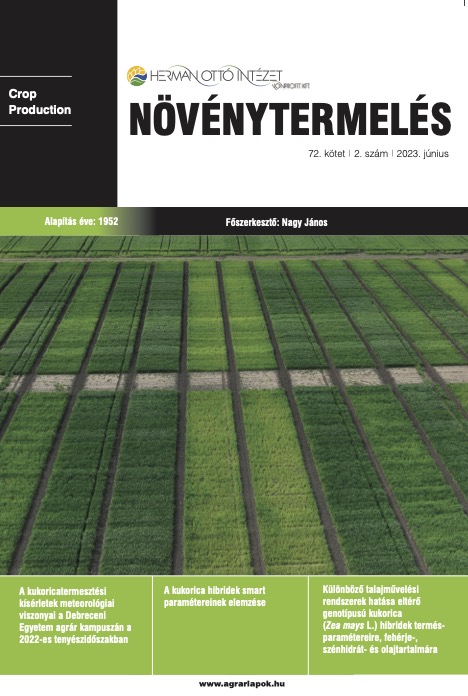
##issue.tableOfContents##
Obituary
Folyóiratcikk
-
Meteorological conditions of maize growing experiments on the agricultural campus of the University of Debrecen in the growing season 2022
5-19Views:150In 2022, a very severe drought developed in the Debrecen area. The average yield of the maize experiments at the University of Debrecen was lower than ever before. On several plots the crop yielded practically nothing. The evaluation of the meteorological conditions of such an exceptional year is essential to increase knowledge on the drought susceptibility of maize and to clarify the limits of stress tolerance. As far as possible, meteorological data measured at or near the experimental site should be used. In response to this need, we have investigated and presented the meteorological conditions on the agricultural campus, especially for maize. An important factor in the exceptional nature of the 2022 drought was the lack of sufficient precipitation to recharge the deeper layers of the soils during the previous winter. April was still average in terms of rainfall, but thereafter a very significant rainfall deficit developed. In the three summer months, a total of 66 mm of rain fell, 115 mm below average. The lack of water and its adverse effects were exacerbated by the fact that temperatures in the May-August period were significantly higher than normal. In particular, the summer months were much warmer than the long-term average, with positive temperature anomalies of 3.4 °C, 2.4 °C and 2.9 °C respectively. -
Analysing the smart parameters of maize hybrids
21-36Views:146In this research, excellent maize hybrids grown over a large area in Hungary were tested in a super intensive drip irrigation experiment. The experiment was set up at the University of Debrecen, Institutes for Agricultural Research and Educational Farm, Debrecen Educational Farm and Landscape Research Institute (DE AKIT DTTI) the Látókép Crop Production Experimental Station. In our study, eight hybrids with different FAO numbers were analysed under field conditions in drip irrigation long-term experiments. The yield of each genotype and the yield components determining the yield were estimated on the basis of individual sampling after physiological maturity. After sampling, the average individual grain weight, individual grain number, thousand grain weight and yield of each genotype were determined by individual sample processing. Despite unfavourable agro-meteorological factors, intensive production techniques resulted in yields of genotypes H3, H5 and H6 all exceeding 15 t ha-1, indicating high yield stability of the examined genotypes. Two factors, individual grain number and individual grain weight, are of primary importance in the development of yield. Genotype-specific evaluation of these factors revealed that the genotype H6 was prominent in the values of individual grain number, outperforming the other examined hybrids by about 9–34%. In addition, in the experiment, the H5 hybrid also had an individual grain number exceeding 600 grains per ear, significantly outperforming the other tested hybrids. The genotype H4 proved to be the most outstanding in terms of thousand grain weight with a value of 465.71 g. These results showed that the hybrid had 10–27% higher thousand grain weight compared to the other tested genotypes. Of the examined hybrids, H2 and H3, which exceeded 400 g thousand grain weight, showed outstanding values despite the fact that they are short maturity hybrids. -
Impact of different tillage systems on the yield parameters, protein, carbohydrate and oil content of different genotypes of maize (Zea mays L.) hybrids
37-57Views:160The aim of our research is to investigate the effect of different tillage systems on maize parameters (yield, grain moisture content at harvest) and on the nutritional value parameters (starch, protein, oil content). The ploughing primary tillage of maize was compared with the tillage practices (disc tillage, straight knife tillage, strip tillage) that are beneficial for soil structure conservation. The study was carried out in two different crop years with two different rainfall distributions, 2020 and 2021, on mid-heavy meadow chernozem soil in the outskirts of Nádudvar, in a mesoparcel experiment with three hybrids of different maturity (FAO 380, FAO 420, FAO 490).
In 2020, pre-sowing rainfall was low in March and April, only 23% and 39% of the multi-year average, which did not favour spring-sown crops, including maize. In June and July, on the other hand, rainfall was 256% and 217% of the multi-year average. In April, only 52% of the multi-year average fell, while in May it was 144% of the multi-year average. The year as a whole was extremely dry compared to the multi-year average, especially in June and July, when rainfall was only 14% and 69% of the multi-year average, respectively.
The impact of the tillage method on yields was significant in both examined years. In 2020, the yield of ploughing (15.84 t ha-1) was higher than both strip and conservation tillage. In 2021, ploughing was also the highest (5.46 t ha-1), higher than all other tillage methods, but 10.37 t ha-1 lower than in 2020.
In 2020 and 2021, the ranking of hybrids by yield was different. The best yield in 2020 was achieved by the FAO 490 hybrid (16.18 t ha-1), significantly higher than the other two hybrids. In the dry season, the FAO 420 hybrid was able to achieve the highest yield (4.33 t ha-1). Content value analysis of maize grains showed different results in the two crop years. In 2020, the oil content was significantly higher in the reduced tillage of the four tillage methods, with no real difference in the other methods. The analysis of starch content showed no significant difference between ploughing, conservation tillage and strip tillage, and no measurable difference between reduced and strip tillage. The protein content in 2021 showed a difference, with ploughing and conservation tillage demonstrably lower than reduced tillage. Compared to 2020, protein content increased from 6% to 8% in 2021. There was also a significant difference in starch content, with 66% in 2020 and 62% in 2021. -
Comparative protein content and Phytophthora infestans resistance testing of Sárvári potato cultivar candidates to select a variety suitable for high quality protein production
59-86Views:49Due to the focus on potato protein from a nutritional biology point of view, in our comparative experiment we investigated the content values of multi-resistant Sárvári potato clones suitable as candidate varieties for primary breeding in order to select a candidate for protein extraction for high quality animal- and human supplementation. Prior to our experiment, multi-resistant clones bred from year to year were regularly found to have higher than average protein content (>3%), therefore the focus was on high protein content as a breed trait.
Comparative dry matter, starch- and protein content tests of the most promising candidates were carried out under identical soil conditions, nutrient supply, irrigation and weather factors, and under identical plant protection, keeping in mind the potential for organic production.
In terms of protein content, the candidate variety S05 achieved an outstandingly high result (4.88%), but in terms of yield it was lower than the second best performing candidate variety S10 (2.89%). The shorter duration candidate variety S06 was lower in terms of protein content (2.29%), but better than the standard, also medium-early Kondor, which was also used as a standard for comparison, and had the best yield. In terms of protein yield per hectare, although lower, S05 was the most suitable candidate for the experimental objective, due to its high protein content. In terms of protein yield, the candidate variety S10 yielded almost the same as Sárvári Borostyán (2.66%).
In the comparative experiment, resistance to potato late blight (Phytophthora infestans) was also tested using a susceptible control variety as host and disseminator of local populations of the pathogen. Based on the infestation scale scores for the growing season, the candidate cultivar S05 was found to be the least susceptible, with the lowest score (1.23). The candidate cultivars Sárvári Borostyán and S06 and S10 also showed low infestation (scale scores 1.43–1.67). In comparison, the susceptible cultivar Desiree scored 9 on the scale and the cultivar Kondor scored 7.49.
The next step was to optimise the cultivation technology and nutrient supply to maximise protein yield by further field trials of promising candidates. -
Analysing the plant density response of sunflower (Helianthus annuus L.) on heterogeneous production sites
87-95Views:47Sunflower is considered a crop that uses soil moisture to the maximum, but it is true that the amount of available water is a limiting factor. Sunflower hybrids use soil water resources with varying efficiency, which is also greatly influenced by the number of plants sown per hectare. The use of satellite remote sensing and positioning, sensor-based measurement, GIS data analysis and processing software, and the emergence and use of technical solutions for differentiated sowing rates, open up the possibility of examining the possibility of site-specific plant density control in sunflower production. In this study, an attempt was made to determine the best sunflower plant density interval for the heterogeneous fertility zones of a given production area. The fertility zones were established using novel GIS methods. In the selected sample areas, three distinct fertility zones were defined. In each fertility zone, three plant density steps were used in four replicates. In the high and average fertility zones, increasing plant density resulted in slightly higher yields, while in the low fertility zones, sowing with reduced plant density did not cause a significant yield difference compared to the standard value. For moisture and oil content, no practical differences between plant density values could be detected. -
Analysing the yield elements of sweet maize (Zea mays conv. saccharata Koern) in irrigation production
97-111Views:151The success of sweet maize cultivation is affected by a number of environmental and technological factors. In addition to choosing the appropriate genotypes to cope with stress effects, it is important to use precision farming techniques, nutrient supply and irrigation adapted to the genotype. Sweet maize is one of the most drought-sensitive crops in arable farming, therefore, the use of precision irrigation farming techniques is essential for successful management. Our experiments were carried out under controlled conditions in three different crop years (2020, 2021, 2022). In June and July, irrigation was carried out with drip irrigation. The raw grain weight per hectare of the GSS sweet maize hybrid differed significantly from year to year. In the unfavourable year 2022, the raw grain yield was 10.400 t/ha. In contrast, in 2021 and 2020, the grain yield was significantly higher, at 1.466 and 2.810 tonnes per hectare, respectively. We measured close, consistent relationships between rainfall and irrigation volume when analysing the combined water use. For 1 mm of water (from precipitation and irrigation), we measured 27.1 kg of grain weight in 2020; 25.6 kg in 2021; and 23.5 kg in the unfavourable growing year 2022. -
Comparative analyses of tetraploid genotypes produced by androgenesis
113-126Views:51Plant breeding uses androgenesis-derived dihaploids for faster breeding. A small percentage of autotetraploids are also produced during the production of dihaploids. This paper presents a microplot field study of these tetraploids. The experiment used 6–6 diploid-tetraploid pairs, which are the results of three different combinations. In addition to phenological data (emergence, plant height, developmental stage on BBCH scale), yield and its components (panicle length, number of filled grains, number of unfilled grains, fertility) were also determined. The uniform vegetative development of tetraploids did not differ from that of diploids. However, they have a longer cropping period due to the prolongation of the reproductive phase. The least time delay was observed in line of 1087/8/35T, making it one of the shortest growing time tetraploid lines. In addition, this genotype has the highest number of filled grains and the second lowest unfilled grains, causing a very high fertility (~60%). This value is very encouraging, as conventional tetraploid lines have a fertility of 50%, while the new neo-tetraploid and PMeS lines have fertility in the range of 68–80%. With the expansion of experiments, hopefully, the genotypes with higher fertility will be identified. -
Impact of land use practices on the ecological nitrogen balance indicators of extensive grassland vegetation
127-143Views:89The effects of different grassland management practices on plant stand structure were investigated in an experiment at the Karcag Research Institute in 2017–2020, which was set up in 2009. The experimental grassland must comply with Natura 2000, the standards for organic grassland certification and the requirements of the horizontal agri-environmental programme. Support schemes that prioritise ecological considerations predispose to different grassland use patterns in a given grassland production area, a fact that justifies the relevance of this research. The specific objective of this research is to clarify the changes in vegetation structure under the most common grassland management practices in the Central Tisza landscape, based on Borhidi’s N balance, an ecological indicator for the meadow Solonetzic soil type typical of the region. In the experimental site with the medium meadow solonetzic soil type, the following grassland utilisation types were investigated in three replications: zero utilisation, i.e. fallow grassland, mulched grassland, where the phytomass was also not removed after stubble mowing, mowing, which meant removing the main crop once a year, and meadow utilisation, where the grass was grazed by sheep after mowing the main crop. In May of each year, a cenological survey was carried out at the time of flowering of the dominant grassland species and the plant species were classified according to Borhidi's ecological nitrogen balance. The highest grouse diversity was found in meadow grassland, 21 plant species, and the lowest in fallow grassland, 6 species. The obtained result may indicate the effect of the open layer of the unutilised phytomass in generating plant species selection in the plants forming the grassland association. It was found that, by the tenth year of the experiment, a change of control plants occurred in treatments representing mulched and meadow utilisation. The change of Festuca pseudovina to a dominant grassland component in the meadow use suggests grazing of the swards at low stubble height. Despite the accumulation of leafy phytomass, the highest coverage of nitrogen-preferring grassland constituents was not in the zero and mulched treatments left unused, but in the mowing treatments. The obtained result may suggest that Alopecurus pratensis, maintaining its position as a leader plant under mowing and being classified as a Borhidi indicator plant for nutrient-rich sites, determined the outcome. In order to clarify the reproducibility of the experimental results, due to the different soil conditions, it may be justified to carry out studies with a similar orientation in other sites and grassland associations.
Database Logos


Keywords
Make a Submission
Issues by Year