
Vol. 72 No. 4 (2023)
Published
December 31, 2023
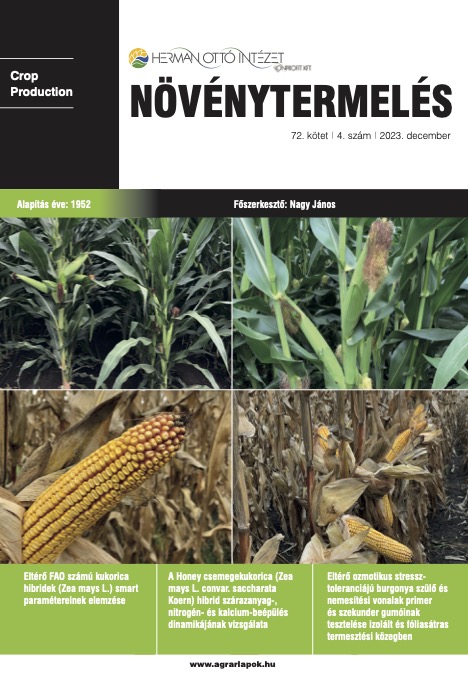
##issue.tableOfContents##
Folyóiratcikk
-
Smart parameter analysis of maize hybrids with different FAO numbers (Zea mays L.)
5-20Views:181Maize is a heat-intensive crop and requires a lot of water. Rainfall is the main meteorological factor determining the yield, and water scarcity is the biggest problem in maize production. When the growing season is dry and temperatures are above average, soil drought typically develops in the summer. The dry autumn-winter period preceding the growing season increases the risk of drought. In our research, we studied five different FAO maize genotypes using intensive cultivation techniques, determining the yields that can be obtained and the main yield parameters that determine the yields and the relationships between them. In our experiment, all five maize hybrids showed excellent yield performance. The highest yield was obtained by hybrid H11 (18.4 t/ha), which exceeded the values of the other tested hybrids by about 5.7–22.8%. Significant differences were measured between the individual grain weight values of the hybrids. Hybrid H13 stood out with the highest individual grain weight value, exceeding the other genotypes by 1.6–25.9%. Based on the correlation analysis between the individual parameters, we demonstrated a significant (p<0.05) positive correlation of individual grain weight with individual grain number values (r=0.568) and also with grain moisture at harvest (r=0.592). Our results indicate that each of the measured individual yield parameters contribute differently to high yield, resulting in significant effects. -
Analysis of dry matter, nitrogen and calcium incorporation dynamics in Honey sweet maize (Zea mays L. convar. saccharata Koern) hybrids
21-35Views:170The cultivation of sweet maize is of great importance in Hungary. Hungary is the largest producer on the European continent and the second largest exporter in the world after the United States. The average annual production of Hungarian sweet maize, which is in demand all over the world, reaches 500,000 tonnes as a result of the properly selected precision cultivation technology. Yields of sweet maize are above average in precision farming, with nearly 70% of the area irrigated.
An important factor in the exceptional nature of the drought of 2022 was the lack of rainfall in the previous winter half-year, which was not sufficient to replenish the deeper layers of the soil. April was still average in terms of rainfall, but thereafter a very significant rainfall deficit developed. A total of 66 mm of rain fell in the three summer months. The water shortage and its adverse effects were exacerbated by significantly higher than normal temperatures between May and August. The water deficit was compensated for during the growing season by precision drip irrigation, with 344 mm of water being applied. In particular, the summer months were much warmer than the long-term average, with positive temperature differences of 3.4 °C, 2.4 °C and 2.9 °C respectively. The best indicator of sweet maize yields is dry matter incorporation dynamics.
Based on the results measured during the phenophase, it was found that the growing season can be divided into three dominant intervals. The Honey maize hybrid produced 18% dry matter in the first stage, from emergence to the juvenile stage, and an additional 4% from the juvenile stage to silking. The intensive stage of dry matter incorporation lasted from silking to the R3 phenophase (harvest), with a total of 72%. Continuous knowledge of the grain moisture content of sweet maize is an important indicator for operational efficiency. Our research showed that, at the R3 phenophase, the moisture contents of plant parts were closely correlated, with the grain moisture content being the highest. Our research results demonstrated that dry matter gain from silking to the R3 (harvest) phase is very intensive, with a total heat requirement of 840 HU for the examined hybrid. -
Testing of primary and secondary tubers of potato parent and breeding lines with different osmotic stress tolerance in an isolated and greenhouse cropping system
37-61Views:63Probably one of the most defining problems of our time is providing food for the growing population of the earth. The aim of today's modern plant cultivation is to minimize risk factors and maximize the possibility of success. In our experiment, we examined potato parent lines (C103, C107) and their breeding lines (C11, C20) with known osmotic stress tolerance, which, based on our previous knowledge, could be valuable breeding subjects for both our current and future research. Primary tubers were made from shoot cultures produced by in vitro micropropagation under isolated conditions, then the harvested primary tubers were planted in green house at two different plant distance and fraction group (normal: T1: 25 cm, F1: 20–45 mm and narrow: T2: 15 cm, F2: -19 mm). We examined the changes in the tuber yield, as well as the influencing role of plant distance both in the amount of harvested tubers and in the distribution between fractions. In the case of the secondary tuber, we observed the emergence dynamics, the leaf height and fresh leaf weight values before harvest, the chlorophyll-a, -b and total chlorophyll content of the fresh leaves, as well as the Fv/Fm values of the chlorophyll fluorescence in the parental pair. The tuber yield measured per plant was lower in all cases for primary tubers at narrower plant distance and for secondary tubers at T2 plant distance was also reduced by about half. Significantly different results in the amount of primary tubers harvested as a result of narrower plant distances were obtained for three (C103, C107, C20) genotypes, and for two (C103, C20) genotypes when examining the secondary tubers. The fractional distribution in the number of primary tubers was positively influenced by plant distance in genotypes C103 (2nd fraction), C20 (3rd fraction), while C107 (3rd fraction) and C11 (3rd fraction) genotypes showed a slightly decrease. The emergence dynamics of the examined secondary tubers depended to a large extent on the characteristics of the genotype, however, the plant distance and fractionation also had a decisive influence. 50% of emergence was measured at the earliest for the C11, the latest for the C107 genotype (DAP 43. and 79.). The plants growing in a narrower plant distance, the 50% emergence ratio and the maximum emergence were generally reached 4–11days later than the plant grown under normal conditions. In the measurements of leaf height, fresh leaf weight, chlorophyll-a, -b and total chlorophyll content, according to genotype and plant number, the values of the C103 parent line and the C20 breeding line were in most cases significantly higher compared to the other two genotypes. As a result of the narrow number of plants, the tuber weight per unit area was significantly reduced in the observed parent (C103, a: 371.97 g/m2; C107, bc: 61.73 g/m2) and breeding lines (C20, b: 97.28 g/m2; C11, c: 2.13 g/m2). The higher number of seedlings and fractional planting resulted in significantly lower values in the weight of secondary tubers for genotypes C103 and C20, and when examining the distribution between fractions, we measured a statistically measurable difference for these two genotypes as well. Our results provide a good basis for learning the development processes of the potato genotypes included in the study and for the creation of breeding lines adapted to the extreme weather conditions of today, for the development of cultivation technology and seed production methods applicable to their specific characteristics. -
Response of Szeged winter wheat cultivars (Triticum aestivum L.) to drought stress
63-78Views:59In our experiments, we aimed to identify which cultivars from the applied breeding program have favorable drought stress resistance properties. The experiments described in this paper were conducted under field conditions from 2013 to 2022, using the automatic rain shelter system of our institute, as well as the adjacent control treatments. Twelve Szeged wheat cultivars and one drought-tolerant control cultivar, Plainsman V., were compared for their response to drought stress based on three agronomically important parameters (heading time, plant height and yield). The effect of water deprivation was most pronounced on yield, with an average yield depression of 31% observed in the tested cultivars. Heading time and plant height were not as sensitive to water deprivation, but significant differences were observed in some cultivars based on these parameters as well. In some cases, considerable deviations were observed in positive and negative directions from the average values among the tested cultivars. Based on the obtained results, it can be concluded which cultivars are suitable for cultivation in drought-prone areas, can be used for further detailed research on the effects of drought stress, and can serve as a breeding material for drought tolerance. -
Results of a water and nutrient management (NPK) long-term experiment
79-95Views:165The analysis of various nutrient replenishment levels was performed in a multifactoral long-term field experiment at the Látókép Experiment Site between 1996–2021. During the long-term fertilisation experiment, the N150 kg ha-1 dose resulted in the highest yield (10.74 t ha-1) averaged over the examined crop years and irrigation. As a result of the analysis of each nutrient level, it can be concluded that irrigation reduced the differences between crop years and this effect was strengthened by fertilisation. It can be concluded that optimum fertilisation and irrigation can mitigate the unfavourable effect of crop years. -
Effect of maize (Zea mays L.) emergence dynamics on yield
97-112Views:166Recently, there has been an increased interest in improving sowing technologies and practices, as sowing is one of the most important, if not the most critical, operations that a farmer carries out during the growing season. The emergence dynamics of sown seed have been suggested by several authors to have an impact on yield potential. This condition was studied in two crop years that differed in environmental conditions. Under these effects, individual yields of the earliest- and later-emerged plants were examined. Various physical parameters were measured, such as ear weight, ear length, ear diameter, as well as individual grain weight, thousand grain weight and number of grains. Correlation was found between these yield parameters and the ripening time. Our results confirmed that there is an influence of the emergence dynamics on the yield potential, as the earliest-emerging plants yield the highest yield. Therefore, our breeding technology should also meet the goal of getting as many plants to germinate in the first emergence period. -
Quality analysis of different FAO number maize hybrids (Zea mays L.) in irrigated production
113-124Views:151Three maize hybrids of different ripening periods and FAO numbers (350, 450 and 550) were examined at the Látókép Experiment Site of the University of Debrecen. The precipitation deficit was compensated by irrigation in the extremely drought year of 2022.
When evaluating the yield of the maize hybrids, it was found that the hybrids with higher FAO number produced more yield. Compared to the yield of the FAO 350 hybrid (14.241 t ha-1), the FAO 450 hybrid yielded 12% more and the FAO 550 hybrid 13.3% more significantly.
When grain moisture values were analysed, a similar correlation was found, with higher grain moisture associated with higher yields. It was found that, compared to the grain moisture of the FAO 350 hybrid (15.1%), the FAO 450 hybrid showed significantly higher values by 7% and the FAO 550 hybrid by 29%.
Based on the quality analysis of maize grain, it was found that the protein content, in contrast to yield and grain moisture values, was reliably lower as the FAO numbers increased. Compared to the protein content of the FAO 350 hybrid (7.27%), the FAO 450 hybrid achieved 14% and the FAO 550 hybrid 18% lower values. Oil content did not differ significantly between hybrids with different FAO numbers (3.82; 3.54 and 3.14%). Starch content was 2–3% higher in the higher FAO hybrids, but the difference was not significant.
Database Logos


Keywords
Make a Submission
Issues by Year