
Vol. 73 No. 2 (2024)
Published
June 30, 2024
##issue.tableOfContents##
Folyóiratcikk
-
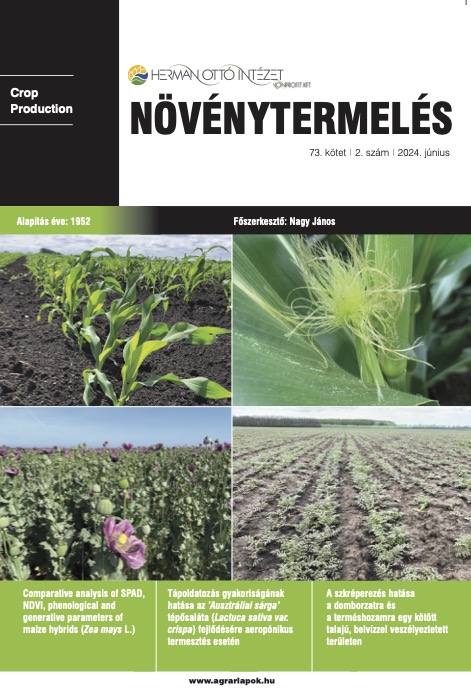
Comparative analysis of SPAD, NDVI, phenological and generative parameters of maize hybrids (Zea mays L.)
5-22Views:66Maize is a versatile multi-purpose crop that plays an essential role in the global food security. Meeting the needs of a growing population places the arable lands under the stress of intensive crop production. As the variations in climate conditions pose additional threats to maize production, the challenge focuses now on sustaining the crop yield, ensuring maximum yield and safeguarding crop protection.
The experiment was carried out in 2023 at the Látókép Plant Production Experimental Site of the University of Debrecen (Hungary). The authors aimed to monitor the changes in spectral reflectance at leaf and canopy level at several growth stages of two different maize hybrids. Another objective was to evaluate their field agronomic performance and eventually compare between their results. Thus, SPAD, NDVI and LAI indices were recorded at five phenological stages (6-leaf, 12-leaf, silking, dough, maturity) of the development of two maize hybrids. Other agronomic characteristics of maize had been measured, including plant height, cob length, stalk diameter, grain moisture content, nitrogen accumulation and grain yield.
The results demonstrated that Mv 352 hybrid had higher potential in terms of yield produced (13.64 t/ha) comparing to Fornad (12.93 t/ha), in addition to higher plant height, cob length and stalk diameter. The SPAD, NDVI and LAI recorded values showed higher values as the different growth stages developed and then decreased reaching the maturity phase. It was found that both hybrids had slight variation in their performance in this regard. However, in terms of nitrogen accumulation, Mv 352 had higher nitrogen content accumulated during the whole growing period in comparison with Fornad, highlighting its great performance in terms of nitrogen absorption and translocation.
This study highlights the importance of monitoring SPAD, NDVI, and LAI values, as well as the plant nitrogen accumulation that provides insights into the physiological conditions of maize plants during the different growth stages, allowing for the early detection of stress factors, therefore enabling timely interventions. Additionally, this work emphasises the crucial aspect of performing these measurements for the selection and breeding of high-performing maize hybrids. -
Effects of fertilisation frequency on the development of 'Australian yellow leaf' lettuce (Lactuca sativa var. crispa) under aeroponic cultivation
23-43Views:53The high nutritional value and mineral content of lettuce has attracted the interest of many researchers in indoor experiments. Therefore, in our research, we chose ’Australian yellow leaf’ lettuce (Lactuca sativa var. crispa) as the experimental plant. In aeroponic systems, the droplet size, the intensity of the nutrient application and the light are the most important parameters that determine the physical and nutritional parameters of the plants. Based on these, the aim of the study was to determine the effect of different nutrient application intensities on aeroponically grown ’Australian yellow leaf’ lettuce. Four treatments were set up in the aeroponic system (AeroFlo20) which means 1st treatment – 10×15 min/day, 2nd treatment – 8×8 min/day, 3rd treatment – 4×15 min/day, 4th treatment – 2×30 min/day. During the nine weeks of the experiment, leaf number (pcs/plant) and root length (cm) development, total chlorophyll (µg/g) and carotenoid content (µg/g), water potential (bar) and stress parameters (Fv/Fm, Fv/Fo) were measured. Based on our results, it can be concluded that leaf number, plant height and root length increased with decreasing nutrient application intensity in ’Australian yellow leaf’ lettuce, so that 30 min of nutrient application twice daily is sufficient if these parameters are taken into account. In the case of water potential, significantly higher values were obtained for the treatment with most daily nutrient applications (10 times 15 min/day) (-3.72±0.33 bar) than for the treatment where plants were given nutrient solution twice a day (p<0.05). -
The effect of soil scraping on topography and yield on soil with heavy texture and endangered by excess water
45-60Views:48In this study, the authors examined the applicability of scraping on an agricultural field in Békés County with a heterogeneous topography and a high risk of inundation by excess waters. The impact of the intervention was analysed through the homogeneity of the topography and yield data. It was found that the level differences of the originally created height categories on the plot have decreased, the surface of the plot has become more homogeneous, as a result of which no inundation has developed in the area since the scraping in 2020. The previously detected significant differences between the yields of the height categories were reduced, and the homogeneous topography resulted in a homogeneous crop yield on the whole plot. The crop yields achieved since the intervention exceeded the yields of previous years and resulted in a large yield surplus compared to the regional averages. Based on the obtained results, scraping can be considered an effective landscape-forming operation that can be recommended in areas with high risk of excess waters. -
Effect of genotype and some agrotechnical factors on quality parameters of winter wheat (Triticum aestivum L.)
61-76Views:59In a long-term experiment, the quality parameters (protein, starch, dry matter, wet matter, Zeleny index, grain hardness) of nine winter wheat varieties and hybrids were examined using DA 7250 NIR on calcareous chernozem soil after different previous crops (sweet maize, sunflower, grain maize) in three fertiliser treatments (control, N90+PK, N150+PK). The experimental results demonstrated that the crop rotation had only a small, non-significant effect on quality parameters. Fertilisation and genotype had the greatest effect on these parameters. The obtained results showed that the protein and starch content of wheat genotypes varied in opposite directions with agrotechnical factors. Fertilisation significantly increased the protein content of wheat genotypes (control 7.40–11.73%; N150+PK 11.21–16.22%) and significantly decreased the starch content (control 73.55–76.56%; N150+PK 67.80–75.10%). Dry and wet protein content were significantly modified by fertilisation and genotype. The wet meal content varied from 11.38–23.55% in the control treatment and from 24.38–37.22% in the N150+PK fertiliser treatment. Of the examined genotypes, GK Börzsöny and KG Vitéz belonged to the premium (improvement) baking group on the basis of wet gluten. Zeleny index and grain hardness were significantly increased by fertilisation. Zeleny index varied from 8.30 to 27.63 ml and grain hardness from 16.34 to 69.88 ml in the control treatment and from 31.19 to 42.17 ml and 42.75 to 84.11 ml in the N150+PK treatment, depending on the previous crop and genotype, respectively. Based on long-term experimental results, Hydrock, Hyxperia and Hycardi hybrids showed the best Zeleny index. The genotypes with the best Zeleny index scored only average values for other quality parameters. -
Analysis of the effect of agrotechnical parameters and crop year on maize (Zea mays L.) yield using polyfactorial yield trial data
77-100Views:159Field crop production is of paramount importance, the fundamental basis of food production and the source of our livelihood. Maize is one of the world's most important crops, essential for both food and energy security. The research was carried out in Hungary, at the University of Debrecen's Látókép Experimental Site, on calcareous chernozem soil in a complex tillage experiment, set up in 1989 by Prof. Dr. János Nagy. The analysis of the examined years (2015–2023) was carried out in a similar way as in the research of Gombos and Nagy (2019, 2022, 2023, 2024), i.e. we examined the deviation of the total precipitation and mean annual temperature of the given year from the 30-year (1981–2010) site average. RStudio and repeated measures model and LSD post hoc test are used to analyse the maize yield data.
Of the nine years studied, 2015 was the year with the third lowest significant maize yield (7.94 t/ha). The subsequent year 2016 yielded the second highest significant maize yield of the studied period (11.39 t/ha), The 2017 yield (8.64 t/ha) was significantly lower than the preceding year, while 2018 was more favourable for maize (9.18 t/ha). The 2019 harvest produced the statistically third highest maize yield (9.42 t/ha) in the studied period. The yield of 2020 (9.24 t/ha) was not significantly different from that of 2018, but was statistically different from all other years. The yield of maize in the unfavourable year 2021 (7.05 t/ha) was statistically the second lowest in the studied period. Of the nine studied years, the most unfavourable year for maize was the record drought year of 2022, when a yield of 2.52 t/ha was observed. The following year, 2023, recorded the highest maize yield of the studied period, 11.97 t/ha. The greatest impact on maize yield was exerted by the crop year with 73.5%, followed by fertilisation with 24.7%. The effect of tillage was 1%, because the different base crops performed differently depending on the crop year, thus neutralising the effect. -
Effect of basal and top-dressing fertilisation and irrigation on leaf area index and yield in maize stands
101-118Views:84The effects of basal and top-dressing fertilisation and irrigation on leaf area index (LAI) and yield in maize in an extreme dry year (2022) were investigated. The studies were carried out in Hungary, at the University of Debrecen Látókép Experiment Site on calcareous chernozem soil. In the field experiments, nitrogen (N) was applied as a basal and top-dressing fertiliser in split rates in a non-fertilised control (A0). The spring application rates of 60 and 120 kg N/ha (A60, A120), applied as spring basal fertiliser, were followed by two top dressings at V6 and V12 phenophases (V690, V6150 and V12120, V12180), at rates of +30 and +30 kg N/ha, respectively. The application rate was 115 mm of irrigation water. Based on the results of the test year, it can be concluded that in the different phenological stages (V8, V10, V12, Vn, VT, R1 R3, R6), averaged over the hybrids and treatments, LAI values increased in the vegetative development stage. The highest value was observed in the Vn phenological phase (irrigated 3.074±0.595; non-irrigated: 2.495±0.324) (p<0.05). The lowest LAI values were measured in the A0 treatment (irrigated: 1.663±0.633; non-irrigated: 1.324±0.455), while the highest values were measured in both irrigated (2.620±0.928 m2/m2; p<0.05) and non-irrigated (1.702±0.622; p<0.05) conditions in the A120 treatment. There was no significant increase in LAI as a result of top-dressing. The lowest fertiliser rate (A60) increased yield by 92.3% under irrigated conditions and by 64.7% under non-irrigated conditions compared to the A0 treatment. The 120 kg N/ha basal treatment resulted in a further yield increase compared to the 60 kg N/ha basal treatment (irrigated: +19.8%; non-irrigated: +24.4%). The highest significant yield was obtained with the A120 treatment (irrigated: 11.863±1.104 t/ha; non-irrigated: 8.649±0.971 t/ha; p<0.05). A different degree of correlation between LAI and yield was found as the phenological stages progressed. Under irrigated conditions, LAI values measured at the VT (r=0.753***) phenophase had the greatest effect on yield. Under non-irrigated conditions, the Vn (r=0.602***) phenological stage showed the strongest correlation between the two factors. The research carried out contributes to increase the target yield, to achieve sustainable production and to make appropriate decisions in extreme dry years.
Review
-
Analysis of agricultural land use of Hungary (2000–2020)
119-137Views:173Hungarian agriculture has undergone significant changes between 2000 and 2020. Only 25% of the 965 000 farms active in agriculture in 2000 were in operation in 2020. The number of farms engaged in crop production (273 thousand) has fallen dramatically, by almost half. Within this, fewer farms were engaged in arable crops and plantations and more in horticulture.
In 2000, there were 2883 crop production organisations and 270 736 individual holdings. In the following years, the number of economic organisations increased and the number of individual farmers decreased significantly. Both for economic organisations and individual holdings, arable crops dominate. However, the share of arable crops was higher in the case of the economic organisations, while horticulture and plantations played an important role in the case of individual farmers.
The common farm sizes of between 1 and 5 hectares were replaced by medium farm sizes, and these holdings accounted for 57% of the total agricultural area.
The share of arable land decreased from 83% of the country's area (7.7 million hectares) to 78.7%. The share of agricultural land decreased, the share of domestic forest increased and the share of reed and fish ponds remained substantially unchanged. The share of arable land increased, the share of orchards remained similar, while the share of kitchen gardens, vines and grassland decreased.
The area sown to wheat and maize is stable (1–1.2 million hectares), but in some years the area sown has fallen below 1 million hectares. The importance of both crops is shown by the fact that, despite fluctuations in area in recent years, a significant proportion of the arable land in Hungary is under wheat (22–23%) and maize (24–26%). The sowing area of sunflower has more than doubled and that of rapeseed has almost tripled. The share of these two oilseeds in the arable crop sector has increased significantly, with sunflower growing from 6.6% in 2000 to 15.2% in 2020 and rapeseed from 2.6% to 7.7%. The area under fruit crops and vines has declined sharply. Vegetables have experienced a similar decline as fruit crops.
The volume of crops increased steadily, with wheat and maize growing by 41.7% and 71.4% respectively compared with 2000. Sunflowers more than tripled and rapeseed increased almost fivefold. At the same time, weather extremes caused by climate change have become a growing problem in recent years, leading to an increase in the average yield per hectare. It ranged from 2.6 to 5.4 t/ha for wheat, 3.7 to 8.6 t/ha for maize, 1.6 to 3.0 t/ha for sunflower and 1.5 to 3.6 t/ha for rape.
Obituary
Database Logos


Keywords
Make a Submission
Issues by Year