
Vol. 74 No. 4 (2025)
Published
December 31, 2025
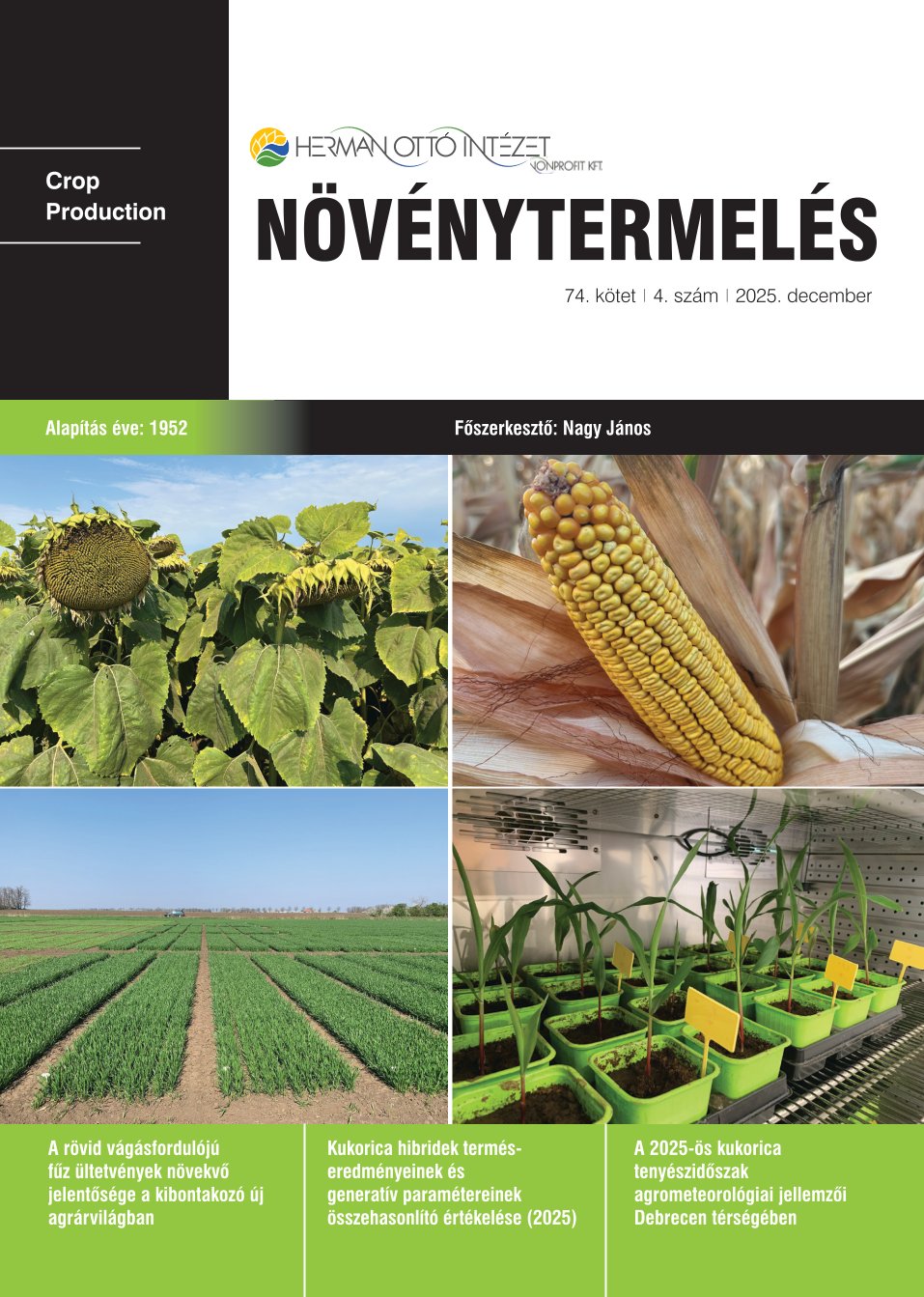
##issue.tableOfContents##
Review
-
The growing importance of short-rotation willow plantations in today’s changing agriculture
5-19Views:87Today’s experience clearly shows that crop production plays a key role in solving many of the challenges our world is facing. The effects of climate change are undeniable, as they influence yield stability in unpredictable ways and therefore also the profitability of growing crops. Growing environmental awareness is also changing the expectations towards crop production technologies. Plants remain important in renewable energy production, even though solar and nuclear energy are the main focus of current developments. Reducing the use of chemicals is also an important part of producing healthy food. The question is whether agriculture can introduce innovative technologies that help to meet these expectations.
The aim of this study is to explain why the cultivation of improved short-rotation willow (Salix sp.) deserves more attention in addressing today’s problems. We show how precision breeding can help to increase the biogas yield of energy tree plantations, which supports the wider use of willow as a raw material. On saline soils, planting salt-tolerant willow genotypes can provide several environmental benefits. Nowadays, the use of plant biostimulants is becoming more common. Aqueous extracts made from willow shoots can stimulate the growth and grain yield of maize plants.
The many possible ways of using willow confirm that Hungarian farmers should give more priority to establishing willow plantations on marginal lands. -
The system and methodology of variety breeding
113-126Views:199In Hungary, seed production operates within a strictly regulated certification system defined by legal provisions. The purpose of this system is to preserve and monitor the quality and genetic value of seeds, which form the foundation of crop production. One of the main elements of the certification process is the small-plot post-control testing conducted at the Monorierdő Variety Post Control Station of the National Food Chain Safety Office (NÉBIH), commonly referred to as variety post-control. This procedure represents the final, so-called progeny control phase of seed certification and includes two main types of testing: varietal identity and varietal purity verification. Both are based on the principles of distinctness, uniformity, and stability (DUS), which ensure that the seeds of each variety remain clearly identifiable, homogeneous, and genetically stable across generations. The implementation and evaluation of these tests are defined in detail by national standard and internal regulation. These documents specify the methodology of variety post-control, the criteria for assessment, and the official procedures of certification. This process allows for the continuous monitoring of variety preservation and multiplication, contributing to the reliability of seed production, the protection of seed quality, and ultimately ensuring the genetic stability of crop production.
Folyóiratcikk
-
Comparative evaluation of yield results and generative parameters of maize hybrids (2025)
21-44Views:96There were significant differences in yield and morphology among the maize hybrids included in the experiment based on the 2025 growing season. The H6 hybrid proved to be the best performing genotype, excelling in terms of yield (21.20 t/ha), individual grain weight (258.19 g), number of kernels, and thousand kernel weight (488.72 g), and achieved significantly better results than the other hybrids in several traits. The H3 hybrid also showed high yield potential (19.36 t/ha) and resulted in high grain weight and favorable SPAD values, proving to be the second most productive genotype. The H5, H4, and H2 hybrids can be classified as normal performers, producing stable but more moderate yield levels and grain weight, but there were significant differences in yield among these hybrids. SPAD values and NDVI values showed clear differences between the hybrids. The H4, H3, and H5 hybrids achieved outstanding SPAD values during the vegetative stage, indicating rapid initial development, while the H6 and H2 hybrids showed balanced SPAD dynamics throughout the entire growing season. Based on NDVI values, the H2 and H5 hybrids proved to be the most stable in the generative stage, indicating their good stress tolerance. Overall, the study showed that yield is influenced by grain weight, grain number, and plant condition indicators, and that the H6 and H3 hybrids represent outstanding agronomic value based on several parameters. Based on these findings, it can be concluded that different genotypes responded differently to the agrometeorological effects present during the unfavorable growing season of 2025, even with the use of drip irrigation. -
Agrometeorological characteristics of the 2025 maize growing season in the Debrecen region
45-55Views:158In Hungary, soil drought, atmospheric drought, and extremely high temperatures often interact in complex ways to cause significant maize yield losses, so the issue of drought was also the focus of the agrometeorological study for 2025. As in previous years, the main meteorological factors determining crop yield were analysed and the weather in the Debrecen region was evaluated in relation to the individual phenological phases.
At the beginning of the growing season, the upper soil layers were saturated with water, but slightly less water than usual reached the deeper layers. April, which is favorable for maize (sowing and germination period), was followed by a particularly cool May, significantly slowing down plant development. Due to the very dry, very hot June, signs of water stress were already visible to the naked eye in the second half of the month (plant height, leaf condition), as a result of increasing soil drought and regular atmospheric drought during the daytime. July proved to be favorable with rainy and moderately warm weather, which was the main reason why the average maize yield was above average. In line with previous research results, this year's harvest proves that the seemingly extremely unfavorable weather in June does not in itself prevent above-average yields. -
Possibilities for reducing drought stress in potatoes (Solanum tuberosum) through various foliar treatments
57-80Views:79Abiotic stress factors, especially drought and heat stress, which are becoming more frequent and intense due to climate change, pose significant challenges to potato production. The aim of this research was to examine the effects of different irrigation schemes and foliar treatments – salicylic acid, silicon, hydrogen peroxide, and microelements – on the physiological parameters, yield, and quality characteristics of potatoes under drought conditions. In a field experiment conducted in Sonkád (Hungary) during the 2024 growing season, a medium-late Manitou variety was used. During the study, two irrigation doses and four types of foliar treatments were tested in a split-plot design. Based on the results, full and 50% irrigation significantly increased stomatal conductance, NDVI, leaf area index, and yield. Among the foliar treatments, silicon and hydrogen peroxide had a positive effect on relative chlorophyll content and NDVI, but did not result in a significant increase in yield. Treatments with salicylic acid, microcomplex, silicon, and the total dose significantly increased starch content, while the application of silicon increased the amount of reducing sugar content. The results of the first year of experiments indicate that foliar treatments applied without irrigation can only occasionally mitigate the negative physiological effects of water deficiency, but irrigation is essential to achieve significant improvements in yield and quality. The research may contribute to technological developments aimed at increasing drought tolerance in potato production, but further experiments are needed. -
Analysis of reserve proteins in sunflower hybrids using a MALDI-TOF MS device
81-90Views:65One of the basic for the successful production of hybrid seeds is ensuring the genetic homogenity of the parental lines and their hybrids. This can be assessed using laboratory methods, such as protein markers, isozymes, and molecular markers, as well as field tests. MALDI-TOF MS (matrix-assisted laser desorption/ionization time-of-flight mass spectrometry) is particularly suitable for examining the genetic homogenity of seeds, as it allows obtaining a unique “protein fingerprint” for each sample based on the detected m/z values and peak intensities. Proteins appear as characteristic peaks in the mass spectrum, and their presence or absence can be used to infer the uniformity of the samples. The advantage of MALDI-TOF lies in its ability to rapidly and reliably detect proteins, even in complex samples, while measurement parameters – relative intensity, absolute intensity, signal-to-noise ratio, resolution, and peak area – allow an objective evaluation of spectrum quality. In homogeneous seed samples, spectra display nearly identical peaks and intensities, whereas heterogeneous samples exhibit differing peak patterns. Thus, this technique is fast, sensitive, and reproducible, enabling the monitoring of marker proteins, comparison of spectra, and precise determination of genetic homogenity. -
Examination of the effects of genotype, previous crop, and fertilisation in a winter wheat (Triticum aestivum L.) crop stand under irrigated and non-irrigated conditions
91-111Views:72In a field experiment, the yield and protein content of winter wheat were examined in two crop rotation systems (bi- and tri-culture), two water supply systems (non-irrigated/irrigated), five nutrient supply levels, and three genotypes. The aim of this experiment was to examine the individual factors and evaluate the various interactions. The results of the experiment showed that there was no significant difference between water supply and genotypes in terms of either yield or protein content. Under the influence of water supply, an average yield increase of 595 kg/ha can be achieved in the case of biculture, while in the case of triculture, an average yield increase of 512 kg/ha can be achieved. In terms of protein content, a decrease can be observed under the influence of irrigation: 0.2% in the case of biculture and 0.28% in the case of triculture. In all four studied treatment combinations, the Hycardi hybrid wheat achieved the highest yield (non-irrigated biculture: 8173 kg/ha; irrigated biculture: 9088 kg/ha; non-irrigated triculture: 10 256 kg/ha; irrigated triculture: 10 763 kg/ha), but this did not differ significantly from the yield results of the other two genotypes. In contrast, significant differences were found between the crop rotation systems. In the triculture crop rotation system, the yield (2044 kg/ha under non-irrigated conditions and 1961 kg/ha under irrigated conditions) and protein content (2% under non-irrigated conditions and and 1.02% under irrigated conditions) than in the two-crop rotation system. There were significant differences between nutrient supply levels. Increasing fertiliser doses also increased yield and, typically, protein content.
Book review
Database Logos


Keywords
Make a Submission
Issues by Year