
Folyóiratcikk
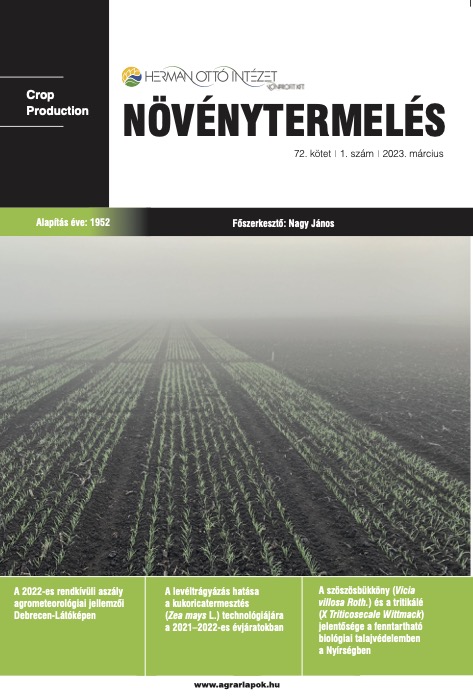
The importance of hairy vetch (Vicia villosa Roth.) and triticale (X Triticosecale Wittmack) in biological soil conservation on Nyírség region
Published:
2023-03-31
 https://doi.org/10.12666/b9k9p465
Authors
View
Keywords
License
Copyright (c) 2023 Edit Kosztyuné Krajnyák, Béla Szabó, Judit Csabai, Csilla Tóth, Katalin Irinyiné Oláh, Sándor Vágvölgyi, Péter Pepó

This work is licensed under a Creative Commons Attribution 4.0 International License.
How To Cite
Selected Style:
APA
Kosztyuné Krajnyák, E., Szabó, B., Csabai, J., Tóth, C., Irinyiné Oláh, K., Vágvölgyi, S., & Pepó, P. (2023). The importance of hairy vetch (Vicia villosa Roth.) and triticale (X Triticosecale Wittmack) in biological soil conservation on Nyírség region. Növénytermelés, 72(1), 33-52. https://doi.org/10.12666/b9k9p465
Abstract
Today, soil degradation caused by industrial crop production has reached a level that has made it clear that arable farming based on this method cannot be continued in the long term and is therefore unsustainable. Soil compaction reduced organic matter content and pH, and severe losses in soil life have combined to create a need for sustainable land use.
Leguminous crops, whose species characteristics and agronomic values allow their incorporation into sand farming, are of great importance for the environmentally friendly utilisation of the acidic sandy soils of Nyírség. They are the essential technological elements of sustainable land use, biological soil protection and organic plant nutrition.
Of the legume cultivars that can be grown on acidic sandy soils, the hairy vetch is of outstanding importance, which is also grown as a source of green manure, green fodder and seed, in Hungary, for more than a hundred years. Among the cereals, triticale has made inroads not only in cereal fields but also in acidic sandy soils. Thanks to the high level of triticale breeding, excellent varieties have been produced which have quickly taken the place of rye in the acid sandy soils of the Nyírség.
Our experiment was set up in the Demonstration Garden of the University of Nyíregyháza in 2019–2020 and 2020–2021. The aim of our observation was to investigate the plant height, root length, and number of Rhizobium root-nodules on the main and lateral roots of hairy vetch and the plant height and root length of triticale in a with different sowing dates, in six replicates, at three different measurement/evaluation times.
From our experimental results it can be stated that the morphological parameters of the hairy vetch sown at different times showed significant differences in the phenological stages we examined. Knowledge of these differences is important from an agronomic point of view because the dynamics of vegetative biomass formation can be deduced from them. In case of the sowing was in September, a clearly visible plant cover emerges on the surface of the soil, and a large number of root nodules develop on the main and lateral roots of the early adult plants. The hairy vetch, grown for green manure, protects and enriches the soil with nitrogen at this time of sowing. The formation of vegetative biomass (green mass) is also the highest at this sowing date, which is also important in the production of mixed green fodder. In the case of later sowing dates, the number of green masses, root mass and Rhizobium nodules formed until harvest also decreases.
According to the obtained test results, the soil protection effect of triticale is already apparent in autumn, and the earliest sowing gives the best soil covering effect. The use of triticale is becoming increasingly important in sustainable soil management.
Leguminous crops, whose species characteristics and agronomic values allow their incorporation into sand farming, are of great importance for the environmentally friendly utilisation of the acidic sandy soils of Nyírség. They are the essential technological elements of sustainable land use, biological soil protection and organic plant nutrition.
Of the legume cultivars that can be grown on acidic sandy soils, the hairy vetch is of outstanding importance, which is also grown as a source of green manure, green fodder and seed, in Hungary, for more than a hundred years. Among the cereals, triticale has made inroads not only in cereal fields but also in acidic sandy soils. Thanks to the high level of triticale breeding, excellent varieties have been produced which have quickly taken the place of rye in the acid sandy soils of the Nyírség.
Our experiment was set up in the Demonstration Garden of the University of Nyíregyháza in 2019–2020 and 2020–2021. The aim of our observation was to investigate the plant height, root length, and number of Rhizobium root-nodules on the main and lateral roots of hairy vetch and the plant height and root length of triticale in a with different sowing dates, in six replicates, at three different measurement/evaluation times.
From our experimental results it can be stated that the morphological parameters of the hairy vetch sown at different times showed significant differences in the phenological stages we examined. Knowledge of these differences is important from an agronomic point of view because the dynamics of vegetative biomass formation can be deduced from them. In case of the sowing was in September, a clearly visible plant cover emerges on the surface of the soil, and a large number of root nodules develop on the main and lateral roots of the early adult plants. The hairy vetch, grown for green manure, protects and enriches the soil with nitrogen at this time of sowing. The formation of vegetative biomass (green mass) is also the highest at this sowing date, which is also important in the production of mixed green fodder. In the case of later sowing dates, the number of green masses, root mass and Rhizobium nodules formed until harvest also decreases.
According to the obtained test results, the soil protection effect of triticale is already apparent in autumn, and the earliest sowing gives the best soil covering effect. The use of triticale is becoming increasingly important in sustainable soil management.

