
Folyóiratcikk
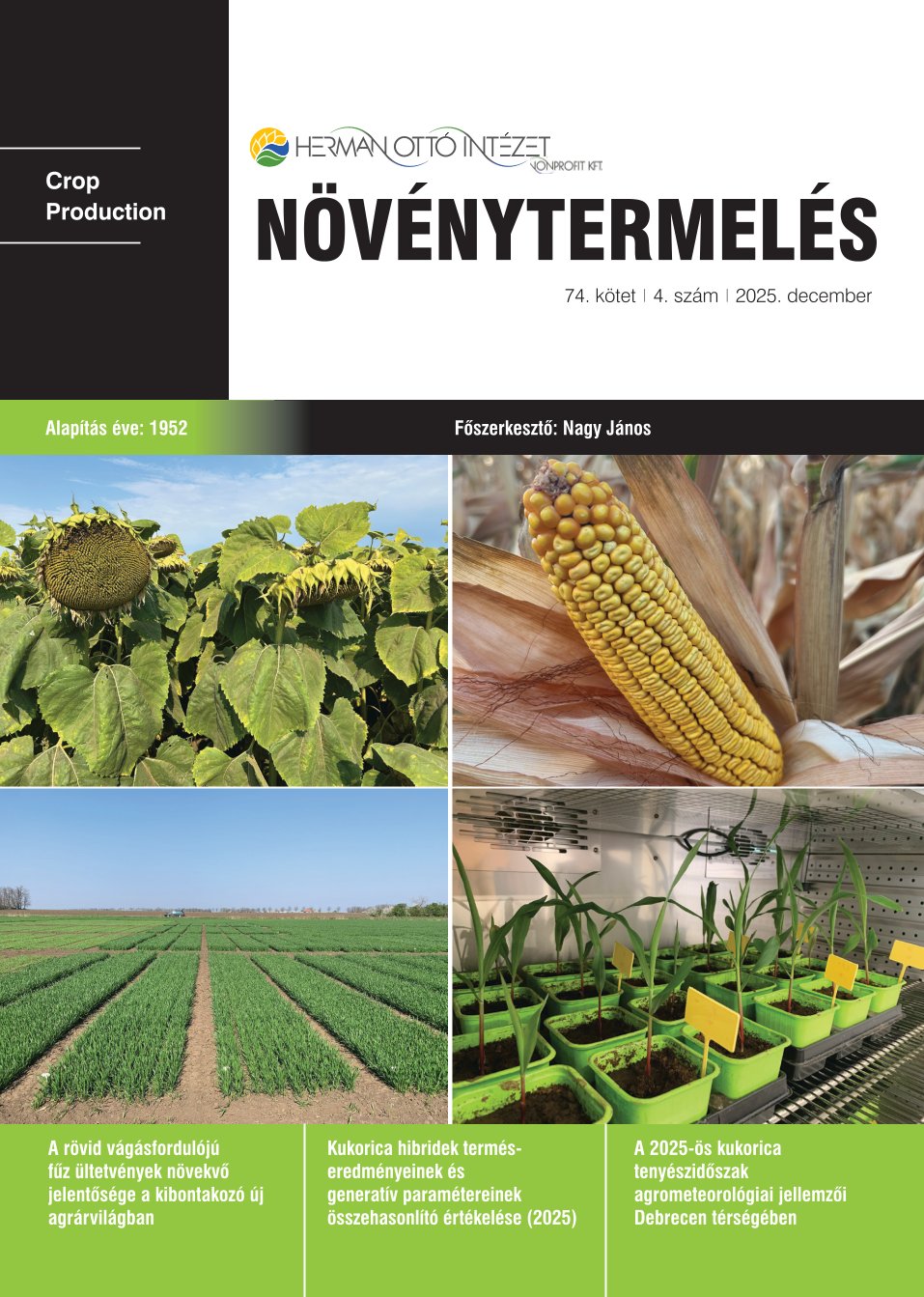
Agrometeorological characteristics of the 2025 maize growing season in the Debrecen region
Published:
2025-12-31
 https://doi.org/10.12666/1yyxdf43
Authors
View
Keywords
License
Copyright (c) 2025 Béla Gombos, János Nagy

This work is licensed under a Creative Commons Attribution 4.0 International License.
How To Cite
Selected Style:
APA
Gombos, B., & Nagy, J. (2025). Agrometeorological characteristics of the 2025 maize growing season in the Debrecen region. Növénytermelés, 74(4), 45-55. https://doi.org/10.12666/1yyxdf43
Abstract
In Hungary, soil drought, atmospheric drought, and extremely high temperatures often interact in complex ways to cause significant maize yield losses, so the issue of drought was also the focus of the agrometeorological study for 2025. As in previous years, the main meteorological factors determining crop yield were analysed and the weather in the Debrecen region was evaluated in relation to the individual phenological phases.
At the beginning of the growing season, the upper soil layers were saturated with water, but slightly less water than usual reached the deeper layers. April, which is favorable for maize (sowing and germination period), was followed by a particularly cool May, significantly slowing down plant development. Due to the very dry, very hot June, signs of water stress were already visible to the naked eye in the second half of the month (plant height, leaf condition), as a result of increasing soil drought and regular atmospheric drought during the daytime. July proved to be favorable with rainy and moderately warm weather, which was the main reason why the average maize yield was above average. In line with previous research results, this year's harvest proves that the seemingly extremely unfavorable weather in June does not in itself prevent above-average yields.
At the beginning of the growing season, the upper soil layers were saturated with water, but slightly less water than usual reached the deeper layers. April, which is favorable for maize (sowing and germination period), was followed by a particularly cool May, significantly slowing down plant development. Due to the very dry, very hot June, signs of water stress were already visible to the naked eye in the second half of the month (plant height, leaf condition), as a result of increasing soil drought and regular atmospheric drought during the daytime. July proved to be favorable with rainy and moderately warm weather, which was the main reason why the average maize yield was above average. In line with previous research results, this year's harvest proves that the seemingly extremely unfavorable weather in June does not in itself prevent above-average yields.

