
Vol. 74 No. 3 (2025)
Published
September 30, 2025
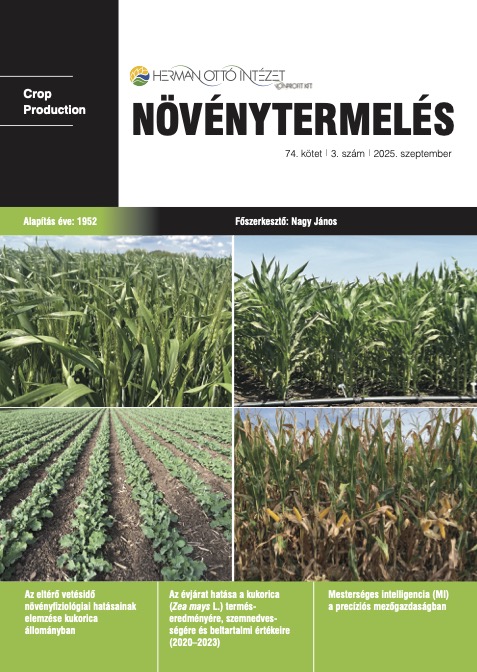
##issue.tableOfContents##
Historical review
Folyóiratcikk
-
Transcriptomic analysis of the combined effects of humic acids and nutrients in maize (Zea mays L.)
5-30Views:49The use of humic acids in agricultural production worldwide dates back several decades and numerous scientific studies support the beneficial effects of the compounds. However, less information is available about their combined use with macro- and microelements. The aim of our study was to investigate the effects of humic acids combined with boron and sulfur using modern genetic tools. We performed genome-level transcriptomic analyses using the Next Generation Sequencing (NGS) technique and found that the combined use of humic acids with nutrients positively influences several plant biochemical processes. Its beneficial effects extend to certain stages of photosynthesis and cellular respiration, and also affect the function of some ribosomal genes. However, among the findings previously published in the literature, at the gene level we were unable to confirm additional positive effects (e.g. stress-relieving, antioxidant effects, etc.) that can be derived from the individual or combined use of humic acids. Our studies provide deeper insight and explain the transcriptomic background of changes in some plant physiological processes observed upon application of humic acid solutions. -
Correlation study of NDVI and yield in maize at different phenological stages with different flight settings
31-50Views:215In this research, the authors sought solutions to one of the most important challenges facing agriculture. The growth of the world's population and the decline and degradation of arable land pose new challenges for agriculture. Cereal crops play a key role in food production, with maize being of particular importance as it is grown worldwide. Precision farming is playing an increasingly important role in modern agriculture, making remote sensing and data analysis of paramount importance.
The weather conditions in 2024 were unusual: spring was rainy and warm, while the summer months were exceptionally hot with an above-average number of heat days. The experiments were conducted during four different phenological stages of corn development (V5, V10, R1, and R3). Outside the growing season, we used three types of flight settings: measurements without RTK, with RTK, and with a combination of RTK and altitude tracking. During the study, three hybrids with different FAO numbers were analyzed, and the results were evaluated at five different nutrient levels in addition to the control.
It was observed that in the early (V5 and V10) phenological phases, there was a closer correlation between NDVI values and crop yield, which can be explained by the favorable spring and early summer weather conditions of the year. The flight settings showed similar results at three measurement times, but differences appeared in the R1 phenological phase. It can be assumed that the large amount of pollen deposited on the leaves during flowering influenced the NDVI values. In addition, the creation of orthomosaics from RTK and altitude tracking images proved to be more time-consuming and, in some cases, required multiple attempts with the WebODM software used. These results provided valuable data and serve as a good starting point for further research. -
Effect of the year on yield, grain moisture, and quality parameters of maize (Zea mays L.) (2020–2023)
51-68Views:154Maize (Zea mays L.) is one of the most important arable crops in Hungary, whose yield stability and quality have increasingly depended on annual and climatic conditions in recent years. The period between 2020 and 2023 clearly illustrates that variability in temperature and precipitation patterns fundamentally determines yield performance, grain moisture content, and quality parameters. While in 2020 balanced heat and water availability ensured high yields, favorable starch content, and an extended ripening period, in 2022 the extreme drought and record-high temperatures resulted in a drastic yield reduction, low grain moisture, and moderate starch content.
During critical phenological phases – particularly flowering and grain filling – heat stress and water shortage greatly influenced pollination success, dry matter accumulation, and thus overall crop quality. In unfavorable years, an increase in protein and oil content at the expense of starch was often observed, indicating an inverse relationship between quantitative and qualitative parameters. Although lower grain moisture at harvest can offer technological advantages, rapid water loss may lead to structural damage and an increased risk of mycotoxin contamination.
The results of the examined period highlight that extreme weather factors caused by climate change—heatwaves, drought periods, and precipitation deficits—not only limit yield potential but also alter quality traits. Therefore, in the future, adapting to year-to-year variations will play a key role: the use of stress-tolerant hybrids, optimization of sowing dates, adoption of water-conserving tillage practices, and targeted irrigation strategies can collectively enhance the stability of maize production under changing agroclimatic conditions. -
Analysis of the physiological effects of different sowing dates in a maize stand
69-86Views:49The aim of this study is to examine how different sowing times affect the germination dynamics of maize hybrids with different ripening periods, as well as their impact on maize development and yield. The experiment was conducted in Hungary, at the Látókép Experimental Station of the University of Debrecen, on calcareous chernozem soil, in a growing season with average precipitation (2023). In the field experiment, three sowing dates were used: Sowing Date I (April 17), Sowing time II (April 24), and Sowing time III (May 23). The same hybrids were included in the experiment for all three sowing dates (H1: FAO 380, H2: FAO 490). Following the germination dynamics test, plant height and relative chlorophyll content (SPAD value) were measured in the stand at three time points: 6-leaf (V6), 12-leaf (V12), and 50% silking (R1) phenological phases. During the first two days of the germination phase, both early and medium-ripening hybrids germinated at nearly the same percentage (H1: 76%, H2: 75%) in Sowing Date I, while in Sowing Date II (H1: 84%, H2: 88%) and Sowing Date III (H1: 87%, H2: 84%), the difference in the germination dynamics of the hybrids was more significant. Between phenophases V6 and R1, the percentage increase in relative chlorophyll content (SPAD value) was highest for hybrid H1 in Sowing Date I and for hybrid H2 in Sowing Date II, while it was lowest for both hybrids in Sowing Date III. The influence of sowing dates on SPAD values was detectable in the V12 phenophase (Sowing Date II p<0.005) for the H1 hybrid and in the V6 (Sowing time III, p<0.005) and V12 phenophase (Sowing time II, p<0.005). Based on the height data measured in different phenological phases, sowing date influenced the growth of maize hybrids, but this effect was not statistically significant in all cases (R1). For the different maize hybrids, the differences in yield results between the hybrids within the examined sowing dates and within each sowing date were not statistically significant. This suggests that sowing date did not have a pronounced effect on the yield of any of the hybrids. At the same time, however, the best sowing date (H1-Sowing date I. 14.959 t/ha; H2-Sowing date II. 14.208 t/ha) may allow for better water and nutrient utilisation and avoid heat stress or drought periods affecting flowering.
The statistically significant strongest correlations between SPAD value and yield for both maize hybrids were found at Sowing Date I and Sowing Date III in the R1 phenological phase (H1 – Sowing Date I: r=0.990**, Sowing Date III: r=0.999***; H2 – Sowing Date I: r=0.976*, Sowing Date III: r=0.944*).
Review
-
Artificial Intelligence (AI) in precision agriculture
87-104Views:47Artificial Intelligence (AI) is opening a new era in agriculture, particularly in the field of precision farming. This paper aims to provide an insightful overview of how AI technologies can be applied to yield prediction, crop health monitoring, and early pest and disease detection. Findings from international research clearly indicate that those countries and producers who adopt these tools early will gain a long-term competitive advantage.
The Hungarian agricultural sector faces increasing challenges: climate change, labor shortages, and market pressure. AI-based tools offer solutions through automation, precision, and cost efficiency. However, implementation requires not only access to technology but also a clear understanding, practical examples, and local case studies that demonstrate how AI works under Hungarian conditions and supports Hungarian farmers.
The future lies not only in technology but in its comprehension. Therefore, review articles like this one play a key role in bridging the gap between science and farm-level decision-making. The methods and models discussed here provide a foundation for developing domestic case studies and decision-support systems that directly benefit farmers in their everyday operations. -
Application of MALDI-TOF MS in scientific research and agricultural practice
105-132Views:128Today, MALDI-TOF MS is a key tool in proteomics, microbiology, medical diagnostics, and is widely used in food safety and materials science. This technology has undergone revolutionary developments in the recent years: new matrix materials have been developed that improve ionisation efficiency, and more advanced data processing algorithms have been developed to increase the accuracy of analyses. Due to its speed, cost-effectiveness, and reliability, this technology is increasingly emerging as an alternative to traditional identification methods.
MALDI-TOF MS is an innovative and versatile tool that may be important in plant breeding and food quality control. Not only does it provide reliable results in genetic purity testing and toxin analysis, but it also contributes to plant physiology research and the development of plant protection strategies, as well as the detailed mapping of plant protein expression patterns. The method enables the identification of new stress response proteins that may play an important role in future plant breeding programs. Advances in proteomics research are opening up opportunities to explore protein changes in response to different environmental influences in greater detail.
The combination of MALDI-TOF MS and intelligent data analysis may open new horizons in disease diagnostics, the development of precision medicine, food safety, agriculture, and environmental analytics.
Database Logos


Keywords
Make a Submission
Issues by Year