
Folyóiratcikk
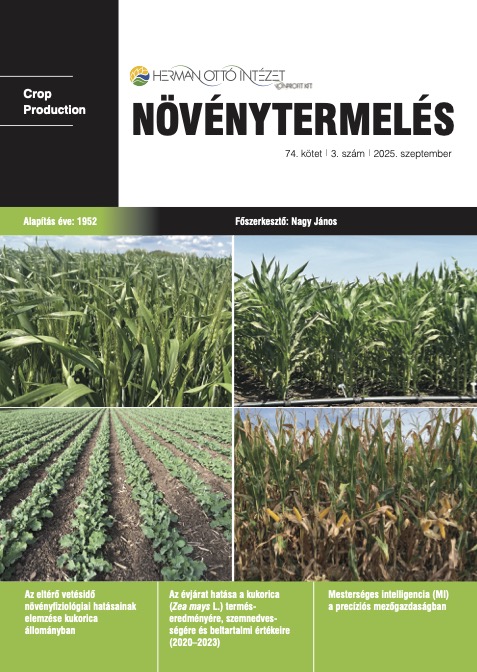
Effect of the year on yield, grain moisture, and quality parameters of maize (Zea mays L.) (2020–2023)
Published:
2025-09-30
 https://doi.org/10.12666/5j6tyd78
Authors
View
Keywords
License
Copyright (c) 2025 Ágota Lovász, János Nagy

This work is licensed under a Creative Commons Attribution 4.0 International License.
How To Cite
Selected Style:
APA
Lovász, Á., & Nagy, J. (2025). Effect of the year on yield, grain moisture, and
quality parameters of maize (Zea mays L.) (2020–2023). Növénytermelés, 74(3), 51-68. https://doi.org/10.12666/5j6tyd78
Abstract
Maize (Zea mays L.) is one of the most important arable crops in Hungary, whose yield stability and quality have increasingly depended on annual and climatic conditions in recent years. The period between 2020 and 2023 clearly illustrates that variability in temperature and precipitation patterns fundamentally determines yield performance, grain moisture content, and quality parameters. While in 2020 balanced heat and water availability ensured high yields, favorable starch content, and an extended ripening period, in 2022 the extreme drought and record-high temperatures resulted in a drastic yield reduction, low grain moisture, and moderate starch content.
During critical phenological phases – particularly flowering and grain filling – heat stress and water shortage greatly influenced pollination success, dry matter accumulation, and thus overall crop quality. In unfavorable years, an increase in protein and oil content at the expense of starch was often observed, indicating an inverse relationship between quantitative and qualitative parameters. Although lower grain moisture at harvest can offer technological advantages, rapid water loss may lead to structural damage and an increased risk of mycotoxin contamination.
The results of the examined period highlight that extreme weather factors caused by climate change—heatwaves, drought periods, and precipitation deficits—not only limit yield potential but also alter quality traits. Therefore, in the future, adapting to year-to-year variations will play a key role: the use of stress-tolerant hybrids, optimization of sowing dates, adoption of water-conserving tillage practices, and targeted irrigation strategies can collectively enhance the stability of maize production under changing agroclimatic conditions.
During critical phenological phases – particularly flowering and grain filling – heat stress and water shortage greatly influenced pollination success, dry matter accumulation, and thus overall crop quality. In unfavorable years, an increase in protein and oil content at the expense of starch was often observed, indicating an inverse relationship between quantitative and qualitative parameters. Although lower grain moisture at harvest can offer technological advantages, rapid water loss may lead to structural damage and an increased risk of mycotoxin contamination.
The results of the examined period highlight that extreme weather factors caused by climate change—heatwaves, drought periods, and precipitation deficits—not only limit yield potential but also alter quality traits. Therefore, in the future, adapting to year-to-year variations will play a key role: the use of stress-tolerant hybrids, optimization of sowing dates, adoption of water-conserving tillage practices, and targeted irrigation strategies can collectively enhance the stability of maize production under changing agroclimatic conditions.

