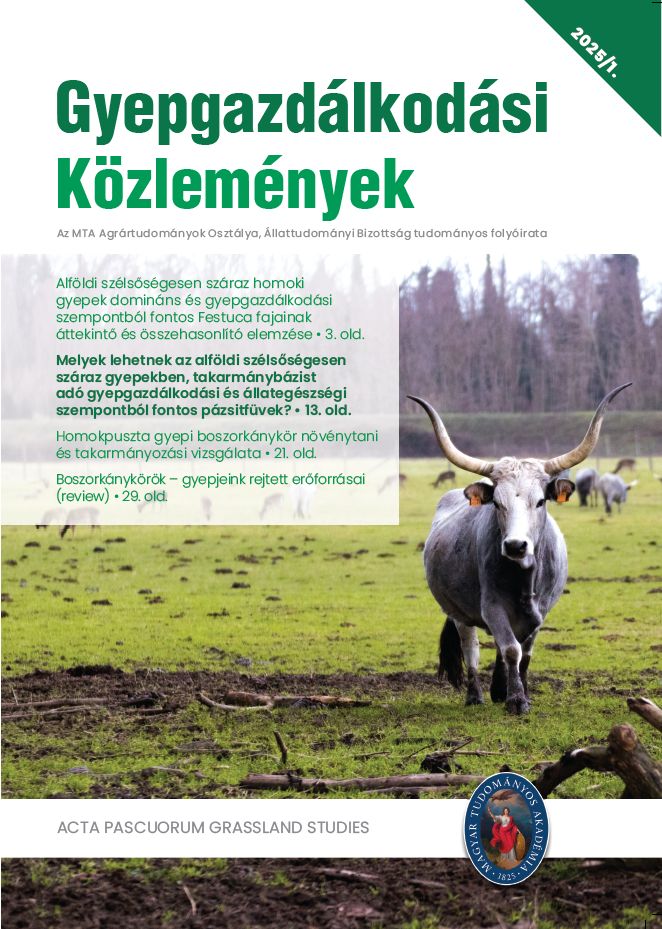
A gyepek helyreállításának lehetőségei különböző élőhelyeken, különböző legelő állatokkal: Áttekintő esettanulmányok II: Kecskelegelők
 https://doi.org/10.55725/gygk/2025/23/1/16440
Szerzők
Megtekintés
Kulcsszavak
Licenc
Copyright (c) 2025 Gyepgazdálkodási Közlemények

This work is licensed under a Creative Commons Attribution-NonCommercial-NoDerivatives 4.0 International License.
Hogyan hivatkozzuk
Absztrakt
In this summary overview, we present the findings of phytosociological surveys conducted in vegetation types subjected to goat grazing—excluding the control meadows—across seven different study sites in addition to four settlements located in Transdanubia and the North Hungarian Mountains. The areas are also evaluated from a grassland management perspective. Furthermore, we explored the potential use of two invasive species (Solidago gigantea and Calamagrostis epigeios) as goat fodder, and we included a mown meadow as a control. The primary aim was to assess the species richness and ecological value of these areas under varying levels of grazing pressure and grassland management strategies, particularly in terms of conservation and pasture use.
The most degraded plant communities were observed in Nagyréde and Kaposdada, where overgrazing had occurred. This was evident in species composition, as these areas were the least species-rich and showed significant infestation by ruderal species. In contrast, the most favorable outcomes—both for conservation and for grassland management—were found in sites that were initially mown and subsequently grazed by goats. The results suggest that vegetation types developed under light grazing pressure were more beneficial from a grazing perspective. Overall, the study indicates that a combination of light grazing and mowing is the most suitable management approach for maintaining and utilizing these semi-dry grasslands sustainably.
Additionally, both invasive species may have potential for use as fodder when harvested at appropriate phenological stages and supplemented with additional feed, although not for meat production purposes.
In this summary overview, we present the findings of phytosociological surveys conducted in vegetation types subjected to goat grazing—excluding the control meadows—across seven different study sites in addition to four settlements located in Transdanubia and the North Hungarian Mountains. The areas are also evaluated from a grassland management perspective. Furthermore, we explored the potential use of two invasive species (Solidago gigantea and Calamagrostis epigeios) as goat fodder, and we included a mown meadow as a control. The primary aim was to assess the species richness and ecological value of these areas under varying levels of grazing pressure and grassland management strategies, particularly in terms of conservation and pasture use.
The most degraded plant communities were observed in Nagyréde and Kaposdada, where overgrazing had occurred. This was evident in species composition, as these areas were the least species-rich and showed significant infestation by ruderal species. In contrast, the most favorable outcomes—both for conservation and for grassland management—were found in sites that were initially mown and subsequently grazed by goats. The results suggest that vegetation types developed under light grazing pressure were more beneficial from a grazing perspective. Overall, the study indicates that a combination of light grazing and mowing is the most suitable management approach for maintaining and utilizing these semi-dry grasslands sustainably.
Additionally, both invasive species may have potential for use as fodder when harvested at appropriate phenological stages and supplemented with additional feed, although not for meat production purposes.