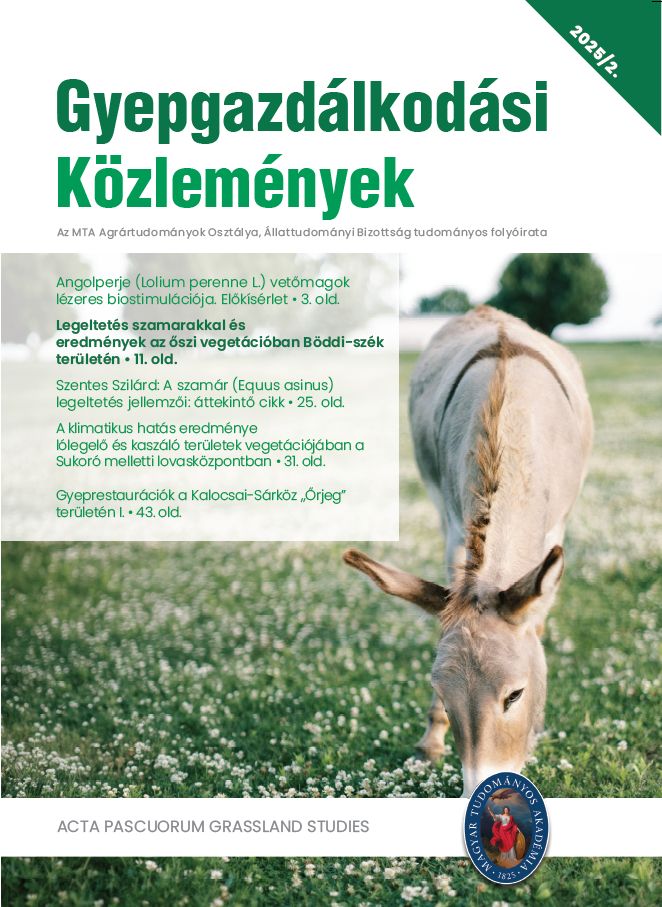
Climatic impacts on the vegetation of horse pastures and hay meadows at the equestrian centre near Sukoro
 https://doi.org/10.55725/gygk/2026/23/2/16828
Authors
View
Keywords
License
Copyright (c) 2026 Grassland Studies

This work is licensed under a Creative Commons Attribution-NonCommercial-NoDerivatives 4.0 International License.
How To Cite
Abstract
The study was conducted on the grassland areas of the Sukoró Equestrian Centre. Phytosociological surveys carried out in 2023 were repeated in 2024 on both the rocky grassland horse pasture and the hay meadow. The objective was to assess the extent to which year effects are reflected in vegetation patterns. The year 2023 represented a dry year, whereas 2024 was characterised by a wet year. Phytosociological data were collected using the Braun-Blanquet (1964) method, applying 2×2 m quadrats, with vegetation cover estimated as percentage values. Quadrats were placed randomly within the study sites. Four sampling areas were investigated. Three were hay meadows: (I) mesic hay meadow; (II) alkali grassland dominated by Festuca pseudovina; and (III) marsh meadow. The fourth sampling area (IV) was a siliceous rocky grassland used as a horse pasture, which remained ungrazed in 2023. Based on the results, increased moisture availability led to a higher abundance of species with greater nitrogen and water requirements in the mesic hay meadow (Alopecuro-Arrhenatheretum) and in the Achilleo setaceae Festucetum pseudovinae grassland. Classification analyses clearly demonstrated the year effect in these vegetation types. In contrast, relevés from the marsh meadow did not show a clear separation between the two years. In the rocky grassland, only the proportion of nitrogen-demanding species increased. Nature conservation–based analyses also revealed a distinct pattern for the marsh meadow, where the proportion of disturbance-tol erant species decreased, while it increased in the other three vegetation types. From a grassland management perspective, the abundance of economically important grasses (Poaceae) declined only in the marsh meadow, whereas it increased in the other three vegetation types, accompanied by higher forage value indices. Overall, with the exception of the inherently wet marsh meadow, the wetter conditions of 2024 had a positive and clearly detectable effect on the studied vegetation types.