Search
Search Results
-
Rural Entertainment in the Püspökladány sub-region
110-117Views:198The Püspökladány statistical sub-region is geographically located in Hajdú-Bihar county’s south-west corner, in the area called Nagy-Sárrét. The tourism of the sub-region has been highly determined by the proximity of Hortobágy National Park and the presence of thermal water, one of the most important resources of the region. As Hajdú-Bihar county – especially Debrecen, Hajdúszoboszló and Hortobágy – possesses these attractive factors as well, in the Püspökladány sub-region rural tourism could be an important means of catching the interests of – mostly Hungarian – tourists.
In the course of this research, my objectives were to introduce the rural hosts of the sub-region, the main features and problems of rural hospitality as an enterprise and the characteristics and activities of rural tourist – from the view of the hosts.
I chose questionnaires as the method of the investigation, and evaluated them with the help of SPSS and Microsoft Excel software. During the evaluation, I calculated distribution, arithmetic mean, deviation and carried out significance-analysis.
The investigations confirmed my presumption, i.e. rural tourism has not gained ground yet in the Püspökladány sub-region. This statement is proved by the fact that I completed only 8 questionnaires in a sub-region with 13 settlements, where rural host activity concentrates on 3 settlements. The results of the questionnaire-evaluation prove the aforesaid. -
Element content analyses in the Institute for Food Sciences, Quality Assurance and Microbiology
203-207Views:470The role of chemical elements to ensure and promote our health is undisputed. Some of them are essential for plants, animals and human, others can cause diseases. The major source of mineral constituents is food, drinking water has a minor contribution to it, so the knowledge of elemental intake through food is crucial and needs continuous monitoring and by this way it promotes the food quality assurance and dietetics.
With the evolution of spectroscopic methods increasingly lower concentrations could be determined, so the elemental composition of a sample could be more precisely and fully described. Due to the results the gathered knowledge up to the present is supported and new observations can be done helping us to understand such complex systems as biological organisms are.
The quality of a food is determined by the full process of its production, consequently it starts with agricultural production so elemental-analysis usually cover the whole soil – plant – (animal) – food chain, by this way the „Fork-to-Farm” precept is true in elemental analysis field also.
The history of elemental analysis in the University of Debrecen, Centre for Agricultural and Applied Economic Sciences, Faculty of Agricultural and Food Sciences and Environmental Management, Institute of Food Processing, Quality Assurance and Microbiology goes back to 1980s when the so called Regional Measurement Central gave the background for research. The continuous deployment resulted in an obtain of an inductively coupled plasma atomic emission spectrometer (ICP-AES) in 1988, which extended the scope of examinations due to its excellent performance characteristics
compared to flame atom absorption (FAAS) and flame emission spectrometers (FES). The instrumental park retain up to date correlate to the developing analytical techniques due to acquiring a newer ICPAES in 1998 and an inductively coupled plasma mass spectrometer in 2004 – which sensitivity is three order of magnitude better compared to ICP-AES. The Institute supports the work with its own ICP-AES and ICP-MS since 2011. -
Causes of floods and flood protection in Subcarpathia
72-75Views:220Subcarpathia is one of the richest regions in surface waters in the Ukraine. Due to its geographical, relief and climatic conditions, it belongs to the active precipitation zone, where great floods frequently occur. As a result of many years of observation, it can be concluded that the interactions of many natural factors can lead to various floods in the catchment area of the river Tisza. These are mostly hydro-meteorological factors, which can lead to great floods with the characteristics of the formed flow. Human activity also significantly influences the occurance of floods: clearing, which can accelerate the process of the runoff, ploughing in the catchment area, which can lead to erosion and the utilisation of areas endangered by floods for various economic sectors.
A series of questions arose in recent years regarding the formation of floods: what could be the causes of floods and what actions need to be made to prevent them. The evaluation of floods made us conclude that passive protection by using dams does not always ensure protection against floods as these were constructed in different times for different water levels. Many factors can affect the whole process which cannot be foreseen, therefore the development of new solutions and new technologies is necessary in flood protection. -
Daily behaviour of Hungarian Grey Cattle under range grazing conditions
45-48Views:439Cattle behaviour on rangeland depends on external factors, such as grass allowance and quality, temperature, net solar radiation, distance from water-source, wind speed and direction, air pressure changes and the applied breeding technology. Our research is based on previous empirical observations and modern methods to analyze the behaviour of the Hungarian Grey Cattle. Today it is crucial to use cost-effective solutions in modern beef cattle farming therefore we introduce a cost-efficient method to study and follow cattle herds. We are studying relation between traveled daily distance and air pressure. The various weather fronts influence behavioural characteristics and traveled daily distance. According to our hypothesis, the pressure-change and the wind direction has significant effect on cattle activity on pasture. As the different air masses alter the barometric conditions and unbalance the neuroendocrine system, indirectly cause relaxed or agitated behaviour
-
Evaluation of dry matter accumulation of maize (Zea mays L.) hybrids
35-41Views:1158The increase of the grain yield of maize is closely correlated with its seasonal dry matter accumulation. Dry matter is accumulated into the grain yield during the grain filling period. The following maize hybrids were involved in the experiment: Armagnac FAO 490, Loupiac FAO 380 and Sushi FAO 340. In order to determine dry matter content, two samples per week were taken on the following days: 22nd, 25th, 28th, 31st August, 4th, 7th, 14th, 18th, 22nd, 25th, 29th September and 2nd, 6th, 9th, 13th October. In the course of sampling the weight of 100 grains from the middle section of 4 ears was measured in 4 replications. Dry matter content was determined after drying to constant weight in a drying cabinet at 60 °C. Harvesting was performed on 13th October 2017.
The daily precipitation sum was determined by local measurements, while the daily radiation and temperature data were provided by the Meteorological Observatory Debrecen of the National Meteorological Service in Budapest. Among the agrometeorological parameters, an analysis was made of the precipitation during the growing season, effective heat sums during the vegetative and generative phase, and the water supplies. The daily heat sums were determined using the algorithm proposed.
The amount of precipitation in the winter period before the 2017 growing season was 210 mm. The soil was saturated until its field capacity. The rather dry and warm March and April had a favourable effect, but there was no worthy amount of precipitation until May (51 mm) due to the condition of the dried seedbed. Sowing was performed on the 5th of May 2017 in a randomised small plot experiment. There was favourable precipitation and temperature during the growing season, thereby providing ideal conditions for maize development, growth and yield formation. There was near average amount of precipitation in each year. The total amount of precipitation in the summer period is 342 mm. Temperature was mostly above the average, but there was no long and extremely warm period.
The Armagnac hybrid reached its highest dry matter mass 126 days after emergence. Physiological maturity was reached sooner (on the 119th day) in the case of Loupiac, and even sooner in the case of Sushi (116th day). The thousand grain weight of Sushi (which has the shortest ripening period) was 286 g at the time of physiological maturity, while that of Loupiac was 311 g. Compared to Sushi, Armagnac showed 12 g more dry matter accumulation (306 g). In the case of all three examined hybrids, physiological maturity was preceded by an intensive phase, when the dynamics of dry matter accumulation was rather quick. On average, Sushi gained 2.8 g dry matter per day between 103 days following emergence and physiological maturity, while the same values were 3.2 g for Armagnac and 3.3 g for Loupiac. The aim of the regression line slope is to predict the behavior of the dependent variable with the knowledge of the values and characteristics of the independent variables using the regression line equation. Furthermore, to determine how the location affected the dynamic of dry matter accumulation in the Armagnac, Loupiac and Sushi hybrids. In regression analysis, the coefficient of explanation showed that the effect of day in the Armagnac was 97%, in the Loupiac 94%, in the Sushi 90 %. The determination coefficient (R2) is useful in determing how the regression equation fits. But, as we have seen, the determination coefficient alone is not sufficient to verify the model’s accuracy, in addition to the determination coefficient (R2), the normality of the data or the residuals, the variance of the variables at different levels, the independence of the data relative to time and non-oblique. Observations are evaluated for the correctness of the fitted model.
Dry matter values decreased evenly and slightly following physiological maturity. According to our research results, it was established that physiological maturity is followed by a moderate dry matter loss. Until harvesting, Armagnac lost 40 g of its thousand mass weight in 29 days, while the same value pairs were 69 g in 36 days for Loupiac and 29 g in 39 days for Sushi. Loupiac – which had the highest weight at the time of physiological maturity – lost the most of its dry weight; therefore, Armagnac and Sushi had higher values at the time of harvesting.
-
Effect of cultivation factors on the yield and yield security of maize
263-265Views:440Cultivation factors have a significant effect on the yield and yield security of maize. Ensuring a suitable green crop is important. Tricultural crop rotation (pea–wheat–maize) in the average of 25 years provided a 2 t ha-1 higher yield compared to monocultural cultivation. A harmonious NPK nutriment supply determines yield and yield security, which can be especially realized by means of the application of precision cultivation technologies. Under average circumstances N 80 kg ha-1, P2O5 50 kg ha-1, K20 60 kg ha-1 active ingredient is the agro-ecological dosage of artificial fertilizer.
Plant density is a factor that determines yield. Optimal plant density – beside the genetic characteristics of the hybrid – is mostly influenced by the level of water and nutriment supply. -
Early evaluation of use of fermented chicken manure products in practice of apple nutrient management
195-198Views:811According to the Green Deal efforts, the importance and relevance of organic fertilization will increase in the near future. Therefore, the investigation of the effects of different organic fertilizers on soil productivity and nutrient supply is a priority area of agricultural research. Organic fertilizer experiment was conducted in an eight-year-old apple (Malus domestica Borkh.) orchard at Debrecen-Pallag. In the trial Pinova cultivar was used. In this study, two different fermented chicken manure products were added to the soil (in 20 cm depth) to test their effects on soil nutrient status, plant uptake and fruit quality. It was found that the applied treatments slightly increased the pH and nutrient levels in almost all cases, but significant effect was not observed in all treatments compared to the control. Leaf nutrient contents (N, P, K, Ca and Mg) were measured in the experiment. Leaf nutrient status was not affected by the fermented chicken manure treatments. However, used treatments had strong effects on the fruit characteristics and inner parameters, such as fruit diameter and Brix value. Moreover, it was established that the applied organic fertilizers increased the yield significantly.
-
Performance of agricultural factors on yield of sweet corn (Zea mays L. Saccharata ) - A review
143-156Views:1510Sweet corn producers and industries require more reliable cultivars which could be accomplished by hybrid breeding. However, progressive phenological growth may be affected by different factors. In this paper, we analyze the key factors that determine the growth and yield of sweet corn. Environmental factors such as temperature and photoperiod were strong determinants of dates of flowering and harvest which are often crucial to yield in diverse climates and agricultural systems, besides the country's pedological conditions, especially soil fertility, affected phenological development. The effectiveness of fertilization in improving sweet corn growth performance was significantly influenced by the soil characteristics, the water supply, the genotype, and the agrotechnological factors. Therefore, genetic improvement of hybrids should be incorporated into the climate and soil elements to stabilize sweet corn yields in various agroecosystems. Decisions made in the sowing period are very significant, as up to 30% of the obtained yield may depend on making the proper choice. Deviation from the optimum date (either early or late sowing) may decrease yield. When deciding about the sowing date of maize, one needs to consider climate, soil quality, geographical location, temperature, weed infestation, sowing seed quality, and the ripening time of the hybrid to be produced.
-
Evaluation of long term experiments from a new aspect
55-60Views:478During our work, we developed a new, simple method to show the effects of fertilization on yield, which can both be applied over the long term as well as in series of independent experiments.
During the testing of this method, at the experimental farm of the Debrecen University Center for Agricultural Sciences at Látókép on a chernozem soil with lime deposits, we examined the fertilizer reaction of maize hybrids between 1989 and 1994. The treatments were: winter tillage, plant density of 70-80 thousand, unfertilized, N 120, N 240 kg/ha fertilized treatments, long term experiments using Dekalb 524 and Volga SC hybrids in long term experiments.
Four parameters are shown in the model. In the examined period TRmax represents the greatest yield in the fertilized treatments, NT the yield in unfertilized treatment, k the „efficiency of fertilizer” to NT and b the depression-coefficient, where the expected value is zero. The expected grain yield of the fertilized treatments (Y), in the function of the unfertilized grain yield (x) is the following: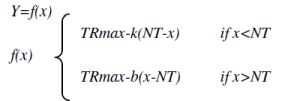
The parameters were determined using the Monte Carlo method, in the optimizing process the sum of deviation square was minimized. The correct conformation of the functions was determined by the greatness of the R-value and the standard error. We found that during six years of testing, the tendency of fertilization efficiency was similar in the case of both hybrids. There was an unfavorable weather interval and, in these years, the yields were low, fertilization did not have an effect and moreover, in extremely bad conditions resulted in an obvious yield decrease. With the improvement of conditions, which in the case of our country means an increase in precipitation, the efficiency of fertilization increases and reaches its peak at 13-14 t/ha. At this point, the yield increasing effect of fertilization is 4-4,5 t/ha. If the yield of the unfertilized treatments increases from 8-9 t/ha, then the efficiency of the applied fertilizer decreases.
Most likely, the k and b parameters depend on the soil of the experimental location (nutrient and water management) and on the amount of pplied fertilizer and the characteristics of the hybrid. With the increase of fertilizer dosage the k-parameter also increases. The greater value though does not obviously mean a more favorable situation. It is true that in medium and good years this means great fertilizer efficiency, but in low or extreme precipitation conditions it also means greater risk. With the increase of the k-parameter, the yield deviation also increases which, from a cultivation point of view, is quite unfavorable. If the value of the b-parameter is other than, zero then the effect is clearly unfavorable, because with the increase of this value, the yield decrease is also greater. The fertilizer reaction of the two examined hybrids can be well characterized by these two hybrids.
Examining the six years, our created model estimated the effect of fertilization on the yield accurately and with a high degree of safety. Both in highly unfavorable and extremely good years, it gave an exact estimate. In our opinion, it can be used well to evaluate the effects of fertilization on yield in the future. -
Analysis of the photosynthetic parameters, the yield and the quality of winter wheat
101-106Views:534The environmental adaptability of crop production is basically determined by the selection of biological background (plant species and
varieties) suitable for the region and the site. The aim of our work is to parametrize the plant assimilation, its intensity, dynamics and the
most important characteristics and the relationships to the quality in winter wheat trials. The measurements were carried out at the research
site of the University of Debrecen in small parcel experiments. We measured the leaf net CO2 assimilation rate, stomatal conductance,
intercellular CO2 level, the transpiration, the leaf temperature and the air temperature by the LICOR LI-6400 portable photosynthesis
system in field trials on the nutrient supply. The soil of the experimental area is calciferous chernozem with favorable water regime.
We have examined the photosynthetic activity, the productivity and yield stability of winter wheat varieties. We have compared the yield
results, at similar agrotechnical conditions in seven cropyears. We also determined the quality parameters of the winter wheat varieties.
Then we valued the yield stability of genotypes with the help of analysis of variance and linear regression equations. We have defined the
connections between assimilation parameters, the yield stability and quality parameters of wheat varieties. -
Búzalisztek minőségének becslése tészta nyújtás-szakítás alapján állományvizsgáló műszerrel
38-44Views:208Literature experience was utilised to develop a method for the extensograph analog testing of paste with a QTS25 Texture Analyser. 54 wheat flour samples from the same variety from variety-preservation experiments at the Szeged were tested with this method. A study was made to establish whether the method is suitable for the estimation of results derived by traditional classification (trial baking, farinograph and gluten tests).
A close and significant correlation was found between the hardness and area data measured with a QTS25 micro-extensograph, the farinograph values and the gluten spreading data, and also between the stretching index (BC/AC) and the water uptake capacity. These correlations correspond well with the findings from a previous experimental series on industrial flour samples. A close and significant correlation was likewise observed between the grain hardness established by the MININFRA method and all the QTS25 micro-extensograph data. In contrast with earlier QTS25 data, however a close correlation was not found between the QTS25 data and the loaf characteristics.
With the use of micro-extensograph data, the estimation of the baking industry value has been improved through stepwise variable selection, with the inclusion of several variables. The estimation of loaf volume could also be solved by means of stepwise variable selection with the inclusion of QTS25 and MININFRA data.