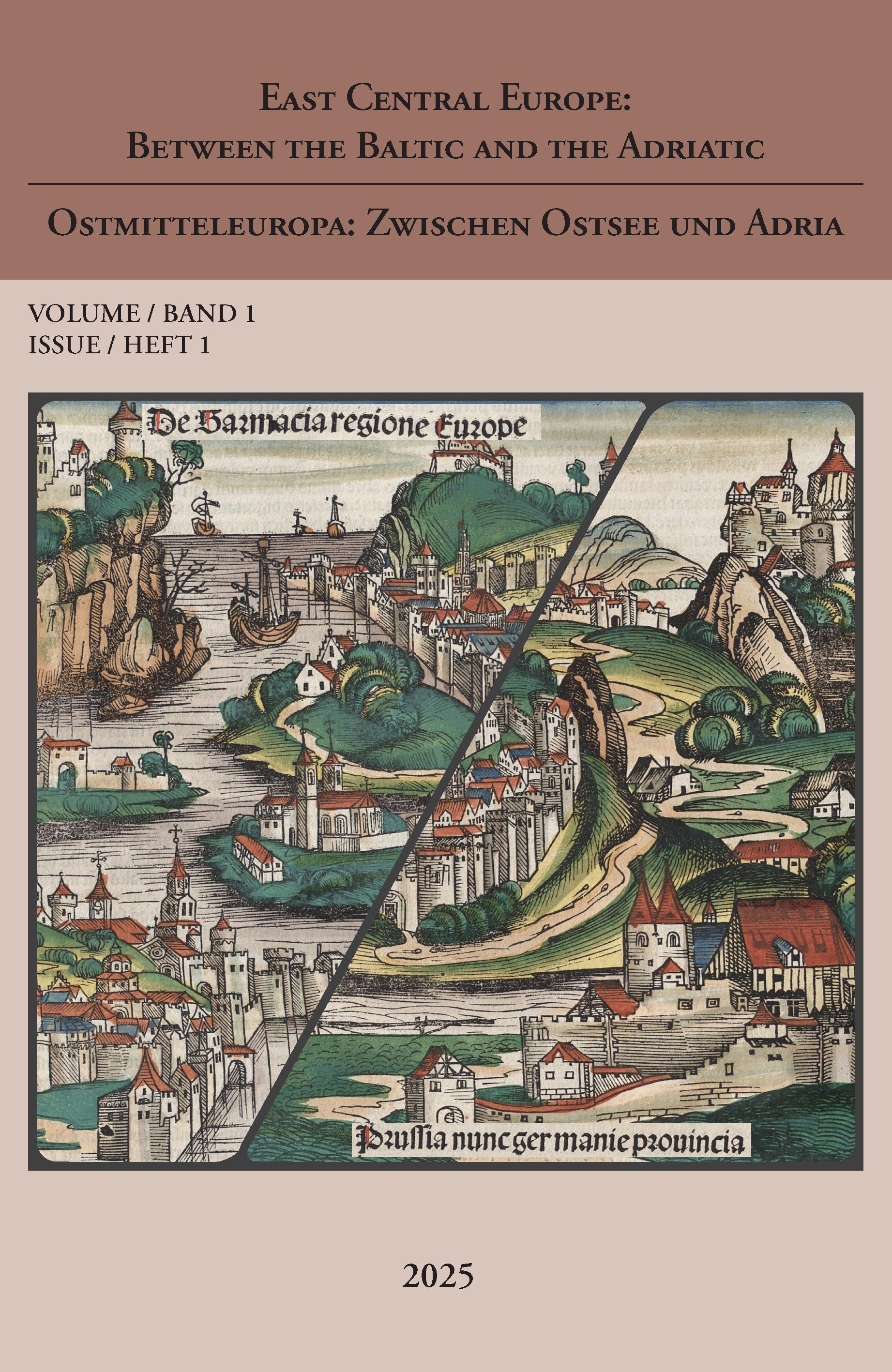
Vol. 2 No. 1 (2026) Current Issue
Full Issue
##issue.tableOfContents##
Articles
-
The Turul and the White Eagles King Andrew II of Hungary and his Polish Relatives
9–36Views:110The research of the relations between certain rulers, territories or peoples can be considered as one of the classic topics of historiography in general and of Medieval Studies as well. The history of Polish–Hungarian contacts in the Middle Ages is no exception, several scientific and popular works have dealt with the relations of the Piasts and Árpáds, and their respective realms. Nevertheless, it is important to emphasize, that we can only speak indirectly about international relations concerning the High Middle Ages, the personal contacts of the rulers and the dynastic ties established between the ruling families are of great importance when studying the various elements of the relations.
This paper focuses on the analysis of certain episodes of the relations of the rulers of Poland and King Andrew II of Hungary (1205–1235) in the early thirteenth century. Family ties were of paramount importance in the case of the Hungarian king as well. This was particularly true given that during his reign matrimonial relations were reestablished between the Árpáds and the Piasts after a hiatus of nearly eighty years. In 1214, Andrew II made an agreement with the ruler of Cracow, Leszek the White, on the marriage of their children, Prince Coloman and Princess Salomea. However, the Hungarian king’s relations with Poland were not limited to the marriage of his second son. The relation between the brothers-in-law, Andrew II and Duke Henry I the Bearded of Silesia, or the case of Władysław Odonic of Greater Poland, and his hypothetical exile in Hungary are perhaps not among the most well-known episodes of this era, but they offer quite interesting details regarding the Polish-Hungarian relations.
-
The Role of Gifts in the Diplomatic Relations between Sigismund of Luxemburg and the Teutonic Order
37–58Views:137In the diplomatic relations between Sigismund of Luxembourg and the Teutonic Order, gifts of varying kinds and value played an important role, in line with contemporary European practice. Far more records survive concerning the gifts presented by the Order to the Hungarian and King of the Romans than those sent by Sigismund to the Grand Master. The Order’s gifts often conveyed symbolic political messages; by contrast, no such function can be clearly identified in Sigismund’s case. In its gift-giving practices, the Order also considered the potential political influence of wives and daughters at princely courts, and accordingly extended gifts to them. Given the Order’s monastic and ecclesiastical character, such a practice on Sigismund’s part is hardly conceivable. Particular attention should be paid to the Grand Master’s most prestigious gifts, namely trained hunting falcons, highly esteemed across Europe. These were distributed according to the rank of the recipients and the significance of political relations, with the number of birds serving as an indicator of status.
Notably, the treasury accounts of the Grand Master record only one Hungarian gift deemed worthy of specific mention: Hungarian wine. Strikingly, the sources indicate that this “gift” was in fact purchased by the Order at considerable cost. As for other items Sigismund may have sent to Prussia, these can be inferred from the practices of other European rulers, typically consisting of objects compatible with the knights’ monastic lifestyle or of religious relics.
PDF86 -
Contributions to the Venetian-Hungarian Alliance and Anti-Ottoman War of 1501–1503
59–72Views:122In my research, I examine the diplomatic relations between Venice and the Kingdom of Hungary during the Jagiellonian era. Through Venetian narrative sources, my study presents the anti-Ottoman war of 1501–1503, a period during which both parties were engaged in conflict against the Sultan. In my work, I devote particular attention to the writings of Girolamo Priuli, a diarist who is less known to the international scientific community. Hailing from a merchant family and working as a banker, Priuli was a member of the Venetian Great Council (Maggior Consiglio), which allowed him to receive first-hand information regarding the news influencing the state’s foreign policy. In his diaries, he made detailed and relatively accurate entries that contain a wealth of information concerning the Kingdom of Hungary. His eight-volume diary covers the period between 1494 and 1512, an exceptionally active era for both countries.
In this study, I intend to present the diplomatic relations between the Kingdom of Hungary and Venice through the accounts of Priuli and the well-known Marin Sanudo from 1500–1503. In this context, I will address the financial subsidies provided by the Republic to Vladislaus II for the maintenance of troops, as well as how the Venetians evaluated these Hungarian military operations. To this end, I will utilize source fragments that have hitherto escaped the attention of historical scholarship.
PDF69 -
The Ethnic and Social Background of the Military in Szeben (Sibiu) and Brassó (Brașov) during the Second Half of the Fifteenth and First Half of the Sixteenth Centuries
73–92Views:94Transylvania was one of the most highly militarized regions of the late medieval Kingdom of Hungary. This study examines the military organization of two Transylvanian Saxon towns, Szeben and Brassó, as well as the ethnic and social composition of their urban military forces in the second half of the fifteenth and the first half of the sixteenth century. The findings indicate that the two towns employed different mobilization systems. Most soldiers were recruited from the local Saxon population, though Szekler and Wallachian individuals were also present. In both towns, a significant proportion of the soldiers were originally craftsmen.
PDF52 -
The Wagenburg-warfare in the Army of King Matthias
93–110Views:103This article re-examines the adoption of Hussite Wagenburg-warfare in the army of King Matthias of Hungary. While Hungarian historiography traditionally assumes the transfer of both war wagons and their associated tactical system, this study argues that only the device, not the method, was adopted. By analysing key engagements from the eras of John Hunyadi and Matthias – including the Battle of Varna (1444), Kosovo Polje (1448), Baia (1467), and the Breslau campaign (1474) – it demonstrates that wagon forts consistently played a secondary, primarily defensive role. Rather than functioning as an integrated tactical framework, they served as mobile fortifications. The presence of experienced mercenary commanders further suggests that this limited adoption cannot be explained by a lack of technical knowledge.
PDF72 -
Further Additions to the Export of Wines from the Upper Tisza Region (Mostly Tokaj-Hegyalja) to Krakow (1586–1605)
111–216Views:99During the early modern period in Poland, wine was quite fashionable among both the nobility and the common people, despite the unsuitable climatic conditions for domestic production. Wine had to be imported from abroad. Sources indicate that wine from Hungary, Austria, the Rhine region, Bohemia, Moravia, Romania, Spain, and France, as well as Greek Malvasia, Dalmatian Rivoli, and Venetian Muscat, was already being imported here in the Middle Ages. However, the Polish wine market was almost entirely dominated by Hungarian wines. While the primary sources on the history of the wine trade – the national customs and tax records – were destroyed in both Hungary and Poland; secondary municipal sources survived, and it is in Kraków that they are found in the greatest abundance. These are still accessible today and are excellent for research purposes. Based on customs, wine tax, and cellar records from Kraków, this study examines the wines from the Upper Tisza region (primarily Tokaj-Hegyalja) that generated the highest volume of trade, specifically covering the twenty-year period between 1586 and 1605.
PDF48 -
“Igni ferroque”. Shaping Early Modern Ukraine History Through Lens of Armenian Sources
217–236Views:90Early Modern Era historical sources, dating back to sixteenth and seventeenth centuries, are crucial for understanding the dynamics of narrative changes between the late Middle Ages and Enlightenment period. Perceived through various lens, they determine (by means of interpretation of myths and symbols) our perception of history till today. This paper could be understood as an attempt to narrate history in a variety of ways inextricably linked to continuous present. The article based on textual analysis of Early Modern Armenian chronicles and colophons originating from Polish-Lithuanian Commonwealth (Rzeczpospolita) should help us to better understand the multifaceted phenomenon of “Orient” and “Europe” constructions, especially the concept of frontier Orientalism as well as antemurale myth. Analysed sources offer a glimpse into interpretive “reading” the history of Black Sea region and neighbouring areas from multiple perspectives – through lens of Armenian chroniclers.
PDF69 -
Arbeitnehmer der Niederländischen Ost-Indien Kompanie (1602–1799) aus dem Königreich Ungarn
237–314Views:99The Verenigde Oost-Indische Compagnie (VOC), a colossal enterprise for its time, employed a vast number of workers. The problem, however, was that two-thirds of the people died either during the journey or shortly after arriving in Asia. Scurvy, starvation, shipwrecks, clashes with the indigenous population, or with rival Spanish or Portuguese competitors were the usual causes of the high mortality rate. The loss of life on the outward journey alone was 15–20%. Upon arrival in Java, tropical diseases – particularly the dreaded malaria, typhus and dysentery – awaited the survivors. The VOC therefore constantly needed a fresh supply of a significant number of people to replace the workers who had died. Even in the seventeenth century, the Netherlands was a small country with a population of just 1.5 million. In the seventeenth century, the VOC had approximately 30 000 employees, of whom around 25 000 were in Asia. It soon became clear that, with such a small population, the Netherlands could not meet the VOC’s long-term staffing requirements. The labour shortage forced the directors of the trading company to recruit workers not only in the Netherlands but also abroad. In this article, I examine VOC workers from the Kingdom of Hungary. From the preliminary inventory, we can therefore conclude that they mostly (87%) held the lowest-ranking positions in the Dutch company and served for an average of six years. Just under 21% of the Hungarians survived the tropical adventure, and only 17% were able to return to Europe. It must be noted that most of them were assigned to lower-ranking positions. They had no formal education, so they were confined to poorly paid jobs (sailor, soldier). They were largely left to fend for themselves, and their mortality rate was much higher than that of the average VOC employee.
PDF (German)68 -
Beyond the Western Metropolis: A Research Agenda for the Spatial History of Urban Crime in Budapest throughout the “Long” Twentieth Century
315–330Views:92This paper outlines a comprehensive research agenda for the spatial and social history of urban crime in Budapest from the city’s unification (1873) to the end of the communist regime (1989). While historical criminology has extensively analyzed the metropolises of Western Europe and North America, the distinct urbanization trajectories and spatial dynamics of deviance in East-Central Europe remain largely underexplored. Moving beyond traditional political and state-centric narratives, this study proposes a robust theoretical and methodological framework to investigate the localized realities of both the organized “underworld” and everyday criminality. Central to this agenda is a four-factor localization model that systematically analyzes the crime scene, the residence and origin of offenders, and the spatial attachments of victims. By integrating quantitative official records with qualitative egodocuments and media representations, the proposed framework captures the lived experience of urban space. Furthermore, it highlights how macro-historical crises fundamentally reshaped the geography of metropolitan crime.
PDF64
Reviews and Reports
-
The Relationship Between Central Europe and the Low Countries from the Middle Ages to the Present Day Conference
331–333Views:102The conference entitled “The Relationship Between Central Europe and the Low Countries from the Middle Ages to the Present Day” was held on 6–7 March 2026 at the Sándor Karácsony Hall of the University of Debrecen. The event was organised by the Faculty of Humanities and the Research Group for Dutch–Hungarian Connections. It brought together scholars examining the historical interactions between Central Europe and the Low Countries from the medieval period to the present, with particular attention to key figures, events, and forms of exchange shaping both regions. The primary aim of the conference was to explore patterns of continuity, change, and interaction within these relationships.
PDF74 -
The III. Bálint Alajos International Conference
335–338Views:93The Third Bálint Alajos International Conference was held at the Móra Ferenc Museum in Szeged between 1 and 3 December 2025. The aim of the conference is to provide a forum for scholars working with museum collections to present their latest research findings. The organisers seek to enhance the international profile of the event and to strengthen professional networks, particularly with colleagues from Slovakia, the Czech Republic, and Poland; accordingly, the working languages of the conference were Hungarian and English.
PDF65 -
András, Sófalvi, Homoródszentmárton templomvára. Esettanulmány az erdélyi templomerődítések történetéhez (The church-fortress of Mărtiniş. Case study on the history of church fortifications in Transylvania). Cluj-Napoca, Transylvanian Museum Society, 2025
339–342Views:103As the author observes in the introduction, “historical Transylvania is the homeland of church fortresses.” In Székely Land and Saxon Transylvania, this distinctive form of communal self-defence became widespread during the Middle Ages and the early modern period in response to both external threats and internal conflicts. A considerable number of these fortified churches have survived, in varying states of preservation, and continue to attract scholarly attention owing to their imposing architectural presence.
PDF55 -
Dániel, Bihari, A Tatárjárás - Magyarország élet-halál harca (The Mongol Invasion: Hungary’s Struggle for Survival) Budapest, Mandiner Kiadó, 2025. ISBN 978-963-341-306-7
342–347Views:97Nearly eight centuries ago, the Kingdom of Hungary experienced the most devastating catastrophe in its history up to that point, when the Mongol Empire – the largest contiguous land empire ever to have existed – invaded the Carpathian Basin from multiple directions, defeated the royal army, and laid waste to a substantial portion of the country. In Hungarian historical discourse, the defeat at Muhi is regarded as commensurate with the tragedies of the Treaty of Trianon and the Battle of Mohács (it is even alluded to in the national anthem), and consequently a wide range of questions, assumptions, and misconceptions continue to surround it.
PDF61